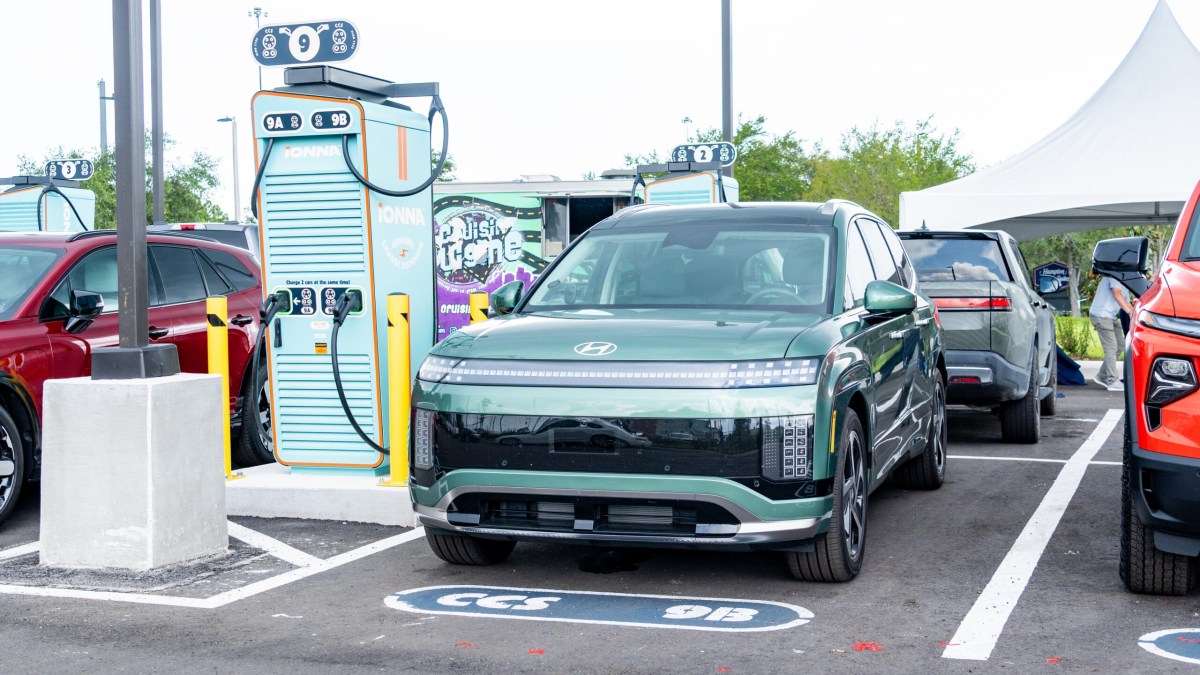
“Nobody stops to fuel their vehicle taking gasoline, gets out, rushes as fast as possible, puts as much fuel in the car as possible, and gets back in the car and drives away”
WTF? This is exactly how I have refeuled every single time I have ever gotten gas. If I could pay a little extra for a pit stop style refuel I would. Who wants to linger around gas fumes, processed “food” , and energy drink boner pills?
A big draw of EV for me is that 99% I don’t need to stop anywhere to recharge. If I do though I want it to be as fast as possible.
We bought an EV and it took a few trips for it to click that you don’t need to charge to 100% or even 90%. Hook it up, hit the restroom, buy a latte, then get back on the road with 50% charge.
You only need enough to get to wherever your longer parking+charge is going to be.
We also figure out the range anxiety. Getting down to 10% isn’t a big deal, especially if that last stop is going to get you back to full charge. Our EV doesn’t even have that great of range to start with.
also charging 10-50% is a LOT faster than charging 50-90%.
100%. The time I spend at a fucking gas station is the time the gas is flowing + the overhead of tapping the card. Plus, if there are ads and the mute button doesn’t instantly work, leaving a 1 star review.
“If there are ads”
WTF where do you live?
Ads at pumps are fairly common in the US. They been around since 2019 if not earlier.
I think he meant this as where would someone live that it would be an if. Ads are pervasive
We have ads in Australia too. :(
They live in the US. You have to watch ads to take a shit.
In Latvia there is gas station chain that has no workers. Fully self service. They have screens that run ads.
AFAIK, in some countries some stations that have workers and where you have to go to pay at cash register also have pumps with screens and play ads on them. Some even have pistols with screens for the same purpose. Yep.
Don’t forget the unmutable unskippable multimedia advertisements on the fuel pump!
(Yes, I know some of them are allegedly mutable, but I have yet to find one.)
Yea, I don’t get all these people who are like “yea lets get a 30 min lunch break at a gas station”. Dude, the last place I want to spend time at on a road trip is at a fucking gas station.
I think it means specifically in the context of long road trips, the kind where everyone gets out to stretch their legs and take a piss while stopping for gas. On the other hand, I was under the impression that EVs simply didn’t have the range for such activities, so IDK.
Modern EVs have hundreds of miles of range and can easily do road trips as long as there are chargers along the route. I haven’t done any cross county trips but I have driven from NorCal to SoCal and eastern to western CO without issue.
My EV has a 330 mile range, and a full recharge at home costs me $4. It’s amazing.
If I remember correctly, the new BMW 3 series EV is like a 430 mile range.
Keep in mind the range listed, just like mileage, is based on certain circumstances. Freeway speeds (~80 mph) will drastically reduce that.
4 hours driving and a half hour charge while doing a biobreak is perfectly doable these days. You can keep that up a long time. Personally not a fan of that long a stretch and we’re doing more 2 hours driving and a break.
I was under the impression that EVs simply didn’t have the range for such activities, so IDK.
Maybe 10 years ago that was true, but now ranges and charging speeds have gotten much better. The infrastructure of gas stations is still better for easy road trips without pre-planning though.
Where I live (Denmark) there is no need for planning your charging, there are charging stations everywhere. I think the same is true for Sweden and Norway.
It’s only a matter of when the infrastructure is established enough. Scandinavia is among the more developed regions with regard to charging infrastructure, but it will be the same in other countries soon.The US doesn’t do infrastructure. Bridges barely work.
Yes USA is a funny country, one of the richest countries in the world, but for some reason they can’t afford basic infrastructure and healthcare for all?
It’s very possible. Aging Wheels on YouTube has a couple videos on road tripping in an EV.
Sure, maybe a few min with a family I guess. But if traveling alone it’s still quick stretch, in and out of restroom in less than 5min.
In Europe I’ll grab an espresso, add an extra min I guess for that.
I know some families will spend maybe 20-30min at such places, but ideally that’s a choice not forced by charging time. Doesn’t need to happen tomorrow, but I do think fast charging is a desirable goal.
When I had an ICE car, it was exactly the same. With our BEV however, I don’t generally need to charge “on the way” as I can start each morning fully charged, and have more than enough battery for a full day.
It’s only on longer trips we need to charge, and on those we can easily combine charge and a short break.I agree with you. I always hurry to get out of there ASAP.
You are missing out on delicious sushi.

It damn well better have caffeinated cream cheese in it or I’ll be disappointed.
Just sounds like a CEO who doesn’t want to invest anything in upgrading anything.
Of course I want to be out of there quicker. I’m driving to somewhere and it sure as shit is not to a charging point.
It’s Ionna, one of the (IMO) best options for DC fast charging.
He’s not justifying slow chargers; he’s justifying building stuff around them. Basically the “truck stop” model.
All Americans should travel to Italy and have a meal at an Autogrill on the highways. It’s likely the best food you ever eat. US highway stops are all hot garbage.
The Autogrills are absolutely great for a motorway stop but you’re over selling them just a tad. After all, you’re now comparing them to restaurants in the Italian cities at either end too.
Anyway, we’ve got 150+ kW chargers at most stops now, at least in the north. And signage for stops indicates if there are chargers. An espresso and toilet break is usually enough to keep going.
I mean, I see no problem with that if they want but the fact remains I don’t hang out. Same as all that stupid Bucees garbage- I have no idea what kind of people are going in and shopping around a department store full of crap.
I’ve never understood the devotion or novelty of it all.
So yeah, that might work for some but yeah, I’d MUCH rather have as quick a charge as possible (and will go to the ones that can get me out quicker) and it seems judging by this thread I’m not alone.
Yes. Because with an EV you live at the gas station.
People need to stop thinking about EVs like cars that need to be fueled. They’re more like phones that need to be charged.
And you know what they keep trying to do with phone batteries? Speed up charging time. They keep trying to find new novel ways of making a charger charge a phone from 0 to 100 in less than 5 mins.
You think they aren’t doing the same for EV’s?
I’m not saying they couldn’t be better. I’m saying that most range anxiety comes from people thinking of EVs like tanks that need to be filled from a special place, when they can actually be charged basically anywhere.
Range Anxiety comes from living on the east coast and wide availability is not a thing, unless it’s a gas station. I mean some places are starting to roll out some more accessibility towards them but seeing a charger at Mc.Donalds, isn’t a thing as much as it is on the west cost. I’m guessing on the west coast you’ll see them in hospital garages, strip mall parking lots, fast food parking lots and of course gas stations. EV’s have always been more a west coast choice.
“Anywhere,” is broad af and isn’t true. Any home, yes. Anywhere is dependent on if a charger is available. I mean yeah, you could have a secondary charger that you have with you like a spare gas container/jerry can in your vehicle and find a spot where you can charge it but at that point you may as well go to a station. Also, if no one really uses their full tank and if 20% is the point where you’re more likely to charge it before the actual anxiety kicks in, you’re gonna want to calculate the amount of time it takes on an average speed for it to run out which makes it so that you’re pretty much screwed if you’re not near a charger, nmw.
Like someone using gas, you could be running on fumes and get to a station, when that ev battery is done, it’s done. I’m pretty sure a lot of us have been in a car and someone’s driving and saying lets see how far we can drive on empty before it runs out completely. It takes so long in a gas car that it’s miraculous and like a joke and a game at certain point; hell! There was a Seinfeld bit on that too with Kramer and test driving a car and it going empty and him and the car lot dude were seeing how far they could get on empty. I know it’s bad for the environment and stupid expensive but the seconds it takes to fill a gas tank is far more worth it to the average individual but that’s my opinion.
The one thing I can say about gas, is a gas tank takes seconds to fill via gas container/jerry can of gas and get you to a station. If you have no electrical source for the charger you brought, how are you gonna charge it just enough to get you to a station to fill it?
Range Anxiety comes from living on the east coast and wide availability is not a thing, unless it’s a gas station.
Before I moved around the world, I lived in Indianapolis. The EV situation there wasn’t fantastic, but it was good enough. Grocery stores, hotels, parking garages, apartments, Costco, even some public parks had charging stations in front of them, not to mention a lot of people’s workplaces. I’m sure that New York, Boston, Atlanta etc. are all better than Indy was, and as EV adoption increases, having chargers in your parking lot will become more and more of a perk.
“Anywhere,” is broad af and isn’t true.
An order of magnitude more places than you can find gas outside a gas station.
you’re gonna want to calculate the amount of time it takes on an average speed for it to run out which makes it so that you’re pretty much screwed if you’re not near a charger, nmw.
Every EV instrument panel I’ve ever seen includes a “range remaining,” same as modern gas cars.
Like someone using gas, you could be running on fumes and get to a station, when that ev battery is done, it’s done.
This seems like a really weird objection. When you’re out of gas in an ICV, you’re done; when you’re out of electricity in an EV, you’re done. There’s no such thing as “running on fumes,” actually; engines need liquid gasoline to inject into the cylinders. When the gas gauge hits empty but the car is still running, that’s just because the sensor that reports gas capacity isn’t sensitive enough to detect the last remaining puddle of gas in the tank. That problem is far less pronounced with battery capacity. So what you’re complaining about here is that the battery state-of-charge sensor is too precise.
I mean, that’s just strange.
The one thing I can say about gas, is a gas tank takes seconds to fill via gas container/jerry can of gas and get you to a station.
There are two scenarios for running out of gas in an ICV:
-
one, you run out right by the pump, or in stop-and-go traffic in town. Both an EV driver and an ICV driver in that situation would do the same thing: ask for help to push it to the pump. The EV driver has an advantage, though: they can push their car into anyone’s driveway and ask the owner if they can plug in for a few minutes.
-
two, you run out on the freeway, far from town. Again, both an EV driver and an ICV driver in that situation would call for help to get them to a station. The ICV driver would fill up a jerry can and take it back to the car. The EV driver would save a trip, because they’d just have a truck tow their car to a station where they could charge up. And actually, just like AAA has spare cans of fuel in their roadside assistance vehicles, some of them are starting to carry around a generator or mobile power bank to get cars that last few miles they need to get to a station.
But for all of this, remember: most of the times you’ve ever run out of gas, it’s not because you misjudged a distance. It’s usually because you didn’t realize how low the tank was when you left. With an EV, you don’t have to worry about that because your battery is full when you leave the house. That or you’re going on a road trip, for which you’ll need to plan anyway; might as well just plan charging stops. Most EVs have that part built into their infotainment systems.
Honestly, I don’t remember the last time I ran out of gas. Like, completely ran out. I know it’s happened to me, but it has been a very long time. Twenty years or more, maybe. I just don’t think it’s as big an issue for most people as they think it will be.
-
The reality: “Nobody stops to fuel their vehicle taking gasoline, gets out, rushes as fast as possible, puts as much fuel in the car as possible, and gets back in the car and drives away,” Cutler said.
I, in fact, do exactly that. I pull up in front of the pump, get out, stick my card in, fill up, and leave. It’s been over ten years since I went inside the store at a gas station, there’s nothing in there I want to buy.
However, needing to spend half an hour recharging if I were on a road trip would be fine, because on a road trip I would stop for a break from driving in any case. But, I almost never go on road trips, and 99.9% of my trips around town would be well within one charge, which I could do at home.
So, while I agree that charging doesn’t need to be as fast as gas, it’s not because of his stated reason.
Yeah that’s a crazy out of touch thing to say. That is exactly what every person does at every gas station.
It’s been over ten years since I went inside the store at a gas station, there’s nothing in there I want to buy
Wait… you dont want a tiny chocolate bar for 7 dollars?
I have a cheap Mazda 6e with the small battery. It has on a bad day 390 km range if I run heater, in sport. For daily use I can hold over a week with that. But I have a home charger so battery is always full each morning. I only ever need to charge in a station on road trips. At least in Norway which is a mature EV market most have home charger. Only those with street parking (not that common in Norway outside perhaps three large cities) don’t have home chargers.
Agree that people want to fuel fast tho’
I could stretch my legs for a few min, but that’s only on long trips.
Also ignores the main issue, what happens when there’s many cars and not enough chargers? It’s not inconclusive to wait for one or two people behind you for gas, that can mean 90 min total stop for EV. Ignoring that the line will be longer if more people need to charge and range is lower.
I want an ev for my next car, but I’m scared of that
I have had a EV for 6 years and and just switched fulle to electric.
Not once in that time I had to wait for a charger but multiple times I had to wait for a pump.
Plus…you know beforehand if a charger is busy so you wont go to a busy charger anyways
How do you know if the charger will be busy?
They are online and share their status with Google maps or the navigation software from your car.
If these damn things are always-connected, always-sharing your location with manufacturer and their 1793 partners, they are able to have the vehicle direct you to an open charger.
Depends…lots of places do not have card readers on the outside to promote shop sales.
So… often you definitely will have to go inside and…wait.
I’ve never encountered such a gas station. I’d probably be completely confused and just leave.
Gasoline cars need to accept grass if they are ever to be a viable replacement for a horse. Like, what if you’re far from a gas station but there’s a meadow right there?
Only fringe enthusiasts can own a gasoline car that doesn’t have a biofuel fermenter attached.
owning a BYD EV here in Australia, 80% of my charging is at home, just plug in to a wall socket powered by mostly solar from my roof. 15% is destination charging eg when buying groceries, plug in, shop, unplug and go and only 5% is charging on a road trip.
We have been wanting an EV (something other than a Swasticar) for our next vehicle and think we could deal with the extended charging times required during a long drive or trip, but we ended up ruling it out.
For us the big problem is the difficulty getting parts and service. Service for the models we looked at is only available at dealers (and only some dealers), and parts are regularly not in dealer stock.
We really don’t want to risk taking a cross-county trip and having the car break down 200 miles from the nearest mechanic. With the additional real possibility of having to wait weeks (or months) for a part, an EV is not an appealing choice for us, at least not yet.
What are you expecting to break down? A modern internal combustion engine plus continuously variable transmission is one the world’s most complex pieces of engineering in common use today.
An electric drive system is trivial in comparison.
I’d be worried about some of the electronics, modern cars, electric or not, tend to be overcomplicated with tablets and server connections and what have you. I might also worry about getting into an accident.
Hate to tell you this, but cars have been like this for about 15 years now.
Been a long time since ol Joe at the gas station could fill the tank and tune your carburetor with a screwdriver.
Yes but other cars can be repaired at any mechanic rather than just at a dealer, which is the issue we were talking about above.
I am well aware of the computerization of cars, how carburetors have not been a thing for more like 30 years, and how generally electric vehicles are better than combustion ones but both are worse than public transit.
My fears are software/firmware issues or battery pack failure. It’s an impossible problem for the common man to solve and you are beholden to the manufacturer. And at what cost? Minor accident? Manufacturer declares it unfixable and deactivates it. Doesn’t even matter if you repair it. Boo!
I really want one, but I can still repair my current car myself if needed.
The problem, as ever, isn’t the concept of an electric vehicle, it is the companies
No, you cannot roadside repair a car with a broken timing chain or clogged catalytic converter, or broken transmission.
What the hell does that have to do with anything? It is trivial to tow a standard car to my home and effect those repairs almost immediately. Just order the parts.
What about the EV? None of the above can easily be done.
I have a seven year old Volvo.
It cannot be repaired at a mechanic beyond simple mechanical things. Everything else has to pass through a Volvo dealer because they locked down their software (Vida) and regular mechanics COULD buy it, but it would cost them several thousand dollars a year for the subscription. Unless they are going to specialize, it’s not worth it. I cannot drop my car off at joe’s garage.
There’s no real difference between ICE and electrics in that regard. You can still do basic repairs to an electric like brakes, tires, suspension, etc.
if you get into an accident on a road trip you’re fucked regardless of what car you have.
You would think that, but Hyundai EVs are popping ICCU fuses and Tesla motors all leak coolant from the seals. There is a Tesla that went 3 million kms. Only needed 4 battery swaps, but it needed 14 motors. Coolant leaks will be problem at higher mileage.
Yet EVs are much less reliable than many ICE vehicles. The control module is one of the weak points. When it fails the car is down until it’s replaced.
No
Huge Study Shows EVs More Reliable Than ICE Cars With One Surprising Common Issue
EVs averaged 4.2 breakdowns per 1,000 vehicles, while similarly aged combustion models more than doubled that rate
https://www.carscoops.com/2025/04/new-study-shows-evs-are-more-reliable-than-ice-cars/
Sorry for lazy copy/paste. 1st search result in ‘reliability EV ice’
Case in point: https://www.reddit.com/r/electricvehicles/comments/1lfssfn/hyundais_iccu_problem_heres_what_we_know/
The GM’s EV reliability is terrible. BMW, Lexus and Tesla are much better, but not looking for a luxury vehicle or a Tesla.
‘Not looking for this or that’ means cherry picking… So I guess you are right in your own little world
Also kudos for posting anecdotal evidence like it would mean something. You are really cheering up my day :)
Yeah but GM can’t make any kind of car reliable.
Get a BYD
But, I’m assuming you are a Yank, given your attitude, so you can’t get them
But you don’t want an EV anyway
Is your entire life purpose whinging about Yanks?
Not in the slightest
But the country is a joke and somehow simultaneously a disaster
I figure I’d upset some EV fanboys with a dose of reality, but holy shit, you’re REALLY upset. Take your meds already.
I was FOAMING when I pasted this 😹😹😹
You could say that about a number of components on ICE vehicles.
I am sure you can show us real word data
As opposed to your ECU?
You’re just making shit up
Particularly when there’s less vibration, heat etc. to fuck with electronics
You’re pushing an agenda here
Why?
Right. My “agenda” is simple. I would prefer an EV, but when in the middle of bumfuck Nevada with no cell service when it’s 110F out, I don’t want a car that can only be fixed at a dealer and that may require a 3 week wait for parts.
You guys don’t have insurance? If my car breaks down away from home, I can get a rental brought to me so I can continue my trip while my car gets fixed.
You don’t do road trips much? Trips don’t necessarily go to the same location twice and it can take days of driving to circle back.
Why circle back? My insurance would give me a car to continue my holiday.
deleted by creator
The world is not 'Murica
My country is bigger than yours, and I love my EV
deleted by creator
*You’re
Some CEO from 'Murica has absolutely zero credibility
How often are you taking cross country trips on the spur of the moment? Take the advantages of owning an EV and then just rent something for the trip.
Often enough and the trips can be for a few weeks. Checked car rental rates recently and a small SUV had a nearly $2K base rate.
Sounds like a plug in hybrid would be right up your alley. Many of the benefits of an electric vehicle (regen braking and the ability to charge at home, foremost) while still being able to fill up instantly using gas. Unfortunately you lose out on the basically-no-maintenance-required part of a pure EV, but frequent road trips are basically the ideal use case for a PHEV.
That’s exactly what we’re looking at.
I think the reason they don’t have spare parts is because the motors are less complicated and, in theory, will need fewer replacement parts. An ICE motor is like 10,000+ moving parts, an electric motor is like 300 moving parts. They’re an order of magnitude less complicated.
LOL. Tesla parts shortages are because they break so frequently. You can’t drive a car without working door handles.
But there are still several ways the software or high voltage system can fault leaving people stranded and that usually isint a roadside fix or even a nearest auto part store run (yet)
Hyundai ICCU failures, for example.
Better not drive a car at all…
Yep
They’re looking for problems to justify their position
For context, parts are as available as they need to be. IOW, parts are in stock when they are frequently needed. If a part is rarely needed, it won’t be in stock locally.
If you choose a common EV model, like GM, Hyundai, or even Tesla, you are extremely unlikely to suddenly need extensive service. Dealers (with EV mechanics) are common, with multiple in every major city, and a parts network that can have anything shipped overnight.
From someone that actually uses an EV: I don’t even have a charger at home. I charge twice a month on a station that takes around 30~45m a session to 90%. You go for a nice coffee or light meal and it is charged when you come back.
Sounds like another chore I won’t wish to add to my pre-existing list.
Because you never need to get gas for your ICE vehicle?
The technology should still be improved as much as possible.
I think for my commute I would prefer a battery chemistry that needed slower charging, if it was cheaper or lasted longer or was safer, or lighter, or whatever. But I think there will always be use cases where it’s worth maximizing uptime, like long-haul driving.
I wonder if trucking will evolve to do tractor swaps, where rigs coming into charge up will hand off trailers to fresh tractors. That way the cargo doesn’t have to take up space in the charging lot or whatever. Or they might do battery swaps. I imagine for above some threshold of cost/minute downtime, the hardware for doing swaps will be worth the extra cost.
In most jurisdictions, trucks are required by law to stop for the driver to rest every 5 hours or so. You can just charge the vehicle then.
oh yeah, duh. the vehicle’s uptime is bound by its operator’s.
But drivers swap on the road and don’t stop.
Nio has had battery hot swapping systems for years, but that’s for progressive countries.
It infuriating how nice an actual non-fossil-fuel infrastructure could be, if only we had a government that would build it. The Nio battery swaps are cool, I want to convert one of my old tractors to a similar setup, except I’ll probably just put a pallet of batteries on top of the engine compartment and forklift them on and off the tractor. But similar idea: let the batteries charge slowly on a rack while the tractor and implements only see a few minutes of downtime. But until we get our political shit together I’m stuck making my own with spit and baling wire.
but the fast chargers do need more infrastructure that takes more space and cost, when having MORE slower, cheaper, easier to install AC chargers everywhere will help just as much
This is pure cope from a nation that is a long way behind the rest of the world on EV technology. I’ve done some very long road journeys, 900+ km in a day, and having an EV would likely have added at least an hour to that day, even more if I was towing.
The reality: “Nobody stops to fuel their vehicle taking gasoline, gets out, rushes as fast as possible, puts as much fuel in the car as possible, and gets back in the car and drives away,” Cutler said.
This is exactly how I go about my business at a fuel stop. Maybe do a few stretches and check everything on the roof isn’t working it’s way loose, but once the pump clicks off, I’m goneburgers.
Good to know you’re the overtired and in a rush driver that the defensive driving courses warn me about. Worse if you’re towing something.
I’ve got shit to do, especially when I’m doing that type of distance.
So leave earlier. Don’t put me and me family at risk.
How is me not wanting to fart around for half an hour every time I stop putting you at risk?
You’re not taking the appropriate rest brakes (while towing).
https://www.schmidtlaw.org/how-frequently-should-you-take-breaks-when-driving-long-distances/
Breaks. Brakes are what slow the vehicle down.
You know there can be two drivers swapping back and forth with no downtime but still well rested right? That how we do most of our roadtrips
Sure; where did they state that in their comment?
If that’s the case I’ll strikeout my comment and publicly apologize.
I mean. That’s kinda the root cause of Range Anxiety.
Even if it was double the time to charge when compared to filling a petrol car. That would go a long way.
I prefer the idea of plug it on and go get lunch and take a piss and have a stretch, rather than have to stand there with it for a few mins and then do all that other stuff.
The thing a lot of these people dknt understand is that not everyone has a garage where they can charge a car. I love in an apartment, where am I suppssdd to charge an EV? My parking space is too far away from my parking spot to charge, and I’m positive that my complex would never pay to add charging spots connected to each apartments meter.
Even if they did, I wouldnt trust my neighbors to plug tjeir EV into my charger. This alsomapploesmto people in houses that don’t have a garage. An I supossed to run an extension cord to the street st night so that anyone driving by can llut into my electricity?
most EV chargers can be locked so only you can use them (normally with a RFID or BLE tag).
Also, having chargers in apartment parkings is absolutely viable. it is more expensive to install than in a house. Not sure about the US but where I live (Spain) I know people that have them without issues
I live in a cold climate and so my apartment stall is electrified in order to run a block heater. The way that it works here is that I am charged for power usage off of that stall outlet, but my unit has a breaker that allows me to turn it off and on. I think charging ports could operate similarly, hopefully offering some kind of smarter scheduling that allows you to only have it active when your car is in the stall and needs charging.
And you think the apartment complexes are going to foot the bull to install that here? Every parking lot would have to be torn up to install that. Its a ridiculous assumprion.
Cutting a narrow trench so you can run electricity out to parts of the parking lot you can’t get to otherwise isn’t exactly a big deal. Utilities do that sort of thing all the time. We can patch parking lots - we do it all the time. Or even just put a pole and run the lines overhead. And, in many parking lots, you can just run the trench or conduit around the edge of the parking lot. You also don’t need every space to be electrified, at least at first.
And who’s going to pay for that? I promise you, my shitty complex won’t.
Won’t they? What if they can charge say $20/month + electricity cost extra for those parking spaces and pocket more money?
Why would a parking lot need to be “torn up” to add a power outlet
Because the parking lot is paved? And you have to break throigh that pavement to run power lines?
You can cut a small trench with a specialized tool… easy enough.
deleted by creator
This is absolutely a valid concern.
There are various available solutions, but little incentive for landlords to bother. Either ev charger for every renters parking spot with some mechanism to lock it out (expensive) or a large pool of chargers that are shared, but you have to badge in and get it billed to you. The latter if too small barely helps and if too large will piss off gas vehicle tenants that hate the “wasted” space.
Not that it answers all your questions, but many EV chargers have access control. The Chinese one I have you have to tap an access card. Tesla charger allows you to limit to Tesla only or even specific Tesla VIN so you can just plug and change while others can’t.
There will need to be systemic improvements to get more chargers to more people (apartments, office buildings, parking garages, etc), but for L2 charging the electrical work is minimal since all the charging circuitry is in the car and the “charger” is just a fancy wire connector and authorizer.
Ultimately as other commenters have pointed out the problem is political rather than technical. Expanding access to things without a profit motive is continuously difficult under our economic and legal system. Chasing faster and faster charging speeds is not really a solution to the accessibility problem.
Exactly… the issue is the reluctance to install something simple as electric power to your parking space. This is not a technical issue… purely ideological nothing else.
It takes 20 mins, and many grocery stores have chargers, plug in when you do your shopping
Most grocery stores here don’t have chargers. If they do, its like 6 spots and theyre always full. Now, how do I charge an EV?
I remember one of the arguments against EV’s were that “there’s so few chargers compared to gas”.
And then you realise that chargers are literally at homes, workplaces, parking lots and ALSO at gas stations.
Which makes speed less important. The headline is spot on.
You go inside gas stations because you HAVE to, not because you WANT to. Same with EVs.
Most of the time, they don’t need to be anywhere near as fast as gas (most, maybe even nearly all, people have or can have a way to charge at home). But there’s lots of people that don’t do long stops on their trips and just want to stop, fuel up, and go. The EV can be a bit slower, but anything over about 15 min is going to be a showstopper for alot of people.
Many people don’t enjoy having to regularily go to the fuel station, but they have to. You do not necessarily have to do that with EVs. Habits form around necessities.
Oh, for sure. I haven’t needed to go to a public charger since I got my EV. And I don’t forsee making very many trips to one in the future. Home charging just changes so many things.
(most, maybe even nearly all, people have or can have a way to charge at home)
What? Most people where?
I live in a fairly rich European country, and EV chargers here practically don’t exist. Almost everyone lives in apartment buildings. If you’re lucky, yours will have 1 or 2 chargers in the underground parking lot or somewhere close by outside.
It’s even worse in Eastern and Southern Europe. Outside of North America, Europe, and China, EVs, as well as chargers for them, don’t exist at all.
Are those ‘most people’ you’re talking about actually just <5% of human population that happen to live in North America or Western Europe, and happen to be wealthy enough to afford that?
EV chargers need not be some special thing. Level 1 charging is more than sufficient for the vast majority of people. Can you find a regular outlet near where you park? Maybe with the help of an extension cord? Or maybe your complex could put outlets in.
Arguably, EVs work even better for places that don’t have infrastructure. Which is easier? Building a network of fuel stations (which need electricity) and keeping them supplied or putting in solar panels in people’s villages? I’d argue the second is generally easier now and is overall better for society - electricity comes with so many benefits beyond just being able to charge your car.
Then there’s upcoming EVs, like what Aptera is working on. Those will be able to add significant amounts of range each day using just the solar panels on the roof. Now you’ve got a car that needs no infrastructure at all (but can use it, if it exists).
I really don’t think charging EVs from regular outlets is at all realistic for the vast majority of people.
Unless you live on the ground floor, you’d have to drag a long ass cable through one of your windows. One of my neighbours actually does that, but just imagine everybody doing it. Not to mention the grid would most likely be unable to handle the load.
I’ve never seen public outlets, aside from USB ports in public transport, so I doubt it’s a thing.
Honestly sounds like a reasonable idea, and not just for EVs. The problem is that more and more countries are steadily moving away from public goods, so every building/complex would have to organize it individually.
Arguably, EVs work even better for places that don’t have infrastructure. Which is easier? Building a network of fuel stations (which need electricity) and keeping them supplied or putting in solar panels in people’s villages?
Absolutely, agreed. But keep in mind the fuel stations are already there, because most countries spent the last 150 years building them everywhere.
It’s an unfair comparison, of course, but it’s also impossible to make a fair one. As it stands, pretty much all developed and a lot of developing countries are already well connected when it comes to gas stations. It’s a lot cheaper and easier to keep them going, than it’d be to replace them all with EV equivalents.
Then there’s the question: does it really make sense to spend the next 50 years upgrading all that infrastructure? When, at least in Europe, public transport is already present everywhere and well developed?
Would it not be a whole lot easier and cheaper to just get rid of fuel stations, and keep expanding public transport, which emits dozens of times less CO2 per passenger than cars do?
Now, obviously, there are still uses for personal vehicles, even if public transport is great. It’s not a question which one to focus on exclusively, but which one to propritize.
Those will be able to add significant amounts of range each day using just the solar panels on the roof.
If this can be done well, then yeah, infrastructure problem kind of solved. Then you’d just need to wait for people to upgrade their existing cars, and afterwards all that gas infrastructure is basically redundant.
The grid can handle the load. There have been studies done on this and the increased load from going EVs will only be a slight increase over the increased electrical generation we have to do anyway. It’s a gradual transition, not a thrown switch. The increased load can be easily accounted for. Remember that an EV charging off a regular outlet is basically the same load as a space heater and that’s only when it’s actually charging.
Wiring charging outlets for people to charge at will require a bit of work, but this is pretty straightforward stuff. Apartments can dedicate parking spots for EV charging. They’d probably pick spots where its easy to run wire from existing power infrastructure. They’d then charge you for the electricity at a reasonable markup or at cost plus a reasonable additional monthly fee. The apartment complex makes a bit more money with a small investment and the tenants get cheaper transportation. For street parking, cities are already looking into adding EV charging to their existing light poles. Worst case, they have to upgrade the wiring. But they probably already have plenty of excess capacity because they switched to LEDs, lowering power consumption. Again, they charge you for the electricity you use at a reasonable markup. The city makes money to maintain the system plus maybe a bit extra and residents get to charge their EV.
The transition from gasoline infrastructure to EV infrastructure won’t be and can’t be quick. There’s just too many gas cars on the road. But all infrastructure wears out and has to be replaced. As demand for EV infrastructure grows, gasoline infrastructure will decline as it naturally wears out and isn’t replaced. It’s unlikely it will ever fully go away, but it could decline to a point where its rare. But that’s decades away.
Yes, public transport is indeed a greener solution. It’s also entirely unfeasible for much of the US. Our cities are just too spread out for it to make much sense most places. For places with the density, it absolutely should be expanded. Even in Europe, people still live in the countryside, suburbs, small villages, etc. Public transit doesn’t make sense everywhere, even there.
And that’s why battery swap stations should exist.
Give me an option to quick-swap modules ;-;
It sounds way too easy to do.Only issue I see: How to make all manufacturers agree on the battery form?
I mostly agree but part of me thinks you can get away with below 80% charges to save time rather than being hung up on the time to reach that 80-100%. (shifting one’s thinking like how EV roadtripping is currently about reaching the next charger rather than a 100% fill each stop)
I say that because some gas vehicles like the two-door Bronco just have relatively poor range (in the 200’s) due to smaller tanks and I’ve seen how long folks can wait in line for gas at Costco. (having also been in line)
Most of the DC fast charge specs are like 20-80% because that last 20% is usually much slower. Even with my home charging I don’t typically charge to 100% because it’s better for battery health not to. And yeah, alot of the planning apps don’t assume you’re going to be charging to 100% each time - they tell you what you need to charge to at each stop.
So many people will get gas then go in for snacks by the time you wait in line and get gas that’s 20 minutes alone.
I was arguing with my mum and she said it can take twenty minutes to recharge the car. I said, after driving for five hours don’t you want to get out, stretch your legs and have a coffee? That’s half an hour easy.
That’s why I figure 15 min, give or take, is low enough for it to not matter for most people. It’s not alot more than what even a quick gas stop would be. And that’s not some unobtainable thing. Tesla superchargers can already do it. Some Chinese brands are already at 10 minutes and pushing for <5 minutes.