

Can we talk about the definition of a “surge”, please!
What percentage increase do you feel is required for surge to be a reasonable definition. A 35% increase feels surge-y me.
The council planted a new tree on my road, trees surged in population from 1 to 2 yesterday
100% surge is legit
That’s why we’re talking about relative percentages.
In your example we would need to know how many trees existed on your road/city before. If there were less than 3 or 4 trees in your city before this, saying there was a surge is likely fine.
I gave you that information, I said “from 1 to 2” and added context of “a tree” (singular)
My terribly made point is that although technically correct when talking about relative increase it’s dumb as fuck to say trees “surged in population” after adding just one more on one street. It’s a drop on the ocean.
I feel like the term surge respects the final total relative to what its maximum could be as well as the relative increase. But obviously language is regional and up for interpretation
I’m super confused by your point.
In this case we’re looking at Steam.
I have no clue how many people submit to the steam survey, but I’ll assume it’s representative.
A quick google suggests steam has about 120 million active users.
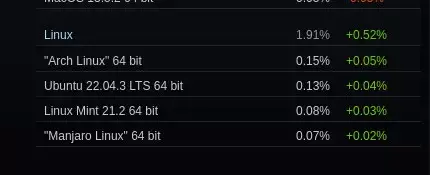
Linux went from about 1.4% to 1.9%.
Rough math says Linux went from 1.7 million to about 2.3 million.
Or an increase of 600 000.
That a lot, both in relative terms and in real terms.
Here’s a counter example for you.
You own stock in banana company. Over one day the price increases 2x. All the news agency’s are talking about how banana surged in price today. Will you then suggest that banana didn’t surge in price because it only makes up 1% of the overall stock market?
Sergei?
sir gay?
It’s not just a percentage thing. 1 person yesterday to 2 people today is a 100% increase. Not much of a surge, at least in terms of news worthiness. Going from 6% to 10% sounds more news worthy than going from 1% to 2% despite the latter being a much larger percentage increase.
Of course, percentage just help show relativity. It’s why people can look at a 0.5% increase and dismiss it as not significant.
Would it help if I translated the percentage for you? Linux surged 600000 to 2.3 million.
It’s not the percentage total but the speed of increase.
Small number random samples in big data sets have huge error margins. You need to smooth this over time to see the real trend.
A delicious canned energy drink from the 90s.
Josta was better.
Click bait media
I just removed Windows from my desktop and went straight Linux after seeing how well things ran on my Deck.
My guess is that most gaming Linux users have a dual boot setup and play games on Windows.
deleted by creator
I used to keep a windows drive to run steam. But it honestly sees very little use nowadays.
Mostly I boot it every few months to see what shenanigans Microsoft has pulled with windows. Other than that, it’s just sitting there. Everything I play runs in Linux.
I run Tumbleweed btw.
My guess is that most Linux gamers tracked by Steam have a dual hardware setup with a Steam Deck and a Windows desktop PC/notebook.
Doesn’t it show +0.05% Arch? I was under the impression SteamOS was tracked as Arch. So if 0.15% is a blend of Arch and SteamOS-Arch, it seems to be growing in quite a few ways.
I was under the impression SteamOS was tracked as Arch.
No, that’s not the case. A separate listing for SteamOS leads by a lot. If you install pure Arch (or another distro) on Steam Deck or for whatever reason install and launch the Flatpak version of Steam, those won’t get counted as SteamOS but otherwise it’s pretty clear how big the installed base of SteamOS is.
Ohh, okay. Thanks for explaining it to me. I misunderstood.
bill’s days are numbered
I mean, he’s not exactly a spring chicken anymore.
Tell me why “market share” of commerical, proprietary games is important to Linux again?
Because of Valve, Linux is finally my main OS. I’m a PC gamer and it was a pain in the ass to dual-boot between Windows and Linux.
These commercial, proprietary games are one of the things that pushes forward the capabilities of personal computers. They are unreasonable, unoptimized resource-hogs. If a Linux system is as capable of running them as a proprietary OS (that has a deck stacked in it’s favor), it means they lose one another advantage over Linux. And it also means that your hardware now is more productive at less bs tasks, especially consumer-grade nvidia cards, who are better supported now than years ago.
Because it’ll be funny if Microsoft just gives up and makes “Windows” a desktop environment for Linux.
Starter edition - with no option of changing wallpaper and a 3 app multitask limitation.
Proprietary telemetry built into the kernel.
…Microsoft will die on that hill.
;)
That would be extremely funny
What would be great is they’d likely need to open source certain stuff for it to play nice with the kernel. Stuff like DirectX. And if that happens it’ll be a singularity moment for Linux compatibility and adoption.
Potentially more support for other things other than gaming, maybe… Hopefully
nvidia openned their drivers not long after they announced that was “working sith valve to givd a better gaming experience on linux”
A lot of people only play games on their computer, hence running linux doesn’t make sense if they can’t play games on it
market share leads to demand, demand leads to supply
this benefits you
this is measuring market share of Linux in the gaming scene, not the other way around.
Now I wonder what the gaming share of linux use would be. Probably very very small percentage. since the wast majority of linux installs are servers
I have at least 20 different devices that run some flavor of Linux. Servers, a laptop, TVs, AP/routers, probably more, if my other “smart” appliances run Linux also.
Do Android phones and tablets count towards Linux gaming?
PlayStations run a derivitive of BSD, maybe those should get honorable mention. ;)
Including phones would be significant. But in my (probably deranged) head android/linux is a different os from GNU/linux. The overlap of the kernel itself is not enough. In that case all switches/routers/storage appliances/toasters/washing machines/fridges/iot sensors often also run linux.