

More Futurism slop, it just don’t stop.
Tech Lemmy loves its Futurism
A lot of people in the comments conflating “AI bubble burst” with “AI has disappeared completely”, and saying it’s not happening because AI still exists there.
When the dot com bust happened, the internet didn’t just disappear overnight, it just shrunk into something more reasonable. I feel like this is the same.
Same vibe as “if global warming is real how come it was cold at my house this morning?”
AI/LLMs will still be around, they just wont be the end all be all some people have been hyping it as
The internet now is bigger than the internet pre dot com burst, though, right?
China has been taking steps to keep it’s AI industry in check. They’ll be fine. Their bubble pop is essentially a market adjustment. We all just get bent out of shape because of how big these numbers have gotten over the last few decades. The important thing is that the Chinese government took steps to protect it’s other sectors which is why we likely saw their bubble pop before ours.
It’s less that they protect companies, and more that they don’t care when they end.
That protects the industry.
Compared to America where specific companies lobby to limit competition, and end up just charging more for shitty products.
It’s pretty much why we keep losing.
Because if the big companies never end, they buy up everyone else. Too big to fail means it’s too big to even exist.
What? Their real estate is popping too. Could you be more specific as to what “steps to protect its other sectors” means?
One great example would be their labor laws. They put legislation in place that restricted (for the most part, forbid) the replacement of human staff with AI. This alone kept many other industries from making the same mistakes the US market has.
I can’t.
I believe what I said, but I’m not following the Chinese market in any serious way. One of my comment edits was to disclose that but I choose the more basic statement. I’m fully willing to be wrong when presented with data. I felt that removing my own hedge allowed comments like yours to more directly challenge the statement.
I’m in the middle of studying for a mid term. I don’t want to use the energy to dig into it. I got my stance mostly from articles I’ve read in passing on how they have regulated their AI market to protect workers and manage circular investing. It could easily have been propaganda.
Refreshingly honest social media comment!
Good luck on your mid term. no /s
their real estates have been “popping” for several years now. i still remember finance bros making videos titled “is china going to collapse in 30 days??!?!!?” a couple of years ago.
in reality it’s just the government managing risk and taper speculation in the real estate market.
It looks like every news article about China’s real estate says their prices are lowering continuously. That means in America that their loans would be under water. Honest question, isn’t that the case for China too?
And the honest answer is: it’s complicated.
First thing, property prices going down is not necessarily a bad thing, but people don’t usually see it that way.
Simple truth: if you own a house, you would want house prices to go up, forever. This is true anywhere on Earth, and it’s true in China too. But as a society, you can’t allow house prices to go up forever. Because that means getting onto the housing ladder becomes harder and harder, young people would have to rent forever. Their income thus funneled into the property owning class, inequality goes up, stability goes down, and so on. Everyone can see the problem, but not all governments can do something about it. This is where China, an oppressive authoritarian government, has its advantage. They doesn’t have to worry about if the voters are going to elect them again. So they are afford to make some people unhappy.
But it’s not that simple actually, lowering property prices is almost uniquely bad for China. Because property is universally seen as the vehicle to preserve wealth in China. In fact a majority of China’s household wealth is stored in the property market [1]. Another compounding factor: China has a large pre-sale housing system. In other words, people are borrowing money to buy houses that aren’t even built yet, and that accounts for 90% (!!) of house sales [2]. I’m sure you can imagine, when property prices go down in this kind of system, people are gonna get really really mad. In fact people got so mad they got onto the street! If you know anything about China, you know how big of a deal this is. This sort of thing just doesn’t happen in China. Last time this happened, people died and that particular event even became a freaking internet meme.
And all that plus the fact property developers in China are often choose to take a lot of risk and are highly leveraged 3. This is almost reminiscent of the subprime mortgage crisis, yet a catastrophe similar to the 2008 crash hasn’t hit. Why? Because China’s government has a much stronger hold of the economy, and they are much more willing to intervene than any western capitalist country. Being authoritarian also helps. They have a lot more policy lever they can pull, so they can allow the property prices to gradually fall, without taking the entire economy with it. Which is kind of unimaginable in the US.
This is not to say their system is perfect - and that’s without talking about their horrible human rights records. Their policy makers are human too, and make mistake. Their stock market will rise and fall, the point is you shouldn’t try to fit what happens in China into the typical western economy boom-and-bust narrative. That’s not how it works in China.
[1]: The portfolio of the average household in China is more highly concentrated in real estate than elsewhere. For instance, 62 percent of its assets are in real estate, compared with 38 percent in Japan and 28 percent in the United States. (2020) Source
[2]: Developers have responded to restrictions on accessing other sources of funds by increasing their use of presale funding (Graph 5). While presales have long accounted for the bulk of new residential property sales in China, their share has increased from around 80 per cent to almost 90 per cent since 2016. (2020) Source
The important thing is that the Chinese government took steps to protect it’s other sectors
But At What Cost?!
Also, so much of this seems to undersell the global common denominator: skyrocketing energy prices.
China is getting hit earlier because they’ve relied so heavily on the Persian Gulf and Russia to date. By contrast, the US - a major energy exporter - can remain insulated (and even reap a fat dividend) as their energy export values balloon.
AI is voracious for energy, so Chinese data centers got hit faster and harder than their American peers. I would not assume this rebounds the same way in the States, because the US is willing to subsidize AI development AND fossil fuel consumption in a way China is not.
I think this is just blatantly wrong. China has vastly more energy capacity that the US and, 3-4x what the USA has. China has the entire USAs energy capacity purely as renewables. The entire time, the competition around energy has been a moot point for China. They don’t need more efficient or powerful chips because they had the energy spare to just use more. NVIDIA CEO Jensen Huang made a good statement on this point. The reason for this, whatever it is, could be entirely unrelated to energy.
China has vastly more energy capacity that the US and, 3-4x what the USA has.
Okay, now look at per capita energy.
the competition around energy has been a moot point for China
That is extremely inaccurate
deleted by creator
I think it’s partially innacurate to compare per capita energy consumption for the two nations.
The average American lives a vastly different lifestyle to someone in china, consider that per capita consumption of China is now higher than that of the EU. It’s not the whole picture. An average American uses almost four times as much energy as a Chinese or European person at home.
If you’re talking about standard of living, sure, per capita makes sense. There’s no argument that for the majority of people in the US their standard of living is probably objectively higher.
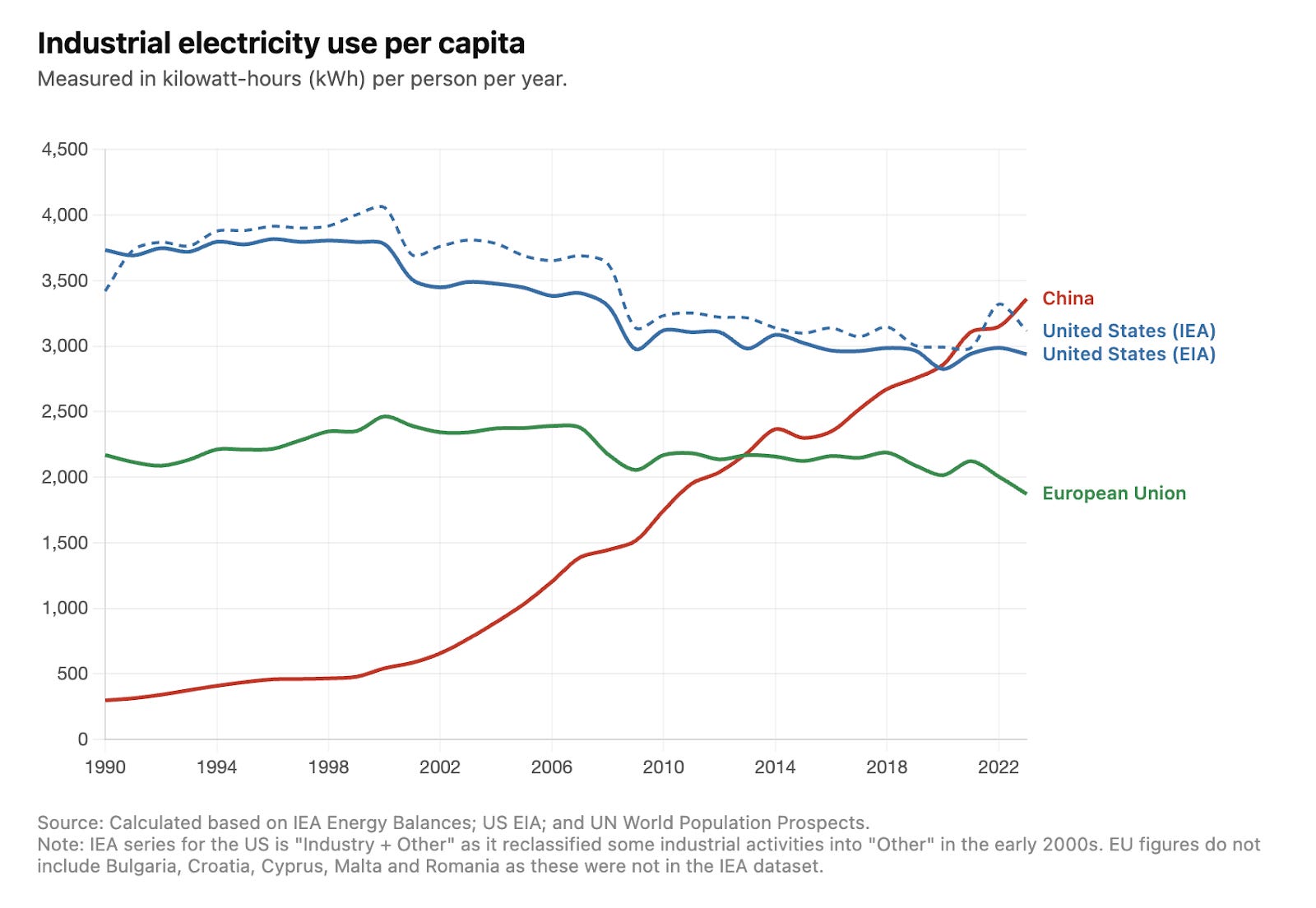
However, China’s industrial electricity usage per capita has overtaken that of the US long ago.
The average American lives a vastly different lifestyle to someone in china
That hasn’t been true in decades.
for the majority of people in the US their standard of living is probably objectively higher
What are you using to calculate standard of living?
Certainly not life expectancy, education, housing, or cost of living.
can you clarify what energy the US is exporting?
The US is the largest exporter of Natural Gas on earth. and Top 3 for oil, like other Lemmings mentioned.
Debt
We’re damn good at it too.
Millionaires trade it like baseball cards.
China built a lot of solar and wind projects, so they’ve been divesting from oil and gas, so a crash lets them stockpile oil for other purposes.
China built a lot of solar and wind projects, so they’ve been divesting from oil and gas
They’ve been building wind/solar because they’ve exhausted oil/gas supplies.
But when Russia started opening up trade, they were happily drinking from the fire hose of cheap fossil fuels. And they’re still some of the biggest coal power consumers.
They’ve been rapidly rolling out Solar/Wind to meet a voracious demand for Wattage that fossil fuels can’t meet alone. But they’ve also been rolling out new fossil fuel plants. And for the same reasons.
I mean, this isn’t true from my perspective. All the Chinese LLM labs are still developing full steam ahead. Model/architectures are getting updated so quickly it’s a meme amongst inference framework devs, because they can’t even support one model before the next one is already out.
…They’ve always been thrifty, though. The difference is they don’t need a trillion dollar bubble to fund their modest, more sustainable dev/inference costs.
There’s been a lot of bounces where the US stock market “lost” trillions then came back to its original point and more, see the election and March of 2025 and 2026
Could mean something could mean nothing, only time will really tell
A correction is something different than a burst. What do you think is the future there?
This is how they win: everyone’s gonna pop, but their iron fist over the banks will prevent an absolute bust.
We haven’t learned from fanny-mae and we’re gonna get soundly fucked.
We learned, we put mechanisms in place. We got people in power that actually wants this to happen so they steal even more wealth from us.
I think there should be no bailouts.
/doubt
AI isn’t a bubble. It’s here to stay. Get used to it.
The dot com bubble didn’t mean the world wide web wasn’t here to stay. There is an AI bubble.
You must admit, a lot of people think the bubble bursting will be the end of the technology. I see that sentiment a lot on here.
It will be an end to trying to force chatbots to do literally everything. It will not be an end to the chatbots.
Depending on when the bubble bursts, It would effectively be. AI needs this continuous terminal upwards velocity of investment with no profit to show for it in order to keep improving despite the diminishing returns we’ve been seeing. It’s viability as a long term technology is uniquely dependent on it reaching a state of efficiency or otherwise capability that doesn’t yet exist.
I really wonder why it is that the pro-ai fanatics are so sure it will stick around just as it is today without anyway to actually pay for it.
You’re confusing AI with OpenAI.
They, anthropic, others, are constantly pushing and over-extending, but theyve already long since by passed models that are useful for various tasks. Certainly not everything, but if the big players died tomorrow you could run a local model on a gaming GPU that would still do decent amounts of work if you were the kind of person who had a use for it.
Not everyone is, and thats ok.
I find chatgpt very useful for work, but id be cool with them failing and having to downgrade. Models already did what I needed well enough a year ago, maybe a bit more.
The companies operating frontier models and AI as a viable technology on the scale it exists today are inseparable. If the big players died tomorrow you’d still have that vastly inferior local model that would be good enough for light work for awhile, but without all the eye-popping amounts of money to continue training and scraping data on unprecedented scale, its usefulness would fade over time. Most companies today would not feasibly be able to host and train their own models to be used in the ways they use frontier models today.
LLMs would still exist as a niche solution for some things but what AI fundamentally is, and how it could be used would be entirely different in very short order.
Three main counterpoint to this.
Why would it fade, even if they never changed somehow their capabilities would be frozen, not degrade.
The open source community also works wonders, people who care about stuff like this will collectively spend millions of hours working on it.
Finally, those older but still highly capable models have become explosively more efficient in the past several years, I saw a figure that models from 2 years back are now 280x more efficient (cheaper to run) than they were when released, there’s no reason a company couldn’t field one of these, work on it slower and more conservatively, and profit from it.
Why do you feel it would be entirely different in any of those scenarios, what did you have in mind there? Some specific use cases it would lose perhaps?
I mean, if every “AI” company went belly-up tomorrow, if development of any new model was banned globally, no exceptions… it would still not go away.
Deepseek 4.1-tier models would be useful for decades, and cheap to run. Heck, I think the scaffolding around them still needs years of development to not be so half-baked.
You aren’t wrong. That sentiment is everywhere in the comments below, and highly voted.
Websites aren’t also incredibly resource heavy money holes with no proven path to viable profitability.
They were back then. Only the ones that got so big they could negotiate their bandwidth costs or even buy out ISPs made it out alive. Everyone else was sunk by the exponential bandwidth costs.
It was expensive, sure. But not entirely nonviable across the board like we see today with AI. It’s not even close.
Those “Big companies that could afford to negotiate Bandwidth prices” don’t even exist in the AI context of today. They’re still speculative. If the bubble pops before that speculative future comes to fruition, the development of the technology towards that end stops.
The chatbots don’t have those because they don’t have anything worth paying for. Ebay, Google and the like all had something people really wanted so they were able to weather the bandwidth costs until they didn’t have to anymore.
My message is aimed at the anti AI crowd. Yes, there is a bit of a bubble right now, but AI progress will continue and it will become part of our daily lives just like the internet transformed how we live.
Lol
China doesn’t have the chips to keep it accelerating.
Or it might be more apt to say that it shriveled like a rapidly deflating balloon: over the past four months
Not as catching as “bubble burst”. LLMs have proven their use. It’s here to stay. There’s a lot of superfluous stuff, but people are coping if they think the bubble is going to burst and their jobs will all go back to how the were.
deleted by creator
LLMs have proven their use.
No they have largely not except in niche applications and they have proven relentlessly they cannot be trusted with anything important.
I feel like people who confuse LLM technology with LLM business are getting increasingly rare.
What use AI has doesn’t matter if it’s untenable to continue to operate long term. Whether or not AI is here to stay is entirely reliant on its ability to turn a profit.