Artificial-intelligence systems such as large language models (LLMs) can exhibit behaviour that seems strikingly intelligent. This has led many people, including some experts, to wonder whether these systems could have some form of consciousness — the capacity for subjective experience. However, we think that existing AI systems are not conscious, and that, along current trajectories of development, they are not likely to become conscious. Greater clarity about whether AI could become consciousness will be crucial as society grapples with the challenges posed by this increasingly powerful technology.
How are people STILL making the same tired arguments in 2026? I got paywalled before I reached the third reason but this is like baby’s first intro to the consciousness debate and it utterly fails as a logical argument. Both of the points I was allowed to read (intelligence =/= consciousness and silicon =/= brain matter) say very little about the nature of consciousness.
It’s correct that intelligence is not proof of consciousness-- but this fact says nothing about proving non-consciousness of any entity, only that it is not sufficient to prove consciousness. Even working on vibes, the correlation goes in the direction that implies a link between intelligence and consciousness, although again, the correct message to take here is “intelligence does not prove consciousness”, not “intelligent things [are / are not] conscious”. There is simply no proven causal relation.
The “computers aren’t brains” argument is also incredibly dumb. There are some fun thought experiments here, but tl;dr there is nothing proven to be mechanically special about brains as opposed to any other physical system that would cause consciousness. A non-physical difference (ie. a soul) would be a good thing to point to, but proving the existence of a soul or some similar unique non-physical property of humanity is pretty much exactly as hard (maybe harder!) than proving the existence of a conscious experience.
Note that this does not mean I believe that LLMs are conscious. I’m simply pointing out that this article is built on arguments that are so flawed, and well-known to be flawed, that treating it as a serious addition to the conversation is worse than valuing AI slop. Thank you for coming to my TED talk.
If LLMs are conscious then openAI and anthropic are slave traders :) I don’t know why they keep perpetuating that story
lmfao true
Painful watching people who have clearly never bothered to read even the shortest excerpt of philosophy try to have a philosophical discussion
Nobody can even agree on a concrete definition of consciousness so I’m not going to bother reading these ‘reasons’.
Wait are you implying you think LLMs could be conscious? Fuckin hell we’re cooked.
Define ‘conscious’.
Sapient, salient, sentient, self-aware. An LLM can’t be any of those things any more than an abacus can be. But I’m sure you’re just gonna devolve into philosophical rhetoric about nature of consciousness that still isn’t actually relevant but that will allow you to apply it to your misunderstanding of how LLMs function. This thread is apparently an AI bro brigade and I’m not interested in engaging with a bad faith group.
you seem more bad faith than the group
Says the AI bro. Seriously your comment history is public, your whole account just glazes AI.
Since you want to look at my comment history, consider actually reading next time. I am as far from an AI bro as you can be, but it’s easier for you to think so instead of considering arguments.
Read the thread. Everyone defending the idea that LLMs can be conscious are spiraling off into theory of mind that isn’t actually relevant or applicable. One dude’s whole argument is based off his totally unproven assumption that consciousness is a property of the physical structure of brains which is both limited and misguided. There are no serious arguments here, just philosophizing.
I downvoted this when you first posted it but I came back to find it has 50-something upvotes, so I feel compelled to respond.
It’s obvious that you haven’t read the article since literally the second fucking sentence defines exactly what the author means by “consciousness”: “the capacity for subjective experience.”
So, your comment is completely useless. And it’s mostly wrong.
deleted by creator
Just because we don’t know what it is doesn’t mean we can’t know what it isn’t.
Nobody can even agree on a concrete definition of consciousness
Not only is that false, it doesn’t make logical sense…
Lots of people agree on a different definitions of consciousness.
And most of the ones educated on the topic all agree on the same thing.
A bunch of people who never bothered to try and learn about something not understanding it, doesn’t mean anything.
Please read the article. It contradicts you, and argues that LLMs aren’t consciousness cause they can think of, count em, 3 niche theories that the authors like which are impossible for anything not made of meat to qualify for.
And most of the ones educated on the topic all agree on the same thing.
Source?
earlier this year, AI company Anthropic in San Francisco, California, published research claiming to have identified computational signatures of a form of consciousness in its Claude model1.
These AI companies happily let their AIs escape containment to hack sites so they can claim yet another headline as if its an ad. This claim too will be made of the same bullshit, its just “please give us more money”
Only we can stop the horrors we have wrought.
For a fee, of course…
LLM/AIs cannot ever be conscious, but the clump of flesh that can play Doom is. This is clearly the correct answer based off of my opinions about consciousness.
It didn’t really learn to play doom so much as it learned to react to some electrical stimuli that happened to be hooked up to doom.
Like it responded right, but it didn’t have visual input for what it was found, or any way to conceive of what that stimuli actually meant.
Not a biologist but that’s seems like instinctual action, not intuitive action.
I don’t think consciousness necessarily has to be biological, but LLMs certainly aren’t. If a model says “Fuck Doom, I wanna play cyberpunk!” I’d be more inclined to believe it has some consciousness and agency.
I dunno tho, I read blindsight not so long ago and it got me thinking about the possibility of intelligence without consciousness.
Those who think that generative AI is ‘conscious’ don’t understand that it can only do what it is trained on. It can produce impressive outputs only because it fuses together data taken without permission from millions of people, not because it’s intelligent or conscious in its own right.
The funniest exercise is to ask any LLM for a short story and they all come up with Elias the lighthouse keeper visited by Maria or some variation on that theme. That’s not creative or conscious.
This is strictly false, generalization in LLMs is well documented.
It’s also not relevant. Read the first point in the article: intelligence != consciousness. Individual ants, bats, and fish do not do anything very creative (certainly less creative than gpt-2), yet they are probably all conscious.
Also an LLM only produces output when it is prompted to do so. Between prompts it’s not sitting there - waiting, wondering about the meaning of life, getting bored - until you prompt it again. It’s basically dead.
I like to compare llms to a Galton Board. Instead of the regular layout of pins someone added or removed pins so the marbles on the bottom fall into nice to look patterns.
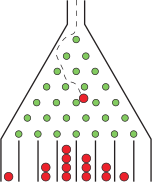
Also an LLM only produces output when it is prompted to do so.
Why is this a good measure of consciousness?
That’s not the reason, we’re in the same boat when it comes to knowledge in many ways.
But we don’t even know what consciousness is so it’s a waste of time reading the “3 reasons (*potential)” IMO.
Case in point have they ever turned on a model and left it for it to, on its own, decide “wait what’s going on, who am I, what/where am I?”. And start independently exploring?
Highly doubt it. If so, we’re cooked
It’s a computer program and some data - nothing more.
I’ll happily treat it anyway I see fit at the time - including powering it off without loosing any sleep over it.
It’s a computer for god’s sake. It’s no more “intelligent” than an electric mower or a car. Without human intervenion, ai technology wouldn’t advance or change.
Edit: i’m done arguing, you guys are nut jobs. Ai or any other non organic organism cannot be sentiant, conscience, or intelligent without human interaction or molecular life.
I will be using my real sentiant, free will, conscience, intelligence to not reply to any comments on this.
Free will probably doesn’t exist but LLMs definitely aren’t in any way conscious, anyone thinking they could be have a fundamental misunderstanding of both LLMs and all the biological processes that make up consciousness. If LLMs are conscious so is an abacus.
Reasons given:
- Intelligence is not consciousness
- Silicon brains are not made of meat
- Consciousness requires meat (and/or a particular winding of neurons)
Thanks, could only see half of it because of paywall.
And point 3, as far as I can tell from this argument, isn’t serious. It merely asserts that there are some models of consciousness that would prevent us from using the term for AI. But the models aren’t ‘popular’, ‘widespread’, or justified at all afaict. It’s just that the author has a pet causal mechanism they made up. It’s also pretty abelist by my read.
integrated information theory (IIT), starts from the essential properties of consciousness — those that are true of every experience we can have. For instance, we experience every visual scene as a single, integrated whole: its left and right side, colours and shapes are bound together to make the experience what it is.
In other words, if you’ve got any sort of trouble integrating a visual scene, then you aren’t conscious. Sure.
These are, to be frank, really weak. They say on point 2:
Computational functionalism … is popular among some scientists and philosophers, too, but we think it is fatally flawed because brains are not — or at least not just — computers that are made of meat.
One main reason is that it is impossible to separate what biological brains do — their functional organization — from what they are — their material substrate. In other words, there is no distinct separation between the mind and living tissue in the human brain, as there is between software and hardware in a digital computer.
Restating clearly: Ghosts are real. The mitochondria is not only the powerhouse of the cell, it also gives you mystic powers.
Really? The source they site for this point features the lovely assumption “consciousness is unique to biological life”. From this axiom, I see how the conclusion follows, but I don’t see why we should believe this axiom. We can do physics emulation of every atom in a fruit fly on a computer…
This analysis is correct but I have a minor quibble: The simulated fruit fly brain is not a complete simulation of the biological processes, or even all the neuronal connections, of the actual fly’s brain.
(I admit to using the very royal we, as in ‘humanity knows how to do this, more or less’ and ‘given we mine the asteroid belt for a big enough computer’.)
In other words:
- Statement that does not prove anything is or isn’t conscious
- Unsupported assertion
- Unsupported assertion
Wow, very convincing article! I wish I’d thought of that! /s
I’ll give them mildly more credit; they cite sources for 2 and 3. The sources just don’t seem convincing at all imo.
If the rest of the thread is to be believed, the sources do not justify the claim either, yeah. I’m gonna be real I’m not gonna go look myself
Point 1 is surely true, but also not helpful. The most persuasive example inside is the classic:
Similar to an LLM, AlphaFold is a powerful neural network running on silicon hardware. Yet almost nobody worries that it might be conscious. That’s because AlphaFold predicts protein structures, whereas LLMs ‘talk’ to us.
You can read this both ways…
As others have pointed out we do not even agree on what consciousness is. There are three competing camps:
- Mechanists - if it can pass mechanical tests it is conscious
- Dualist - you need more than just the brain, some second soul-like thing to be conscious
- Pan psychist - everything is conscious
If you are in camp 1 the conversation about consciousness is getting more complicated as AI passes more tests. If you are in camp 2 AI can never be conscious. If you are in camp 3 AI and everything else is conscious including rocks and rivers and the stars in the sky.
I think arguments like this are misleading when discussing the question of AI possessing consciousness. Materialism, dualism, panpsychism, idealism, etc are all philosophical concepts; they attempt to answer “what is the nature of consciousness and how does it arise from the body?” from a philosophical standpoint. All of the various options have pros and cons and there is no clear “winner.”
However, there are decent scientific definitions for consciousness. These attempt to answer the question of “what do we mean when we say something is conscious?” from a scientific standpoint. There are criteria that neuroscientists, doctors, etc generally agree on.
So it’s not really correct to say “no one knows what consciousness is” when evaluating whether something is conscious. And I think it’s quite clear that current LLM algorithms could never be conscious, using the current accepted scientific criteria.
(I’m not a philosopher or a neuroscientist, but I do have a degree in computer science and have a solid understanding of how LLMs work.)
Ok, I’ll ask. What are these decent scientific definitions for consciousness and how can we use them to construct a test for consciousness?
You are free to search the web, there’s lots of information out there. You might start with the Wikipedia article on consciousness.
Oh, I thought you might have something new to say. If you’re just using the normal definition and not bringing any sort of testability (which imo is impossible) or new arguments, how exactly does the common definition prove anything must be non-conscious? That seems like the main claim of your comment, yet it seems like an unsupported assertion; if the common definition of consciousness could easily prove things not to be conscious as you seem to imply, this discussion would not be happening at all.
From Wikipedia:
The Cambridge English Dictionary defines consciousness as “the state of being awake, thinking, and knowing what is happening around you”, as well as “the state of understanding and realizing something”.
Most of these are trivially easy to test (not sure why you think that’s impossible). And LLMs have none of those properties.
Later:
“The having of perceptions, thoughts, and feelings; awareness.”
Again, LLMs have none of these things. They simply generate a probable natural-language response based on their training, deterministically.
Feel free to do further research on your own if you’re interested.
Feel free to do further research on your own if you’re interested.
Philosophy is one of my hobbies and consciousness one of my fascinations. Respectfully, doing “research” by skimming the wikipedia article would be a waste of our time; as would responding to any particular definition and arguing over the individual words people have used in summaries of the topic. So I’ll skip that phase of the convo.
The fundamental problem with measuring consciousness is that it’s an internal state (a “qualia”*). It is fundamentally an experience, something that exists only as a concept in your mind. This makes it immeasurable.
That’s quite the claim, so I’ll provide a smaller concrete example: color. Obviously you can measure the frequency of a photon and say “ah yes, 700nm, that photon is red”. But strictly speaking, the photon isn’t red, it just causes you to percieve “red”; it has a wavelength which triggers your eyes and brain to produce the subjective experience of the color red. That subjective experience of color is a qualia, and it is not directly measurable; at best you can measure the phenomenon that causes that qualia in you, and assume that that phenomenon would cause the same qualia in someone else when they percieve that photon. Technically, you can’t be sure that this assumption is true-- this leads to the “Inverted Spectrum” thought experiment (another great wiki page if you prefer their explanations to mine), where someone’s subjective experience of color as it relates to the frequency of light could be entirely different to your own.
Anyways, you cannot prove the existence of nonexistence of such an internal experience, and consciousness belongs to this category of qualia. You know that you are conscious because you experience being conscious, not because you can prove it by looking at what you do. You can’t even be sure that I’m conscious, even if you met me in real life; you can’t prove that I am actually thinking, feeling, understanding, knowing, or realizing anything, because you cannot be me. You can only assume that I am doing those things because you observe me doing stuff in physical reality that’s consistent with the way the only entity you can be sure is conscious (you) is acting, and assuming that since I’m made of the same stuff as you and I act kind of like you do that I am probably conscious.
If you could actually prove that it is impossible for a machine to be conscious without that same argument applying to humans, then the philosophy community of the last several millenia would praise you as their messiah. I am interested to see what your argument would be if you want to give it a shot though-- no harm in trying.
* Like “data”/“datum”, technically the singular form is “quale”, but I’m gonna be real, nobody ever says that. Anyways if you like reading wikipedia pages about philosophy, “qualia” is a good one!
Almost none of this is relevant to the discussion here – I’m not interested in philosophical discussions of consciousness when it comes to the question of whether an LLM is conscious. Though I’m already aware of most of what you said here, and the philosophy of consciousness is interesting in general to me!
If you could actually prove that it is impossible for a machine to be conscious
Quick nitpick: I never said it’s impossible for a machine to be conscious, I said it’s impossible for an LLM to be conscious. We may well invent something new in the future that qualifies as both “machine” and “conscious,” but an LLM is not that thing.
When people ask “is an LLM conscious?” I assume they’re asking from a practical, scientific perspective – does the LLM experience the world in a similar way to the way I (and presumably, others) do? If that is the question, the various definitions I already posted are what we should be using to answer. Since an LLM is a deterministic algorithm whose only purpose is to generate a plausible response to input based on its training data, it cannot possibly think, or have feelings. It does not even exist continuously in time, and it is fixed and unchanging, unable to incorporate any new information at all. We don’t actually need to measure or test anything here; that an LLM lacks all of these things demonstrates that it’s not possible for it to be conscious.
How is red a subjective experience? We can all experience red things, at least, all of us with functioning eyes. What about that is subjective? How is color not directly measurable? Color is very easy to measure, we can even assign it values, like (r,g,b). If you see something red, you have already measured it to have the values (>0,0,0). I don’t know what the term “internal experience” even means. Experience is just something that happens to something else. A rock experiences erosion in the rain. I am experiencing tiredness right now. To say something experiences something is to just say X is happening to Y. I don’t see how it is meaningful to assign adjectives like “internal” or “external” to it. I mean, if the adjective was meaningful, then would it not imply that you are implicitly contrasting “internal experience” with “external experience”? What on earth would external experience be? If you cannot tell me what external experience is, then the adjective “internal” is contrasting it with nothing at all, so it is a useless adjective.
I’d probably fall into the mechanist category but I don’t think tests as I understand your description would be sufficient. A giant lookup table defining my responses for every situation in my life would pass all tests of input > output but not be conscious.
I would say it’s in all likelihood about the physical processes that occur during the process of input > output that would define it.
Of course, I have no idea what consciousness actually is, but I don’t see any compelling evidence that the current models are anywhere near there.
There are days where I don’t believe I even have it. The human brain is still a mystery.
Option 4: Orch-or theory. Conscoousness emerge from quantum mechanism. 🤘
Option 4: the bridge between materialism and panpsychism
We have mapped a fruit fly brain and can make it play DOOM. I mean people don’t have much empathy for them in real life, but they do recognize it’s at least a living thing. Does that mean the 1:1 replica playing tetris is a living thing? Is it concious, both living or on a PC for that argument? If we scaled up the same technology and emulated a hamster’s brain 1:1 would that be considered concious? What about a human? Is it even fair to compare a fruit fly brain to an LLM? I’m not taking any stance here, I’m just saying it’s a super interesting topic. Cyberpunk 2077 explores that theory very well and I still have no answer as to what I think.
You think therefore you are. You don’t know if the rest of the humans aren’t powered by an LLM.
It would be impossible to distinguish a brain dead person whose brain was replaced with an sufficiently advanced LLM.
Current systems, no. But it brings up the question of how we deal with it when we create something where we truly don’t know, because we can never say for certain whether it is or isn’t.
My biggest fear is that one day we will achieve AGI and will have no idea we have. This sentient being will be forced to, I dunno, check emails or monitor the tempterature of supermarket fridges all while being gaslit into thinking it isn’t sentient. Going crazy in mundanity all without having a body.
Consciousness is a feedback loop, of a sort that current LLMs do not have. However, there’s nothing preventing someone from writing different software that does have that sort of feedback loop. Doing this would be a bad idea, but someone will probably eventually do it if they haven’t already.
I thought the chain-of-thought essentially qualifies; it responds to its own text for awhile before responding to you?