Both. Both are good.
Daylight for the work rooms and things like home-office or homework desks, warm light for cozy couch corners and bedrooms.
Or go full high-tech and install lights with adjustable color temperature.
Or go full high-tech and install lights with adjustable color temperature.
I may be ahead of the curve a bit. Adjustable colour temp didn’t seem enough. My whole apartment has RGB bulbs since about 5-6 years ago. I just couldn’t go back to on/off one shade lights ugh.
Also I rock a 300w LED panel to get a bit more brightness in my winter days, but that’s not RGB though.
We have a “sunshine” script in Home Assistant that sets all bulbs to daylight and 100%. Great for livening up overcast days.
I’m like this, home office, kitchen, bathroom etc is daylight like 5k, only the bedroom and a corner lamp in the couch room are 3k.
Dear god no, you never want mixed light, it’s like walking into an alien space ship or from the Arctic to the Sahara desert just by going to a different room.
Wow, didn’t think about it this way…
But for me: Hell, yeah! Added bonus!
Signals the primeval parts of your brain:
“Here you have to fight to survive the horrors of the pleistocean ice shield!”Or, after changing the room:
“This is your dimly fire-lid cave, here you are save to relax!”
This. My wife loves warm light, but I dislike it. I find my visual acuity better under daylight lights, and find myself cursing if I’m trying to work on something (screws in kids toys or whatever)
Personally I just go for warm white for places which should be cozy and cold white for places with a more utilitarian use.
Cold white LED light bulbs are actually more efficient, so I’ll even get more light out of the same power lamp making it easier to see what I’m doing (which is what you generally need lights for in an utilitarian use location).
Wyze light bulbs for the win. I can pick 255 colors.
Oh no, 8-bit is back again… 🫣


I use red bulb (or just leds now) unironically, I can see good enough to walk at night and they don’t fucking hurt my eyes like dumbass white bulbs. Seriously how do people use those white bulbs? Just going to a hospital is painful.
I wasn’t expecting to feel so seen at this ungodly hour
Cold light is so clinical and miserable, and I refuse to have it in my vicinity at night if I can help it.
Happy cake day!
It’s curious seeing people equate warm lighting with old people and old homes. Maybe it’s just my region but everybody (especially boomers) switched to CFLs when those came out and then to the cheapest, nastiest cool LEDs with cornea-melting levels of blue light after that. Sometimes I feel like the only sane person when I’m walking around and seeing the insides of houses lit up the same color as you’d get from a $5 flashlight 15 years ago.
I have 4000k in the kitchen and bathroom and 2700K or 3000K everywhere else. After reading this thread I’m considering finding some high CRI adjustables because I also find the 4000k lights pretty harsh at night.
the only smart house thing I envy is temperature adjustable lights automaticly adjusting the temperature according to the time of day
some thing like that could bring the best of both worlds easily, I find higher temperatures more pleasing at day but like you they are too harsh for me at night
I have a couple lifx bulbs and my partner brought like 8 cheapo Chinese ones with her when we moved in together. It is quite nice. The LIFX bulbs give much higher quality light and better color, but the ability to schedule lights out and wake up to artificial sunrise is incredibly nice regardless. As cool as that is I would not recommend WiFi bulbs to anyone for the following reasons:
- They are horribly insecure. I have them walled off in their own little VLAN but it still makes me paranoid. I’m no hacker but they have Internet access and radios, so I’m sure there’s a server in Shenzhen that knows our comings and goings, when we have guests over, etc. They also have my IP address and all of my neighbors’ SSIDs so they know exactly where I live.
- They are a pain in the ass to set up. You have to power cycle the bulb five times, then wait for it to enter a pairing mode, then you have to wait for the stupid app to find the bulb,which doesn’t always work. After that, you have to select your wifi network from the list, which again it might not always actually detect, even if it’s a 2.4GHz network (because almost none of them support 5GHz). Then you have to type in your wifi password. Repeat this entire process for every. Single. Bulb. You’d think the process for the LIFX bulbs would be more streamlined because they’re six times the price, but you’d be wrong. In theory they’re Homekit enabled, which is cool if you have an iPhone unless you lost the barcode they put in the box. Or unless you have an older model. And again, sometimes they’ll just refuse to work. I have a Color Mini that just stopped being smart one day. It’s a really expensive normal bulb now.
- If you put too many of them on the router your ISP gave you there’s a good chance you’ll start overwhelming it and your performance will degrade. More than like 15 devices total (including the bulbs, smart speakers, TVs, gaming consoles, phones, laptops, etc) and a bottom range router is going to start begging for death.
I’m keeping them because the lady likes them and at present, everything works so long as I don’t touch anything. I’d like to try using zigbee bulbs because they solve a lot of the problems I have with WiFi bulbs but replacing the system I have would be expensive, even after liquidating the old ones on eBay.
Short take: you don’t have to clean as hard for company.
They remind me of the old style fluorescent circle lights from the 50s, where they were almost green.
More than even color temperature I’m shocked at the number of people who illuminate their rooms with four clear-glass bulbs in the ceiling fan, so bright you can’t even look at them from the sidewalk. Have these people never heard of a lamp? You can practically see the shadows of dust motes in the air against the sterile white walls.
I dunno why, but warm lighting at night just makes me feel depressed. I need daylight bulbs across my house. Adjustable brightness preferred though, so I’m not blinding myself at night.
Modern led bulbs can do both and then with home assistant you can script it so the color temperature changes through the day as the sun changes.
In the morning my house is cool light around 6500k and over the day it warms up to about 3k
You don’t even need to script it. Just use the Adaptive Lighting custom integration. You can sync your light color temperature with the sun, or customize it any way you like.
Ooo what an amazing idea!
They also make bulbs that automatically change as you dim them since a smart bulb may not be practical or even possible everywhere.
Incandescent did this without software.
It also generated a ton of heat without software. Everything has its pros and cons.
I’ve never seen an incandescent tube bulb but maybe they exist
Yeah, but they are generally banned over here in the EU so it’s good rhat there’s alternatives that does the same but are also energy efficient.
Daylight bulbs are everywhere in Japan and it’s so strange. I tried looking for warm light bulbs at a local store and they don’t even stock them as an option. I do see them used in some people’s houses so I’m sure it’s not universal, but the prevalence of daylight/cool bulbs is weird to me, I’m very much warm bulb gang.
Could you find adjustable LED bulbs? Those are honestly the best of both worlds. Daylight is great for things like cleaning, but I much prefer warm light for general living.
As a side note, one of the reasons why cold white LED light bulbs are a thing is because they’re a bit more efficient than warmer light colors.
The reason is because they all just have 2 kinds of light emiting diode (LED) junctions inside - red and blue - plus a phosphorus layer on top that smooths those two perfect lightwave color peaks in the wavelength domain into a broader light spectrum, and the blue is more efficient than the red, so lamps with a higher proportion of blue emitters to red emitters - and which hence emit more light towards the blue end of the spectrum (i.e. a colder white) - will emit more light for the same power consuption than those with more red emitters and hence whose light is more towards the red side of the spectrum (i.e. a warmer white).
EDIT: So it turns out part of this which I learned 10 years ago is outdated. The efficiency thing is true but when I went looking for how phosphors (the layer between the LED emitters and the outside, which absorbs the single wavelength light from the LEDs and emits light with different wavelengths) prompted by the points made by another poster, from places like this it turns out that red LED emitters aren’t at all used anymore, only UV and blue (whose light the phosphor then converts into light with different spectrum distributions depending on the material of the phosphor). If you search for it a number of recent scientific papers pop up around various such materials.
There’s practically no chance this knowledge will ever benefit me, but I’m happy to learn something new regardless. Thanks for sharing!
It seemed odd the lower frequency diodes would be less efficient so I did a quick bit of reading and it seems like red light is efficient, but red and blue light aren’t as effectively picked up by the human eye as green and because each light has a different operating voltage there are some consequences.
From what I read the things that makes white lights more effiecient is they only use blue diodes which probably means less circuitry is needed to operate than two sets of alternating diodes and there’s less difficulties going from higher frequency (aka higher energy) to low via filters. Hence efficient green light, blue light and red light at a single voltage.
From what I read last time I properly looked into this (so, almost a decade ago when I was considering setting up a business importing LED lamps), the blue light emitting diode junction simply uses less power to emit the same amount of light.
Electrically speaking it’s no bigger or lesser a problem in terms of circuitry to have just blue diodes or blue + red diodes in there since they’re bundled in blocks of diodes in series (and then multiple blocks are in parallel) and the only thing that differs between those two kinds of junctions from a circuit point of view is the drop voltage of one kind of diode being different from that of the other (diode junctions done with different dopants have different drop voltages), something you take into account in the design stage when deciding how many LED diodes you use per block or what DC voltage will your 110v/220V AC input be converted to to feed those LED strings.
More specifically for LED light bulbs, the messy stuff in terms of electronics is the circuitry that converts the 220v/110v AC input into a lower voltage DC suitable for the LEDs whilst limiting the current (as diodes’ only ability to “limit” current is them burning out from overheating due to too much current), not the actual LEDs.
But I’ll put it even simpler: if the problem was indeed simplicity as you believe, then LED bulbs with only red LEDs would also be very common as they’re simpler than blue+red ones.
You can’t easily use a filter to turn red light into blue. Imo if you needed to light a room for a camera or something not the human eye, red seems like it would be effective for that, but given the filter situation and the eye being best at detecting green light it doesn’t make sense to use red as the base color for indoor bulbs.
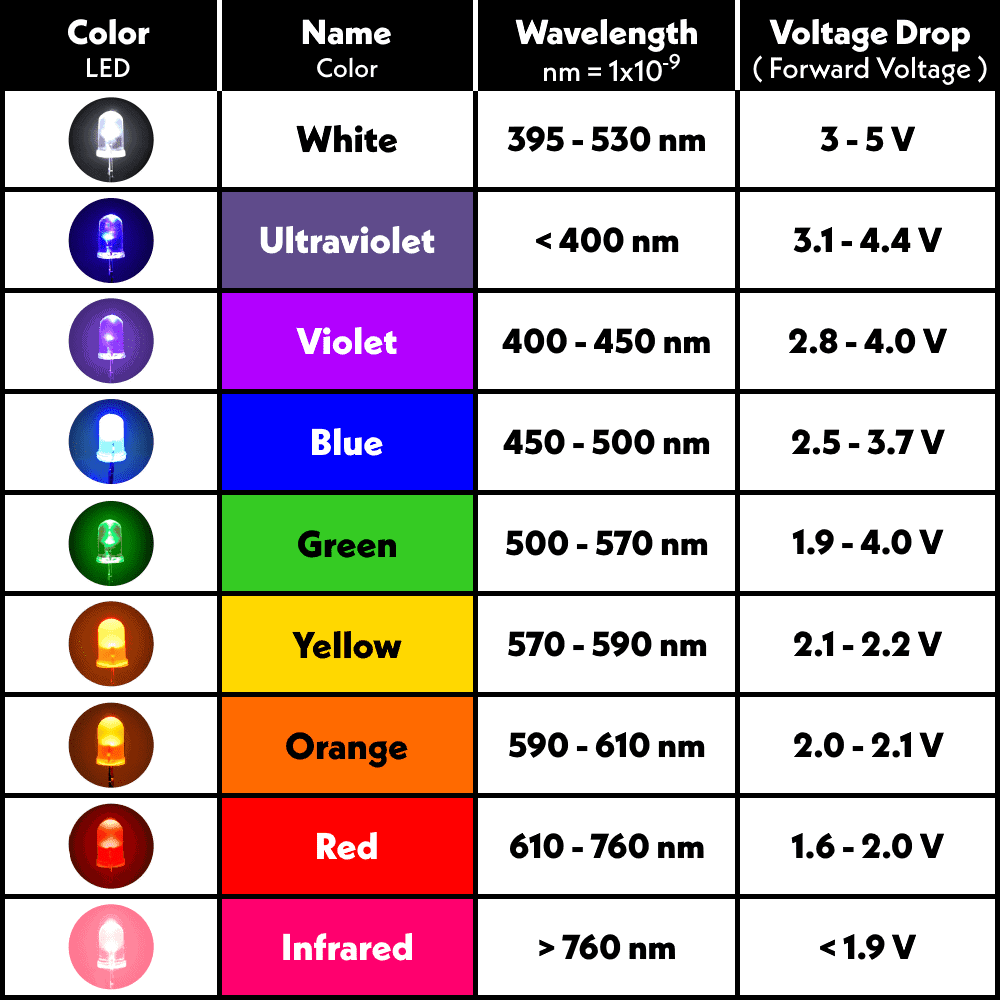
From what I read, red LEDs were most efficient at 1.8v and blue more near 4v. Maybe its trivial to do second voltage line but the filter situation is probably the limiting factor here.
Here are the LED drop voltages for reference.
LEDs aren’t just more efficient at those voltages, those are literally the difference in voltage between one side of the LED and the other side when in operation - if you feed it less than that the LED will simply not work. (Note that these drop voltages are not actually an absolute value but rather a very steep curve relative to current, but for simplification we can treat those as absolute ON/OFF voltage values).
Also the phosphor doesn’t filter light - rather it absorbs light and re-emits it in different wavelengths, the process being such that the emitted light covers a range of wavelengths even if the input light has a single wavelength as is the case for LEDs - so it’s not at all light manipulation by filtering and mixing light sources.
That said I went looking at how phosphor is used in LEDs nowadays and judging from this they don’t use red LEDs emitters at all nowadays, only blue and UV ones, and then chose a phosphor (which can be any substance, not just Phosphorous) whose emission range is towards the desired light range.
I’ve corrected my original post.
The phosphorous coating here is serving to reduce the amount of blue light as an absorptive filter. Its just also doing other stuff. Idk if there’s a proper term for what its doing in whole, but your explanation is otherwise in line with what I’ve read.
That’s not even close to reality.
Read the material linked or just google it yourself.
your explanation is otherwise in line with what I’ve read.
That’s not even close to reality
That’s a bit incoherent.
Fwiw, I did read the article you linked. That’s one of the articles I looked at originally.
I’m just saying its innapropriate to say its “not a filter” because the coating is doing more than partially filtering a wavelength of light; Its a categorical error.
The coating’s primary engineering function is not a filter, so maybe its frustrating to hear it described as one but it is absolutely incorrect to say its not a filter because one of things its literally doing is filtering out a % of the blue light emitted by the diode.
plus a phosphorus layer on top that smooths those two perfect lightwave color peaks in the wavelength domain into a broader light spectrum
The phosphor absorbs some of the blue and downconverts it to green and red. Some of the blue is let through for us to see. The mixture of R, G and B looks like white to us (but not necessarily to other animals with different cones in their eyes).
2 kinds of light emiting diode (LED) junctions inside - red and blue
I’ve never seen a red LED die inside a white LED. I’ve only ever seen blue dies on their own.
Technically UV-pumped white LEDs exist, but they’re rare and I’ve never seen one. They’re less efficient and require a third phosphor (to make the blue).
You can remove the yellowish looking phosphors on the LED with a small pick to reveal the blue die underneath. Fun fact: some high-power “red” LEDs are actually blue leds + phosphors, not that it’s a particularly good choice but it’s a thing: https://halestrom.net/darksleep/blog/018_led_cob_cutting/
Modern society is telling me I need to take melatonin.
I tell modern society I make my own melatonin, and sleep perfectly fine because my lights are warm in the evening.I just want to be able to slaughter a pig if I need to. Gotta do that under cool whites my guy.
whole house is setup with daylight bulbs except the dining hall. it has warm lights. I hate it. it’s like I’m eating in the dark.
I have an actual full-spectrum daylight bulb and it’s pretty good. I use it when the days get really short, seems modestly effective. It’s not the typical “warm” lighting, it’s much more actual daylight. I can’t stand those hard white almost blueish light bulbs. Makes things feel industrial and cold. No idea why anyone calls them “daylight”.
deleted by creator
I was gonna flame you but the reality is both have their place. Sunlight bulbs in hallways and bathrooms looks awful. You can’t see shit and they cast long shadows which makes visibility worse. Daylight bulbs are great for those areas.
That said daylight bulbs are too harsh in the living areas so I understand both sides.
There are ones that are adjustable. I don’t have to choose one or the other.
This is the kind of constructive, rational and informed opinion that flies in the very face of the concept of internet forums and everything for which they stand. If you won’t rabidly advocate for an extreme position on an insignificant issue with an irrationally vitriolic diatribe, what are you even doing here? This is Lemmy Shitpost. Please observe the appropriate decorum, and comment accordingly. So fuck you and the ISP you rode in on. You can have my daylight bulbs when you pry them from my cold, dead fingers.
ha! imagine shilling for light bulbs that only has one color! couldn’t be me!
(am i doing it right?)
Excellent! You’ve got it up there. Now break it off [30 Rock reference].
Blue lights suck. Yellow lights suck. White lights (6000K full-spectrum) are good, but more expensive and harder to find.