Because as capitalism monopolizes, it is compelled to expand outward in order to fight falling rates of profit by raising absolute profits. The merging of bank and industrial capital into finance capital leads to export of capital, ie outsourcing. This process allows super-exploitation for super-profits, and is known as imperialism.
In the People’s Republic of China, under Mao and later the Gang of Four, growth was overall positive but was unstable. The centrally planned economy had brought great benefits in many areas, but because the productive forces themselves were underdeveloped, economic growth wasn’t steady. There began to be discussion and division in the party, until Deng Xiapoing’s faction pushing for Reform and Opening Up won out, and growth was stabilized:


Deng’s plan was to introduce market reforms, localized around Special Economic Zones, while maintaining full control over the principle aspects of the economy. Limited private capital would be introduced, especially by luring in foreign investors, such as the US, pivoting from more isolationist positions into one fully immersed in the global marketplace. As the small and medium firms grow into large firms, the state exerts more control and subsumes them more into the public sector. This was a gamble, but unlike what happened to the USSR, this was done in a controlled manner that ended up not undermining the socialist system overall.
China’s rapidly improving productive forces and cheap labor ended up being an irresistable match for US financial capital, even though the CPC maintained full sovereignty. This is in stark contrast to how the global north traditionally acts imperialistically, because it relies on financial and millitant dominance of the global south. This is why there is a “love/hate” relationship between the US Empire and PRC, the US wants more freedom for capital movement while the CPC is maintaining dominance.
Fast-forward to today, and the benefits of the CPC’s gamble are paying off. The US Empire is de-industrializing, while China is a productive super-power. The CPC has managed to maintain full control, and while there are neoliberals in China pushing for more liberalization now, the path to exerting more socialization is also open, and the economy is still socialist. It is the job of the CPC to continue building up the productive forces, while gradually winning back more of the benefits the working class enjoyed under the previous era, developing to higher and higher stages of socialism.
Put another way:
The English language is violence, I hotwired it
I got a hold of the master’s tools and got dialed in
I’m downwind with the drop
I’m Deng Xiaoping, smoking oil in the wok
-billy woods
For further reading:
-
Qiao Collective’s Introductory Socialism with Chinese Characteristics Study Guide
-
Socialism with Chinese Characteristics ProleWiki page
-
Socialist Market Economy ProleWiki Page
-
People’s Republic of China ProleWiki Page
-
My “Read Theory, Darn It!” Introductory Marxist-Leninist Reading Guide
-
Has China Turned to Capitalism? Reflections on the Transition from Capitalism to Socialism by Domenico Losurdo
-
China Has Billionaires by Roderic Day
-
Imperialism, The Highest Stage of Capitalism by Vladimir Lenin
-
Super-Imperialism: The Origins and Fundamentals of U.S. World Dominance by Michael Hudson
-
Marxism is a Science by Deng Xiaoping
-
Regarding the Construction of Socialism With Chinese Characteristics by Xi Jinping
Was not expecting a Billy Woods quote
It fits!
-
A great dive into the mechanics of it here. Basically, western economies became financialized and investors would rather invest in low risk ventures like software startups rather than factories and industry. On the other hand, In China, the state sector drives industrial development instead of markets. This created a dynamic where western companies would leverage subsidized industry in China and offload the costs for manufacturing while focusing on developing digital and service economies in the west.
Other’s here have covered the why’s of how China became a manufacturing powerhouse, but it is also interesting about how they continue to build things even though China is no longer the cheapest place to make things and hasn’t been for awhile.
One of the most amazing things about manufacturing in China is how extensive their supply chain infrastructure is. This allowes your suppliers to react quickly and do things in days or hours that would take weeks elsewhere in the world. I’ve got suppliers in China that I know will get it right the first time, and will build a brand new product in 6-8 weeks rather than 12 weeks anywhere else in the world. The way the supply chain worldwide revolves around China is both amazing and scary. There are many items today that are nearly impossible to get outside of China at any price.
The other thing is people. Due to the years of experience China is the place where the best tooling and manufacturing engineers are. There are so many people concentrated in the manufacturing centers that if you need to hire 1000 people in a couple days to assemble widgets then you could feasibly do that.
That said, there is definitely a push to diversify manufacturing outside of China and I wouldn’t be surprised if they lose some of these advantages in the coming years. This started with the original US tariffs against China, continued due to how China locked down during the pandemic, as well as the current round of US tariffs.
Cause it’s cheaper.
That was the case in the past but it’s not true anymore. China is just the best in a lot of sectors and also oftentimes the only one who can produce certain things. Here’s a video where someone tried to make a product in the US only, it explains a lot of that: https://youtu.be/3ZTGwcHQfLY
Capitalism
Huge amount of cheap resources, infrastructure and labour made factories in China flourish. Rapid industrialisation was key to this. Other Asian countries did not really benefit from a surge of industrialisation like China did, but India is close.
It’s all china. Always has been.
China has for decades deliberately designed their economy to provide affordable and quality labor to the capitalist world, and in all of the English speaking world capitalists are free to invest their money however they please wherever they please. Since it is cheaper to produce and import particular similar quality products from China than produce them domestically, that is what the right business move would be to minimize costs to maximize profit.
in all of the English speaking world capitalists are free to invest their money however they please wherever they please.
It’s important to understand that they are not free to invest their money however they please in China. Their investment options are limited by the Chinese state, and they come with strings attached. Those restrictions and strings are what separate China (and Vietnam and Laos) from other Global South countries.
No one has mentioned the financial manipulation? I’ve heard policy wonks rant about it for decades. From Bloomberg:
Starting in the mid-1990s, China spent a decade regularly intervening in the foreign-exchange market to keep the yuan at a pegged rate to the dollar. Policymakers were essentially maintaining an undervalued exchange rate to help exporters and further the process of industrialization.
From a library of congress snippet about China/U.S. trade:
China’s currency, the renminbi (RMB), had been undervalued for many years with Chinese government’s continual intervention in setting a target rate for currency exchange. Undervaluing their currency made Chinese exports more competitive, attracted foreign investment, and made imports less competitive.
Underpaid and/or child labour and a government covering and subsidising it
Child labor is illegal in the PRC, and purchasing Power in 2022 was 25 times higher than 1978. It’s time for you to turn off Fox News.
Removed by mod
The PRC does enforce human rights, and they have consitently had higher and higher wages. None of what you said is sourced, you need to turn off Fox News and see what China is actually like these days.
Xinjiang: A Report and Resource Compilation
The PRC is not murdering, enslaving, nor sterilizing Uyghurs. It’s genuinely a complex situation, but you can absolutely rely on the west to uncritically report their paid propagandist and christian nationalist Adrian Zenz of the “Victims of Communism” state department propaganda outlet. The reason why the west keeps pushing this distortion of what’s actually going on in Xinjiang is because they wish to stoke political and civil instability, creating a wedge to force through economic liberalization and capitulation to US demands.
The U.S. doesn’t give a shit about muslims, and are actively committing genocide in Palestine. There’s absolutely no reason to trust what the U.S. State Department says on the matter, especially when nearly all evidence circles back to testemonials (and fabrications!) from Adrian Zenz.
Slave labour.
Do you want to be paid $0.0001 per widget you produce 12hrs per day, 7 days a week? Because that’s how you get cheap things.
The world found a place that had people that desperate.
This is just factually untrue. Real wages for the working class have increased substantially year over year for decades in the PRC. The reason why it’s cheaper is because the PRC has become that much better at producing goods.
wages for the working class have increased substantially
So they’re up to $0.01 per widget? That is substantial!
Purchasing Power in 2022 was 25 times higher than 1978. This process is continuous. You need to turn off Fox News and actually look at what’s happening in China right now.
It wasn’t slave labor, exactly, but it was massively exploited labor. 75 years ago China was easily the poorest country in the world and it’s people were living in the equivalent of $1/day, possibly less.
However, the entire goal of the socialist program was to alleviate that poverty and exploitation, not by enslaving people but by developing the country’s economic and industrial base.
Today, Chinese people have a higher average purchasing power than US citizens do. That means the average Chinese family can afford to buy more goods and services than the average American family. Wealth inequality is also way lower in China than in the US which means that way more of Chinese people have better purchasing power than USians do, simply because that’s how averages work. The US raises the average by making very few people very wealthy and China raises the average by making their billion residents sustainably and incrementally more wealthy.
As for slave labor, the US imprisons more of its people than any other nation on the planet and all of those prisoners are subject to slave labor and massive debt burdens. Official US slave labor from prisons produces over $11Bn in goods and services, much of which goes to the profits of for-profit prison management companies.
China has no such system.
I don’t know why you’re getting downvoted. It’s well-known they use slave-labor concentration camps filled with Uighurs.
Xinjiang: A Report and Resource Compilation
The PRC is not murdering, enslaving, nor sterilizing Uyghurs. It’s genuinely a complex situation, but you can absolutely rely on the west to uncritically report their paid propagandist and christian nationalist Adrian Zenz of the “Victims of Communism” state department propaganda outlet. The reason why the west keeps pushing this distortion of what’s actually going on in Xinjiang is because they wish to stoke political and civil instability, creating a wedge to force through economic liberalization and capitulation to US demands.
The U.S. doesn’t give a shit about muslims, and are actively committing genocide in Palestine. There’s absolutely no reason to trust what the U.S. State Department says on the matter, especially when nearly all evidence circles back to testemonials (and fabrications!) from Adrian Zenz.
It’s well-known

You can’t bring us evidence because there isn’t any.
The US tried to foment division in China by funding and organizing Salafi terrorist into Xinjiang, and once its efforts failed, it made lemonade out of its lemon by concocting and promoting a genocide narrative.
The only countries pushing this narrative are the “always the same map” imperial core countries, which just so happen to be largely the same ones supporting Israel’s genocide.
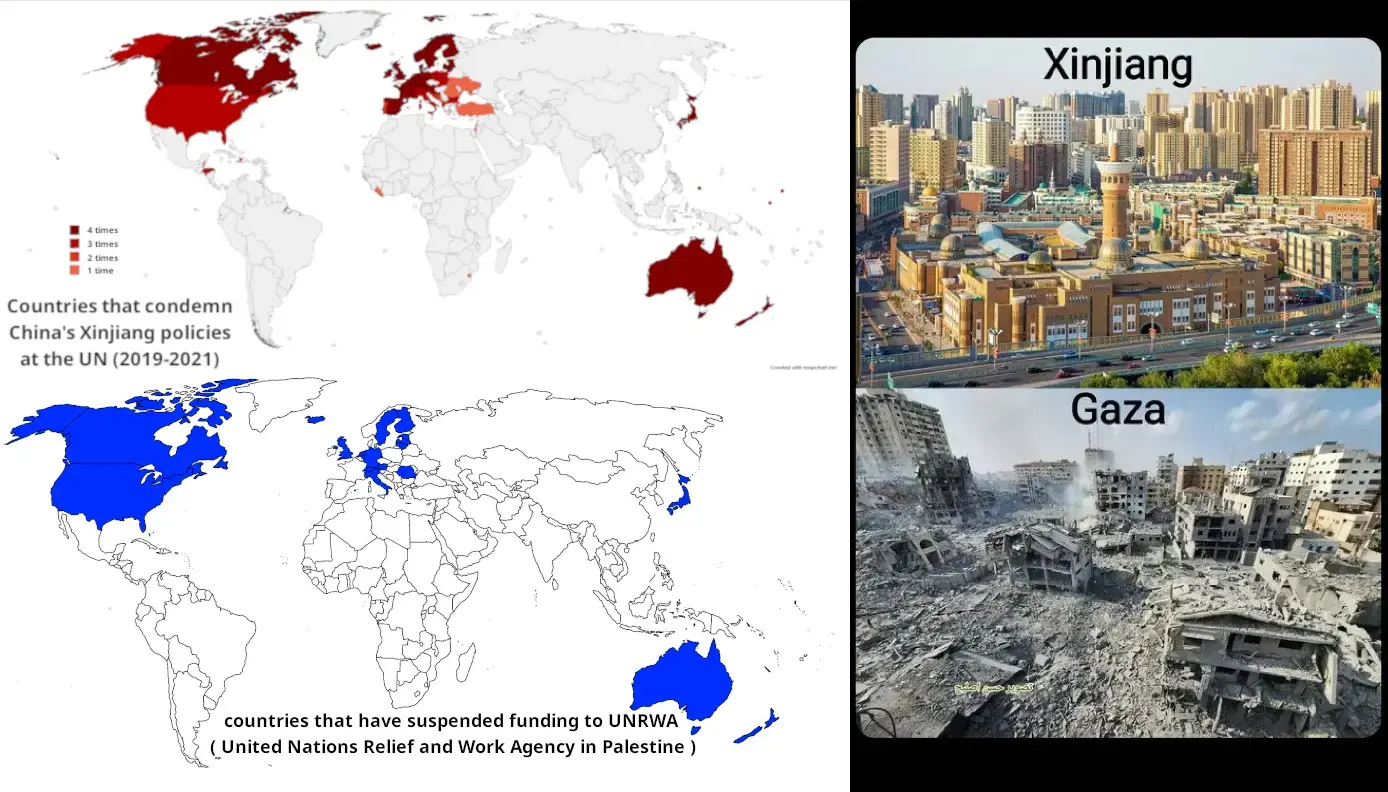
Almost no predominantly-Muslim country buys the Uyghur genocide narrative, because they know it’s bullshit, because they talked to the Uyghurs themselves.
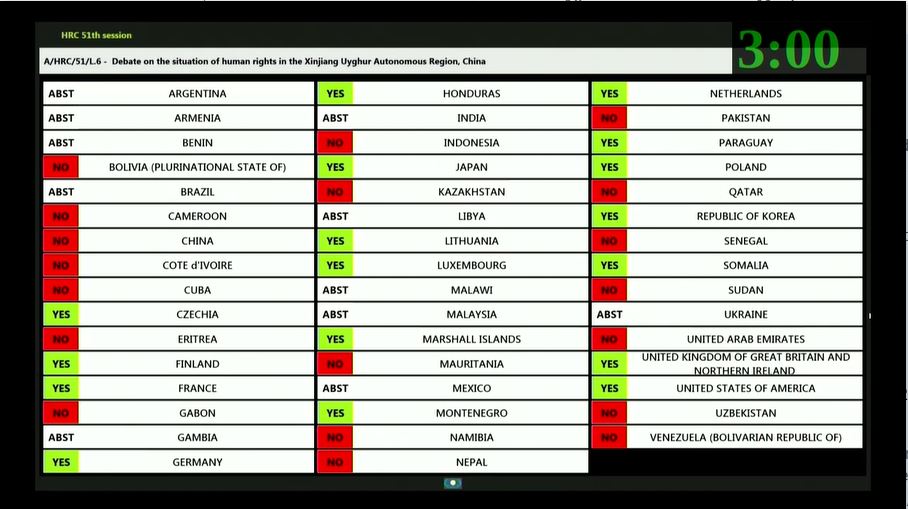
https://twitter.com/un_hrc/status/1578003299827171330#HRC51 | Draft resolution A/HRC/51/L.6 on holding a debate on the situation of human rights in the Xinjiang Uyghur Autonomous Region of #China, was REJECTED.
- The Uyghur Human Rights Project is a product of the National Endowment for Democracy, which is the American government’s main regime change NGO.
- A Reddit AMA Claiming To Be A Uyghur Quickly Exposes A CIA Asset Slandering China
- The Xinjiang Genocide Allegations Are Unjustified
- Uyghur genocide allegations
- American Debunks All Major Western Propaganda on Uyghurs and Xinjiang
- US-Funded Uyghur Activists Train as Soldiers of Empire
- The blueprint of regime change operations How regime change happens in the 21st century with your consent
I should have noticed it earlier, but seeing that photograph comparison made me realize that Herzlians deny the extermination of Gazans despite its overwhelming evidence whereas they completely believe in the Uygur genocide conspiracy theory despite its utter lack of evidence.
Even if you believe in the Uyghur genocide claiming that all products made in China is made by them is just absurd.