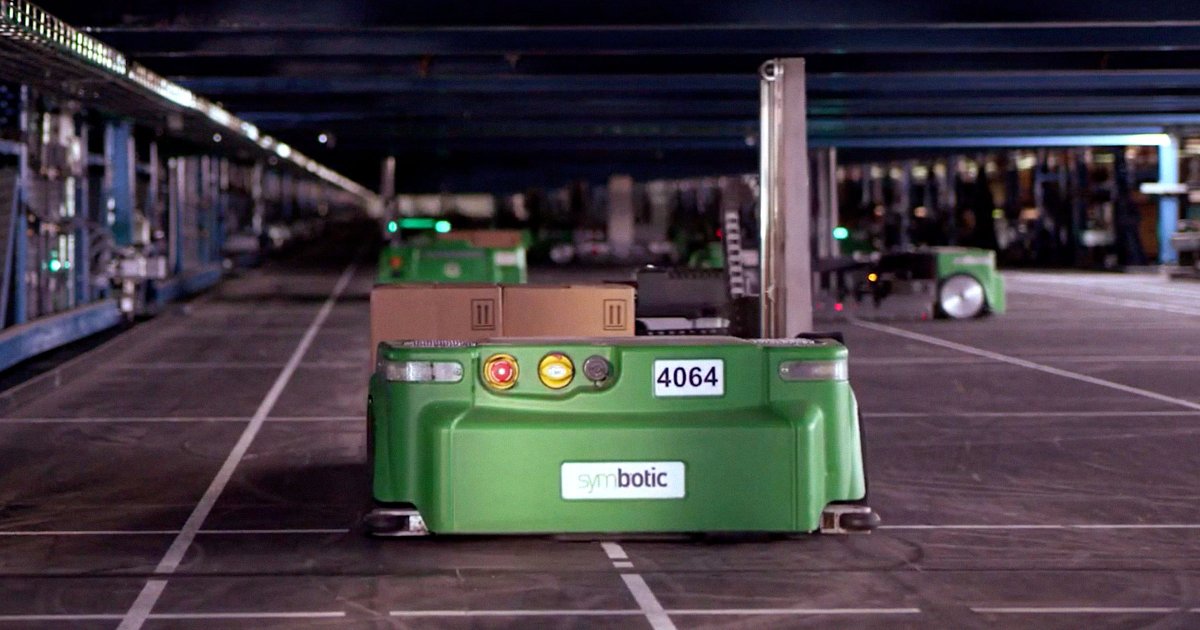
As a forklift monkey: I hate my job and feel that humans weren’t meant for this monotonous kind of work. Like boomers who screwed in one nut on an assembly line who made enough to provide a family of 4, I’d blow my brains out before I’d do that. So fuck these jobs.
Yeah, the problem isn’t automation, it’s billionaires pocketing all of the proceeds.
unskilled warehouse workers.
It’s ironic to call them unskilled in an article describing how their skills are beyond billion-dollar robots.
“Unskilled” meaning you can teach someone to do the job reasonably well off the street in a few hours. Unfortunately robots are not humans and thus need to be meticulously designed while a guy just needs a decent paycheck and benefits.
There is no such thing as unskilled labor. All labor requires myriad skills. At best, some jobs are easier than others, for some people.
All references to “skilled” labor are somber reminders of centuries worth of capitalist propaganda implemented solely to underpay workers.
The length of training required for a job is irrelevant. Some jobs may require years of training for a repeatable mechanical task, like watchmaking. Others may let the worker pop off on day one with virtually no guardrails or training, like landscaping. Both (all) jobs are difficult, and both (all) workers deserve respect.
Do not call work skilled or unskilled, because it is not true, and such labels accomplish nothing other than forwarding bourgeoise interests.
100% agree. I work in the nuclear sector and jobs can literally be walk around and make sure nothing is on fire but its considered “skilled labor.”
Link to the original article. Oh wait it’s WSJ slop.
Remember when the disclaimer “please allow 6 to 8 weeks for delivery” was practically ubiquitous on mail order packages? It’s almost like that was a SANE way to run a logistics network!
We don’t send pieces of paper back and forth with days long transit time to complete an order anymore.
Robots are more expensive and are less capable than people? What a surprise! Not. I saw that coming years ago… 🙄
Especially at Walmart when loading a truck means throwing the shit inside and as fast as possible. Used to unload Walmart trucks. Wish had pics (this was wat before smartphones) You open back doors and the boxes would just spill out. There was always breakage. But Walmart didn’t care. It fuck up way Walmart does business and they are shady as fuck. But allows them to not care about the products. But yeah robots are slow and no way can work at the speeds required at a Walmart distribution facility.
There’s lot of types of warehouse automation outside of a robot skating on the ground picking up pallets or cases or anything. As in, there are certainly automation systems that work alongside people or other different bots that absolutely thrash the throughput of a typical warehouse operation
Walmart merely made a number of very stupid decisions when entering the automation game, but to them its drops in a bucket. They’ll just move on to the next one
So much of automation is trying to put robots in places humans were ment to be instead of designing processes that are for robots not people.
It’s no wonder to me there is often issues
I’ll never understand takes like this. You think humans are meant to be shuffling around a warehouse picking and packing orders mindlessly?
I get being annoyed at corporations for greedily trying to save money at the expense of workers, but ultimately, I can’t be that upset over shit jobs going away.
In my view, we have to be focused on how to help The displaced workers which we have historically done a terrible job of. It only becomes more important as we are able to automate more and more tasks that previously required a person. Automation absolutely can be a tide that raises all boats; we just have to demand that it be so. Otherwise, all the benefit will go to the oligarchs instead of the people.
The process is designed around human ability, not what is easiest to implement in a machine.
Our capabilities are different. I don’t mean that humans are biological geared towards working on a warehouse. But that we design warehouses around what humans can do
No, they aren’t saying that “humans are meant to be shuffling around a warehouse picking and packing orders mindlessly.”
The point is that the processes are designed around human operators with specific considerations for the abilities and constraints of an average human. Dropping a robot into a process without updating said process around the abilities and constraints of the_robot_ creates new problems. Humans and robots work in different ways and cannot be substituted 1:1 without creating problems.
Now displaced warehouse workers learn to maintain or program the bots and adapt to new jobs, but at some point, all this bot productivity should be taxed too or the wealth keeps concentrating among the few, rather than revenue to build better society for We The People.
That requires affordable education. Which is against the policies of those wanting you dumb so you continue helping vote for our one-sided policies that do nothing to help self but only the needs of an already overabundance and selfish select few.
Just tax wealth hoarding, doesn’t matter how the hoarding was achieved
Walmart spent billions replacing warehouse workers with robots, only to discover the robots can’t lift dog food and the engineers cost more than the workers did. Apparently the automation revolution has reached its greatest technical challenge yet: doing the job it was supposed to automate. Somewhere, a PowerPoint deck is quietly being deleted.
So instead of hiring actual people again, they’ll look for cheaper engineers and robots.
Nah it’s at least another decade of sunk cost management style then they will pivot back to humans once minimum wage has been repealed and the labor camps are in place
The system designers get tripped up by the strangest things. I once worked in a factory that uses copper bars of varying lengths, and the designer didn’t expect the bars to ‘sag’ when picked up flatwise from the middle. So I can imagine picking up a bag of dog food would do that.
I mean anyone who’s ever done anything with a long piece of lumber or piping or anything could predict that.
That’s a bad engineer problem. Tasks must be reduced to absolute minimums, and operating scenarios must be maximized. Otherwise failure conditions will win.
It’s one of the great ironies of our time that we spend billions on slop machines but haven’t yet been able to build a robot that can empty the dishwasher.
As a bachelor, a dishwasher is already a cabinet. It doesn’t need emptying.
I’ve considered buying a second dishwasher so I can just swap between two self-cleaning cabinets.
Robots can work well in warehouses. Amazon’s have been a success, for example. This just sounds like whomever WalMart hired to design this didn’t know what they were doing and Walmart got screwed. Maybe they tried to automate the wrong tasks, or leaned too heavily on the sales pitch of “AI magic” rather than understanding what they were buying.
The article also mentions Kroger’s failed dive into automation. From what I can find online, the automation worked, but it was a flop because it was expensive and underutilized — it wasn’t worth the money spent because it was focused on filling online orders that dried up.
https://www.wsj.com/tech/amazon-warehouse-robots-automation-942b814
https://retailboss.substack.com/p/krogers-350-million-lesson-why-big