We all know the pictures of the astronauts on the ISS floating around. We also suspect that a lack of gravity is bad for the body as the muscles go weak and such.
Why don’t spaceships just rotate to cause the effect of artificial gravity through centrifugal forces?
The ISS is primarily designed to research the effects of microgravity and other space environment issues. Hard to study zero g manufacturing when your station has artificial gravity.
True
Because the constant rotation complicates things a lot.
Specifically talking about the International Space Station, its main mission is a microgravity laboratory. We put it up there so we can learn about microgravity. Why go through all the expense of putting it up there and then spinning it to make gravity when we get it for free down here on the surface?
As for other craft? We have yet to develop manned spacecraft that can do the duration where it would be worth doing. Even the longer Apollo missions were in space for a whopping two weeks and 2/3 of the crew still landed, got out and stretched their legs. It hasn’t been worth the engineering hassle to do it.
And it is an engineering hassle, because…
-
The ship has to be designed to handle it. It’s under additional stresses, so it’s got to be built tougher to handle it. That’s added weight, and just typing that sentence made at least three rocket scientists cringe to death.
-
Humans actually aren’t great at living in a spin gravity environment. The smaller the radius of the spin, the worse it gets. For one thing, in a centrifuge, there’s a pretty steep gradient in centrifugal/centripetal/pedantic force, the farther toward the rim you are the greater the gravity. For very small distances that can be significant enough to cause problems on its own. But also, spinning humans isn’t good for their vestibular systems. Each of your inner ears has three semi-circular canals filled with fluid, and little hairs that can detect the movement of that fluid. This allows you to sense rotation around three axes, kind of like a gyroscope sensor. This evolved in an environment that rotates a 1 rotation per day, functionally stationary. Spin a human at several RPM and that constant rotation is enough to start throwing off balance, causing nausea etc. So the bigger the radius of the spin, and the slower, the better. That takes more weight, and there go three more rocket scientists.
-
It makes the spacecraft a pain to handle. You need to be able to orient spacecraft in space to point engines, windows, instruments, docking adapters etc. in various stable directions. A constant roll complicates that. “point in this direction and fire the engines” becomes a pain because, say you’re constantly rolling, and you need to change the direction your long axis points. What thrusters do you fire in what combination to steer the ship? Or do you stop the roll, maneuver/use your telescope/dock/whatever, then start rolling again? So now you’ve got to deal with gravity starting and stopping variously throughout the journey. Or, do you design the ship to have sections that do roll and sections that don’t? First, look up “gyroscopic precession” on Wikipedia. Second, wiring, plumbing etc. is a pain in the ass to handle via slip ring, let alone crew access. Third, that adds weight, which…I should probably stop saying that, rocket scientists aren’t cheap to train and that’s nine we’ve killed just in this list.
In conclusion, look what you made me do.
That was worth every second it took to read.
For number 3 and the slip ring. I have always thought, just make the stuff on the end self sufficient. Essentially make two spacecraft. One to run all the experiments in zero ish g. And the other to be like living quarters. You can even make them suit up to commute. But you would need one heck of a long arm to make the 2 palatable. Maybe 3 craft, two way the hell out there attached to some crazy long tethers. One in the middle. Then some kind of speed sled thing to get a person from the outside in or something. Probably need to worry about balancing out the change of weight due to the sled (and person) moving from outside in and such.
“point in this direction and fire the engines” becomes a pain because, say you’re constantly rolling, and you need to change the direction your long axis points. What thrusters do you fire in what combination to steer the ship? Or do you stop the roll, maneuver/use your telescope/dock/whatever, then start rolling again? So now you’ve got to deal with gravity starting and stopping variously throughout the journey.
according to the hohmann transfer orbit
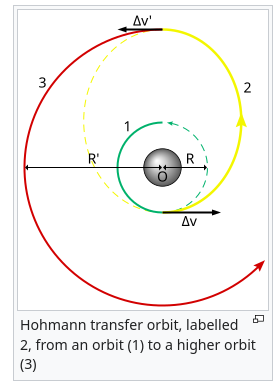
you only do one burst at the beginning of the journey, then drift for 6 months before entering the atmosphere of the target planet to slow down.
So there’s 6 months where you don’t need to fire any engine. My plan is to first do the acceleration burn, then install solar panels on the outside of the ship (attach them via some kind of cord and cable) they fly outward due to centrifugal force so they get constant sun exposure, and then put the ship into rotation. So you don’t need to do any work on the outside anymore, until you’re shortly before landing, then you stop rotation, get in the solar panels, enter the atmosphere, do landing burn, and land.
Humans have flown a total of ten manned missions that involved a Hohmann transfer: Apollo 8, Apollo 10-17, and Artemis 2. All ten flew to the Moon. On a typical Apollo mission, the outward bound coast leg is about 72 hours, between TLI and LOI, during which time they had to do the release-turn around-dock-extract maneuver with the lunar module and do at least one course correction.
We’ve been wasting tax payer dollars for more than half a century now designing and redesigning manned Mars missions that aren’t ever going to fly. Some of the various “artist’s conceptions” over the decades have included various centrifugal gravity solutions, be it the wagon wheel type or the bolas type or whatever. I don’t believe any actual hardware has even begun construction. Before you start worrying about that, you’ve got to 1. have a society healthy enough to fly manned deep space missions, and 2. figure out how to shield the crew from radiation first. Neither of which we have figured out at the moment.
This was brilliantly and very humorously explained.
-
Small ships would have to rotate really fast to make 1G, and it’s not worth the trouble if nobody lives there permanently.
interestingly bigger ships would have to rotate faster than small ships to achieve 1g btw
this is due to smaller ships having a larger curvature so less velocity is needed
edit: no wait i just did the maths again and you’re right. smaller ships need lower absolute velocity of the outside walls, but angular velocity is higher.
Yes, but the smaller the ship, the worse the Coriolis force will be. Imagine a 10m corridor with opposing gravity on each end, and no gravity in the middle. Travelling across would be extremely disorienting.
i think that would be so much fun!
Key goals for both moon and mars missions is finding out how much gravity we need. We know we’re much healthier at 1G than in microgravity, but where is good enough? You can’t really draw a straight line to predict it. Does the moon have enough gravity for people to stay healthy long term? Does mars? Where should we set the rotation of a space station with artificial gravity?
Because it’s expensive.
You have to build equipment to withstand constant load, which is much heavier, which means more launches and launches are more expensive.
Suddenly there is a greatly reduced working and living area. You go from being able to work in any surface to only surfaces near the “floor”. So you need to build more areas, and the architecture becomes more complex, both requiring many more launches.
A lot of the things you want to do in space, like science experiments, have to do with micro gravity, so introducing artificial gravity would make space stations kind of pointless.
To make the structure big enough to spin comfortably would require a very large structure, which means a lot of material, and a lot of launches. And more places for things to go wrong, so a lot more engineering and safety assurance is required.
It is primarily the latter reason. Rotating e.g. the capsule of the Artemis mission in a way that would produce enough fake gravity would be… interesting. And the astronauts’ feet would have gravity, while their heads would not.
Yeah that is a large part, but I don’t wanna minimize the other parts, because they all mean you need a significantly larger vehicle rather than “just” a counterweight.
There’s a rotating spaceship in a parking lot in Japan. 20 years ago NASA paid Japan to build the Centrifuge Accomodations Module for the ISS, but Congress cut the $100m it was going to cost to launch it, so it’s next to some bushes with bird poop on it.
As some have already mentioned - coriolis forces. But why not build bigger so coriolis forces aren’t an issue? Because spinning up anything of sufficient diameter to even come close to 1G would need some kind of unobtainium to be strong enough to keep the spinning object intact. Say 5 tons of mass at 0 G is just mass, but now accelerate it and you need to figure out how to support 5 tons.
1 rpm for 1 G is going to need almost 1km radius. 2 rpm is ~400m.
You can see that the numbers, size, and engineering get pretty ridiculous to keep people from being sick when spun.
We don’t necessarily need a full 1 G. We could probably get away with 0.5 G or even less. I wonder if things get more practical if we just have enough artifical gravity for orientation, standing, and sitting
Here is a great video on spin gravity. It covers an important detail that another comment mentions but most over look. Spinning fast enough to create gravity-like centrifugal force causes real dizziness at small diameters. 5 or 6 rpm is about the maximum we can stand.
That’s why you split the ship in two and spin the habitation module around the heavier part of the ship¹, connected by a tether, as in Project Hail Mary (which the video says is still too fast… so just make the tether longer).
- Well, around their common barycentre, but you know what I mean.
Yeah, a good idea. You run into some material strength issues, but I think this is the way.
You would need a pretty large radius to generate stable rotational gravity. If the radius is too small, the speed of rotation would make standing or walking nearly impossible. The larger the radius, the more imperceptible the rotational effects would be.
ok so i did some calculations:
If your ship is 9 m in diameter (just chosen at random, not because Starship is by chance 9 m in diameter)
that means x = r*cos(omega*t) and x’’ = r*omega^2*-cos(omega*t) = 1g for t = 0 implies r*omega^2 = 10 m/s², r ≈ 4.5 m, omega ≈ 1.5 rad/s
so the ship would have to rotate with roughly 0.24 rotations per second or 14 rpm. seems doable to me. the outer walls would move with 6.7 m/s or 24 km/h.
Doable, not practical. Another major concern is the induced dizziness and general discomfort from such a small circumference. If you stand up straight, your head moves significantly slower than your feet. There are more effects that humans don’t do well with.
In addition keep in mind that this implies significant mechanical complexity the moment you don’t rotate the whole craft, but only a section or ring. If you do rotate all of it, simple tasks like taking a photo become… cumbersome.
Also like others have said, it’s not a permanent residence for anyone, and the main goal of the ISS is the study of low- or micro-gravity.
Have you ever been in one of these?
You can easily sit on the wall while it’s spinning, and it actually feels pretty normal. But, if you try and stand up and walk around…you’re going to have a very bad day.
For some reason your link didn’t work for me - in case it helps anyone else, here’s the link again:
Thank you.
actually i have been, and i have attributed it to the device not providing consistent centrifugal forces. instead, gravity interferes and makes it inconsistent. which would not happen on a spaceship.
lol did you just watch Project Hail Mary?
no? never heard of it
It’s a book / movie that just came out where the operators of a spaceship continually turn artificial gravity on and off by using spinning to create centrifugal force. I’m assuming there are recently a lot of people wondering this same question.
deleted by creator
the one in space odyssey did.
Among everyone else’s reasons, they’re also using the ISS to do micro gravity experiments.
For clarity: I don’t know for certain. I am not involved in the community, not an engineer.
Opinion: It’s incredibly difficult to do. A spinning station needs to be designed to do such a thing. It needs to be balanced and have thrusters positioned in such a way to both spin up and maintain the rotation as it goes. The ISS has been built and expanded over decades by tons of new science modules over time as new breakthroughs happened.
Spinning objects can behave in strange ways and having a regularly shifting center of mass can be a challenge by itself, and that’s before you start planning for yet uncertain experiments to bring aboard.
In addition to this, it would be an ENORMOUS challenge to dock with a station that is spinning, and the added danger to do this (or increased fuel consumption of spinning down and then spinning back up) just isn’t worth it. The alternative of maintaining a central core that is static relative to the spin wastes power and creates a massive risk (more moving parts, especially those which might create friction against metal aren’t easy to maintain in space).
Also, a small spinning station is much harder than a massive spinning station because it would have extremely noticeable differences from normal gravity to the people on board. Your head and feet would likely be moving at noticeably different speeds, which by itself is disorienting, but moving either towards or away from the direction of the spin would feel different (dropping an object would mean it falls away from the direction of spin).
Lastly, maintenance would mean that every single EVA either wastes a tremendous amount of fuel to spin down/up again, or risking flinging a person into space every time they exit.
Realistically, on a much larger station, artificial gravity via spinning might be a fantastic idea, especially for longer-term living aboard, but for the ISS, given its history, its goals, and especially where it’s at, it’s just not a great idea.
increased fuel consumption of spinning down and then spinning back up
wastes a tremendous amount of fuel to spin down/up again
I think a flywheel mechanical energy storage system could both serve as a way to store energy and as a way to manipulate the rotation while preserving rotational energy. To slow down the rotation, transfer the rotational energy to a flywheel, and then transfer it back when you need to go back to speed. That adds some mechanical complexity but it creates a more efficient way to control rotation. Plus with electric motors and solar panels, that should be possible to manage without using any propellant fuel.
I wasn’t sure if a flywheel would be good for something like this given just how much mass needs to move and how fast it needs to move to produce close to 1G of force. If it can manage something like that, that would be a super good solve for this.
That said, even if it wasn’t a good solution for the actual ring, it might be a perfect solution for the core’s movement. Given that it can be much less mass as it’s pretty much exclusively used for docking, it could basically just be a pressurized tunnel with attachment points for the ring. Spinning that up and down with a flywheel seems super reasonable.
I wonder if two opposing rings would be connected by some sort of circular maglev track where the mechanism would just preserve overall angular velocity but spin the two halves in opposite directions. The spin could be entirely powered by electric motors, and energy could be conserved if it needs to slow down or speed up. That might be a lot of mass, but it might not cost any fuel to get it spinning.
We can’t launch anything very big, and things that are constantly spinning are hard to engineer for 100% reliability especially if you have to assemble them in orbit.
And since we can’t launch anything very big anyway, it would make sense to maximize interior space. Leaving two sides of the craft basically unusable as a floor and ceiling reduces available surfaces in a space by 1/3.
Because it’s way more expensive impractical and error prone I assume
Just gonna link to the SpinCalc here as its pretty cool