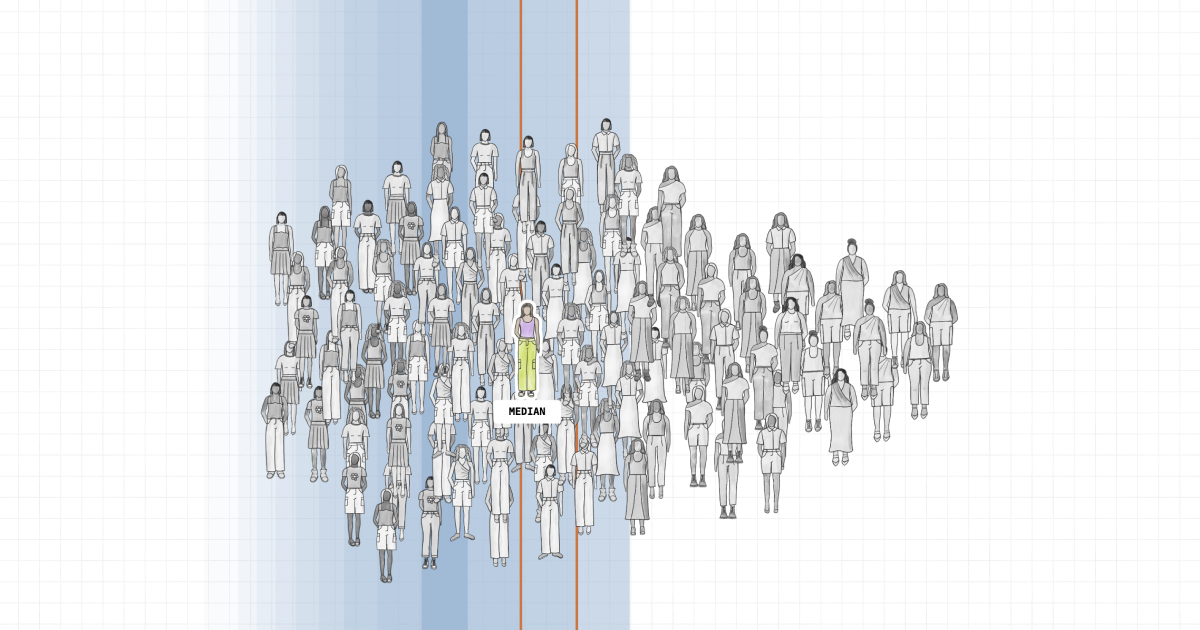
I heard my sister say “Yeah I usually wear a double zero” and it was at that moment I realized there is absolutely no regulation of women’s clothing, only chaos.
Yep. When I heard that a friend wore a double zero my first thought was “so she’s two dimensional?”
When that size system first started being used, size zero would have been for a newborn infant. Actually, size 0 didn’t even exist then.
There are no sizes, only Zuul
Women’s clothing is a nightmare and every time I must interact with it makes me want to throw all clothing into the ocean and demand sackcloth for coverings.
As a father with a tween daughter, I second this motion. “Fashion” will mean tying a cord around the waist.
It’s been like a decade since I’ve learned of this but I am still shocked that pockets are so rare for women pants. I’m probably being naive but wouldn’t a company that made women’s pants with pockets just blow up? I just think pockets are so insanely useful.
I’m not gonna complain about most men’s clothes being cut for fat people anymore.
I’m still gonna complain. Ive got a L that fits perfectly and a XXXL that makes me look like Harold from Hey Arnold. Lucky for me my gender doesnt store such personal worth in size like that.

And I’m going to complain that since society is appallingly obese, now I, with an athletic body, can’t find convenient clothes. Box stores like Costco don’t even stock sizes under 38 in my region. That’s fatso size and I need 32’s. I’m 6 foot 2.
E: downvoting me doesnt make you not obese, nor does it undermine my statement.
I know right? Even if they have a size that is close to you the cut makes it so either you have to pick something that is baggy at the waist, or something that is so tight at the shoulders you can’t even raise your arms.
I’m a man with nearly an hourglass figure. The odd time i wear even a slimfit dress shirt it looks like a wingsuit on me.
Didnt pay enough attention to the actual information, because its too indepth for a topic I’m not really interested in, but it was a pretty neat experience. Very well presented.
Post more stuff like this that you find please id love to see something I’m interested in
The size range of most adult women’s clothes was once referred to as “misses” sizes, as in “young misses”. So a size 12 (before vanity sizing existed) was actually intended to fit an average 12 year old and the size numbers referred to the approximate age of teen that could be usually be expected to wear it. There was no size 0 back then, misses clothing usually went from 12 up to 20, although the range sometimes started at 10. After that, a woman moved into “woman’s” sizing and the next number up was 40.
“Vanity” sizing started to appear in about the mid 80s and every manufacturer had their own idea of what a size 12 was supposed to be. This is when I first noticed that off the rack sizes no longer matched up with sewing pattern sizes.
Here’s an example of a sewing pattern size chart from the 1950s. All the pattern companies used standard sizing, with minor variations.

One thing i found interesting is that as much as the manufacturers of clothing shifted the clothing sizes, average waist sizes still increased more than the clothing sizes did. IMO this highlights that the problem isn’t just their marketing but the food, diet, and overall health of the community impacts it as well. The medium size was supposed to reflect the median waist size, if waists are increasing, the measurements have to increase as well to maintain that status quo.
I have anecdotal evidence that similar trends sometimes happens to male clothing. I typically fit a medium pair of track pants perfectly. My parents bought me some track pants from costco, they got small and medium because they didn’t know my size. The small pair fits as if it were a large. My theory is the average costco male is a middle aged dad type, by making their sizes ridiculously big they can go home a feel good about fitting the medium pair instead of the large they typically wear.
Maybe , but as I’ve settled into my dad bod, I’ve found that the bigger issue is a different shape, somewhat like women’s clothes. I definitely have more sympathy for them. It’s great that men usually only need to care about waist size and inseam size, but now the same waist size may be big or small depending on the rise, same with inseam. I definitely need to shop by brand that fits, and assume the numbered sizes are still actual measurements.
That being said, for lettered sizes, I’ve definitely turned to brands that are larger. I usually buy Carhardt t-shirts because I can wear an xL-T (and they have tall sizes!) when another brand is needed a 2x or 3x, then I’d go up a size if they don’t have tall.
For me the Costco question is easy: they never have tall sizes.
Oh trust me I’m under no illusion that I’m anything other than a fat blob.
We’re taller now.
Most of the excess in the pants was in the waist/thighs area. There wasn’t much of a big difference in pant length between the pairs. Its also possible the sizes ran big and costco got a good deal on them, as a male, im just not used to such a wide swing in sizes.
Or since there’s nowhere to try on clothes before you buy them in a costco, middle-aged dad bods would be disappointed that the Costco clothes they bought are too big for them. Then they’ll have to go back and make an exchange or return. All that trouble might make them forget how good they might have felt for a fraction of a second when size large was too big for them.
I got news for you, most men wouldn’t use the dressing room anyway. They’ll hold those pants against the ones they are wearing and decide from there.
I bring a tape measure and measure width and inseam.
Thanks for sharing! I cross posted it to !dataisbeautiful@mander.xyz
I find it interesting that this article focussed on waist size as the issue. I mean I assume they know what they’re talking about since I know nothing about women’s clothing but I had always assumed the body shape thing at the end was the most important problem
My read was that waist size is the issue because the manufacturers have made it the issue. The idea you can derive the other dimensions as a function of waist size is clearly an assumption that has a limited range of validity, and there hasn’t been a broader effort to come up with something better.
Good to know I wasn’t being irrationally angry, but exactly as rationally angry as I should’ve been
Slim male teens (i was one, i actually am still a teen (a tiny demographic on lemmy it seems) and slim, but nonbinary now (but that doesn’t actually affect my clothes sizing, as i have not done any biological transitioning yet)) have the inverse of this issue: trousers tend to be too big at the waist and hips if you’re slim, so almost all options are either too wide or too short. Seems like these big brands are pretty damn stupid (and evil) and only consider median people (by designing everything for them only) and fat people (by labeling fat people stuff as not fat people stuff in order to manipulate fat people into seeing their brand positively).
also the way this page presents information reminds me of Create mod’s Ponder feature
It seems like the sizes have stuck with a normal BMI assumption where that’s not the case anymore and most people are overweight so can’t find clothes that fit them well without going into plus-sized clothing (which is less fashionable of course).
You didn’t read the article and directly went to blaming women for being fat and vain when it’s always been about maximizing profits at the expense of women’s comfort.
The same phenomenon exists in the bra industry, where women are binned into a narrow distribution of ill-fitting sizes. Bras are a medical necessity for many women and poorly fitted ones often contribute to back pain, sores, inflammation, aggravates HS, and more. Yet scummy companies like Victoria’s secret have pushed as many customers into 36C as they can to cut manuf costs.
If you read the article its actually a bit of both clothing manufacturers and increasing waistlines. Clothing sizes increased about 2.5" while waist sizes increased by 4". Its an issue of the clothing manipulating sizes to sell more clothing and the effects of modern processed foods and diets coming together. Clothing gets harder to sell as the size increases so they bump up the sizes to try to keep up with increasing wasitlines without shifting their sale strategy status quo too much.
The major flaw in this argument is that the size increase of clothing is compared between 1995 and 2021.
If you look at the distributions comparing women’s sizes between the ages of 15 and under, 20-30 years, and 30+ years old, you’ll notice that women naturally gain weight as they age.
At the same time, the market share of fast fashion has grown by over $100 billion in this time span. Currently, women in the 30+ cohort have the most purchasing power. This means that older women are able to buy more clothes, and older women tend to weigh more.
Clothing sizes for women are not standardized like they are for men. You don’t get to walk in and pick a 33x34 and leave. Women have to try a spread of 3-5 sizes, because every company has its own size, and women’s waistlines can vary up to 5"+ because frequently bloat due to periods. Add in the fact that women’s waist lines naturally slowly go up as they age, and you get the impossible task of knowing exactly what your size is when everything is conspiring to make is as difficult as possible.
The first comment assumes that women are choosing smaller sizes out of vanity, when in reality it’s because it’s impossible to know what your size is due to non-standard sizing and the fact that you need to estimate how your fit will be when you’re not bloating, and your size on an average day creeps up as you age.
Companies are quietly taking advantage of this because a woman will not suspect much if she wore a size 8 in her 20s and wore a size 10 in her 30s, when the reality is that her size 10 is actually a size 12 by former standards.