- cross-posted to:
- greentext@lemmy.ml
- cross-posted to:
- greentext@lemmy.ml
You must log in or # to comment.
deleted by creator
Classic: https://www.youtube.com/shorts/0dKrUE_O0VE
The Katy cost a mere $7 billion and it’s still often a glorified parking lot. It’s got less throughput than a single train for moving people, but I’m sure adding another lane will fix it. https://www.youtube.com/shorts/o-F-7Yc-A8U
Love this reply
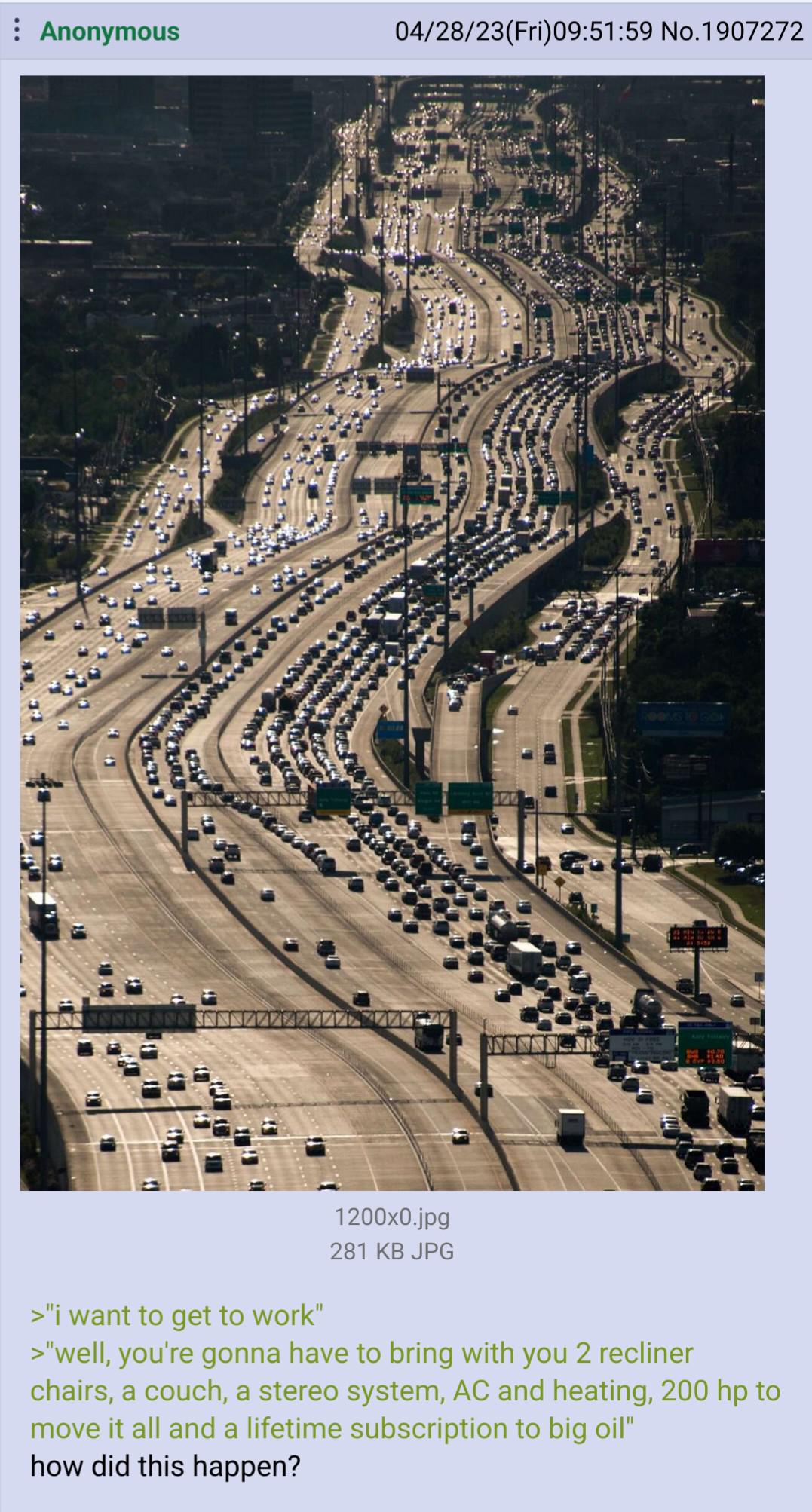
I used to just think of this as yeah sure things are just bigger in America, it’s a huge place with lots of people… but then I realized that the cities with ridiculous numbers of lanes like this aren’t any bigger than cities in the rest of the world. Houston (pictured) isn’t even in the Top 200 biggest world cities.
I’ve looked it up and the Katy Freeway on the picture has an average of 219 000 vehiclra using it per day. Let’s be very generous and assume an average of 1.5 person in each car, so around 329 000 people are moved each day thanks to this highway.
A single metro line or two tramway line moves more people per day than that.
Its crazy. At its widest it has 26 lanes. It amazes me that they just kept widening it, instead of thinking “We’ve added 5 lanes, we should probably find an alternative solution”.
In the city where that exists, they really isn’t much else that’s viable. Decades of bad urban planning mean that comprehensive public transportation is not cost-effective in that area. And “not cost-effective” doesn’t just mean “expensive”, it means “would cost an order of magnitude more than the city budget”. So the only real solution for them in the short term is to build the world’s most ridiculous laughingstock of a road.
Key phrase being “short term” - nobody seems to build with a 20+ year plan to improve the city in America, whereas in European cities every time I visit one I haven’t been to in a decade, I usually notice I’m reaping the benefits of major infrastructure improvements which take decades to plan and build. Short term, selfish (what will get me elected again, or what will pay me the biggest bonus) thinking, and corruption, is what keeps American cities shitty
Yep, just look at Tokyo.
people argue that japan has an easier time doing public transport because it’s a slim island that’s roughly linear from north to south, so it’s easy to serve it by one public transport line.
But the same is true for the US, where most people live either on the east coast or on the west coast. You basically have two slim, linear areas that can be served by 1 line of public transport each.
It’s even worse in Canada where 50% of the population literally lives in a straight line in Ontario/Quebec
And we’ve been “studying” high speed rail in that corridor for roughly 40 years now. One of these days we’ll build it, I swear!
I think the big problem with Canada, the US, the UK, and other former British colonies is that the legal system gives private property owners a lot of rights.
In places like France or China the government can just say “we’re building this” without a lot of public input. But the second CA put out their high speed rail proposal it was met with hundreds of lawsuits over eminent domain.
Another problem is that the US has stupidly strong private property rights. Everyone whose land is going to need to be confiscated to build the railroad tracks will try to bilk the high-speed rail authority out of every dollar they can, and because the US has a very strong civil court system which strict procedural law, it only costs a landowner a few thousand dollars to cause millions of dollars worth of legal headaches for the rail authority
isn’t that also true for highways?
The difference is that most highways were built in the past before such things like environmental studies were required and before many of the attack vectors used by property owners and other obstructionist parties to block construction were discovered or created. The US no longer builds major roadways, and merely widens existing ones, which in many cases do not require more land to be requisitioned.
interesting. here’s a short reminder that railway tracks existed before highways (even before combustion engines in general). it’s sad that they were neglected so much. maybe they can be built directly adjacent to existing highways? at least along the coastlines …
This idea has been adopted to some degree. The Brightline West high-speed rail project (in construction since 2024, planned to open 2028) connecting Las Vegas with Los Angeles uses existing land along the existing I-15 expressway, which is extremely congested.
I believe it was during the presidency of Ronald Reagan that private rail operators were relieved of service requirements for passenger trains, as long as the companies maintained the tracks and gave priority to passenger trains operated by Amtrak, the American state rail operator.
The companies have completely neglected the tracks and many are in poor condition from heavy use by freight trains, and as a result, maximum speeds have been drastically lowered to maintain a level of safety. Many ordinary trains in the US run at around 80-90 km/h, which is miserably slow.
In addition, Amtrak trains are supposed to be able to overtake slower freight trains by using splits in the track (where a section of track splits into two temporarily, the slower train taking one side and the faster train taking the other to pass it). However, as freight rail operators have realised, the number of engineers and conductors needed to run the trains is directly proportional to the number of locomotives, and thus they prefer running fewer, longer, trains than many shorter ones. As a result, freight trains are unbelievably long, some are a good few kilometres in length, which is longer than the entire sections of split track, making such sections worthless as it is impossible to use them to bypass the slower trains.
Where Amtrak has complete control of the tracks, such as in the northeast, service is comparable to European rail providers. For example the Acela service, which runs between Washington (DC) and Boston with stops at Baltimore, New York City, and Philadelphia. There are 20 trains per day and it reaches a top speed of around 250 km/h. The total journey takes 6.75 hours and travels 735 km (12 stops) meaning the average speed is a comfortable 109 km/h.
It’s sprawl. Building up costs too much via some combination of building taxes, NIMBYs, and construction overhead, so people build out instead. Building out means more and more miles of infrastructure (Roads, water, electric, natural gas, signs, gas stations, etc., etc.) per capita.
Then when the people in the sprawled-out suburbs want to visit the city centers anyway, because that’s where jobs and shopping inevitably are (People live where people live), they have to build massive roads to get in and out.
I have never been on a road like the one in the picture.
I’d have a nervous breakdown.
“Can I sit in the recliner at work?”
“No. You have to leave it outside so that poor people can’t have apartments there.”
Unless you’re poor, then it’s also your apartment
But don’t let us catch you using it as one, that’s illegal.
How did this happen?
Convenience and Capitalism, what a wild duet!
And it’s not even convenient…unless you purposefully destroy existing infrastructure and aggressively promote individualism in your society such that nobody has any other real choice! Walking distance? Never heard of her.
Well now it’s fascism
I mean, the answer is in the line right above the question.
It’s the bike lanes! 😡 /s
STAY IN THE BIKE LANE !!
Linking the page for my favorite hair pulling topic on traffic: https://en.m.wikipedia.org/wiki/Induced_demand
By hyper subsidizing car road infrastructure we make it almost impossible to use anything else and competing infrastructure (trains, planes, seperated bus traffic) appears more expensive by contrast forcing more people to use cars.
Also the plot of Who Framed Roger Rabbit (1988) if I recall correctly.
Fascinating! Seems I have to thank the artists of my past for my supplemental progressive education.
Modern American society, mind you

Even though the USA is clearly the worst, still almost all countries have about twice as many people driving as taking other forms of transit, and in many more, the majority. So the image applies to the majority of people in most countries.
Even the Netherlands. poster child of biking 😔
I mean, 40% of the population biking to work is nothing to sneeze at, compared to the US’s 6-or-so %
It’s huge, but it’s still fewer bicyclists than car users. But, at 40% it means that bicyclists have a stake in every decision being made, and people will listen to them. Car drivers will probably still win more than their fair share of contests, but at least they’re not unopposed.
And for most of the countries that don’t have a lot of cars, it’s not because they’ve decided to invest in public transit and bike lanes, it’s that people are poor and can’t yet afford cars. Like, India and Brazil aren’t places where people love public transit, they’re poor.
What happened to China is likely going to happen to them as they get richer. Even if the world switches over to electric vehicles that’s still vast resources plowed into massively inefficient sofas on wheels.
Very anecdotal so feel free to disregard, but I’ve traveled across the whole Europe and haven’t seen anything like that in the picture.
Maybe the closest thing was a toll gateway somewhere in France where road widened up to about 20 booths. But then it immediately narrowed back to three.
If you add up the India bars, you’re quite far away from 100 % still… Mass NEET is the answer I guess.
Or mass feet.
American society is 99% in on it, but many other places are trying to go there too.
We’re mostly going the other way in Western Europe
Not particularly quickly in most places, mind, but we’re heading in the right direction on that at least
Everybody wants a back yard, nobody wants buses or trains
I don’t want a back yard. What I want is the noise isolation and the feeling of safety and personal space. I also like having the ability to use that space for personal projects if I want to.
I have seen condos and other urban spaces that are well-built enough to provide the same benefits that I see from a back yard. But they’re very expensive.
My basic point is that people sometimes forget what they really want, and instead focus on something that has given them those benefits.
I wouldn’t mind living in an apartment building, so long as it’s equally co-owned by the people who live in it, and by nobody who doesn’t. And that it has a green space on the property for recreation and a community garden.
I don’t want a backyard, I want a park within walking distance.
I don’t want an expensive hunk of steel and plastic, I want a train that picks up every ten minutes.
I know a large number of people who feel the same way. But none of them have billions of dollars to lobby my mayor or governor or President. Hell, even when we do get a bit of outright bribery to bend things our way, a single petty asshole can foul the whole project.
I have both (not so much on the train front unfortunately).
That’s a lot of lanes. I’ve never been anywhere more than like, 10 wide and that’s counting both ways, and that’s in the city.
I hear if they just added one more all problems would be solved.
Looks like Houston TX to me. Horrible experience there, they are allergic to public transportation and sidewalks.
I once had to visit a client in Dallas and noticed their office was right next to a hotel, so I booked myself in there expecting to be able to just cross the relatively small side road on foot. NOPE.
Even doing it in the car was close to a half mile round trip if I followed all the rules of the road.
With all those luxuries, why not just live in this thing and avoid rent?
Many people do sadly
I’m happy to never see wherever the fuck that is.
Houston
What if we made two separate sections that you could add or remove? Even better, let’s add a special vehicle to the front, with a trained driver. To aid the driver; rails. Oh, more people want to join? Let’s add a hitch system to the front and back of each “car” so we can add as many as we want.
Why did my brain go to motorcycle sidecar when you said a separate section you can remove? But yeah trains are the correct solution, this is coming from someone who loves his 01 Tacoma.
Yo, not bad.
Check it; double rail… side by side connectable trains. Somehow.
Modern designs are too limited. Make a 20 foot separation between the rails, giant 4x4 train.
That was actually a thing the Germans did on a few occasions, if memory serves they had to link the tow trains for the Gustav Railway Gun. I think it’s also been done on occasion for smaller locomotives to move overloaded cars.
When you look at old cars, they were simple. Small, just enough power to get around. SUVs are monstrosities that shouldn’t exist.
Old car:

Hey found the guy that can point out the exceptions. How hard can I roll my eyes.
That’s rich coming from you.
Don’t follow, can you explain? Are you stalking me? This is the second strange message I got from you today.
I got your back, bro. I went through his history and pasted that same response to one of his random comments.
How is that picture 1200x0, but I can see it?
Edit:oh wait they just named it that. I’m not always smart.
Hey at least you also wind up doing your job mostly over the Internet with people that aren’t anywhere near your office when you get there.