

Fear Mongering About Range Anxiety Has To Stop — CT Governor Calls Out EV Opponents::Several state governors are fighting fear mongering as they attempt to reduce transportation emissions in their states.
I’ve had an EV for 9 months now and I’ve actually experienced far less range anxiety with my EV than with my previous ICEs. This is due to the fact that because I can charge overnight in my garage I almost never leave home without a full battery. Versus before with my ICEs where I’d often be driving across town on fumes because I’d forgotten to fuel up the night before.
I drive in the city/urban areas the vast majority of the time so 200+ miles of range is plenty for my day-to-day needs. I’ve honestly never run into a situation where I’ve been worried about running out of juice; I rarely even get below 50%.
As for longer drives, I’ve done several 600+ mile road trips without issue. Sure, charging takes a bit longer than fueling up at a gas station but the opportunity to stretch my legs, rest in the car, or get a bite to eat does wonders for reducing road fatigue. As for finding charging stations, I’d recommend planning your route beforehand but the charging network is dense enough in my region to where I can usually choose to skip a station if it’s too busy and try the next one.
Yup, this is the part people seem unable to wrap their heads around. Waking up with a full battery every morning and never needing to play the whole “I probably have enough to make it to work and back” game is insanely liberating.
This has been my experience too, I’ve put 90k on my EV in the past 2 years. I’ve never experienced range anxiety, and I live in Australia which is a similar size to USA and we do regular road road trips of 5 plus hours.
Road trips in EVs are actully more chill because the car informs you where and when to charg and you never wait more than 30 mins to complete a charge, which frankly is how long you should be resting between 3 hour driving stints anyway. Evs actually discourage driver fatigue which has to be a plus no one mentions too.
Every single range anxiety issue I’ve read about has been from a person who almost certainly doesn’t own, and hasn’t driven an EV or has some weird preserve petrol agenda.
Where I used to live and work near Hartford range anxiety wouldn’t be an issue. Where I now live and work in Oklahoma it still is an extremely big issue. A friend in CO with an EV wanted to come visit but couldn’t make the drive in one day due to charging options. Hell, if I want to go on a 4 hour drive to Amarillo I need to carefully plan my fuel stops because there’s hundred mile stretches where I can’t even fill up my Ford Focus, let alone charge a Tesla. Range anxiety is a legitimate concern for much of the country.
For much of the country in terms of land maybe, but not in terms of people. Most people live in or near high population areas where using an EV is fine. The person in question saying that fear mongering needs to stop was the governor of Connecticut. Connecticut is not Oklahoma. There is zero reason to fear monger range anxiety in Connecticut.
But even for people in places like Oklahoma, there’s a couple things you should consider. First is, don’t rush out and buy an EV just because you feel like you’re being told to. Only buy an EV once your existing vehicle is no longer viable. Buying a new car when your old one still works is not very green. But definitely consider an EV when the time comes, even if you have range anxiety. Why? For one, the money you will save on gas can allow you to rent a gas car for those long trips you need to make and then you don’t have to put those extra miles on your own car. Remember, tires are expensive and wear down with miles driven. Or, with the money saved from gas, you could take a bus, a train, or possibly even an airplane. Or if you really don’t want to do any of that, you could probably find a buddy who still has a gas car and trade for the week. Just because you buy an electric vehicle, doesn’t mean you are now locked out of ever using a different kind of transportation. But number 2? Over the coming years, EV infrastructure will be constantly increasing. Yeah, some states are being regressive at the moment, but they will turn around. So even in places were range anxiety is legitimate, it won’t be a problem for much longer, except in those edge cases where even a gas car currently has issues, but since even a gas car has issues, it doesn’t make a difference. And third? There are so many companies working on battery tech right now, it’s crazy. Some are working on higher energy density so we can get longer range, others are working on better materials so we can stop using unethically acquired minerals, some are working on making batteries that function better in the cold. None of this helps the car you buy today, but it will help the car you buy in 5 years.
There’s a reason I specifically opened with how in CT it isn’t an issue before explaining that in the majority of the country (notice I said country vs the population) it still is. Like the CT governor you still seem to not quite grasp the reality of what it is like to live somewhere other than a built up urban area. There are no buses here, there are no trains here. If I wanted to rent a gas car, I need to drive 120 miles to the city because there isn’t a rental option in my town (which actually qualifies as a “city”. It’s an hour drive to the nearest movie theater. While NYC alone has more people than the entire state of OK, there are still millions of people living here that simply can’t get by with an EV for day to day lives, let alone if they want to make a trip by any transportation method. Add in the fact that even with current developments and proposals battery energy density is a hard limit of physics and chemistry, unless a completely new method of energy storage is invented it will always be 1/100th of what gasoline has meaning EVs will continue to be absurdly overweight. Don’t worry, I’m not in a rush to sell any of my ICE vehicles, at this point I might literally hold onto them forever because there isn’t a single car being made new right now that I like better than anything I currently own.
some states like Tennessee have removed EV infrastructure the charging stations
how is range not an issue
In your example it sounds more like Tennessee is the issue, not range anxiety. If they were to remove all gasoline infrastructure suddenly ICE range anxiety would be a major issue? No, it is the people removing the infrastructure.
From what I read online, Tennessee anxiety ought to be much more widespread than it seems to be.
There’s no fear mongering about it! I’m anxious about the range of an electric car and not having a quick and convenient way to refuel if I near empty.
Honestly, track how far you normally drive and you’ll see you don’t go that far. My PHEV has a paltry 26 mile range and we use electric only 90% of the time. An EV with 200+ miles wouldn’t be an issue unless you travel for work.
People really like to overestimate how much range they actually need on a daily basis.
I drive maybe 200 miles a week. Almost all EVs could easily get that range in spring/fall. And even in the worst of winter as long as I have 120 volts to keep the battery warm I’ll make it through the week no problem.
Honestly big fast charger networks aren’t the biggest hurdle. We need basic 120v or 240v outlets ran to every apartment/town homes parking spot. With essentially a trickle from 120v you’ll be fine for 90% of your driving needs.
I don’t think the issue is the daily basis. It’s the few long trips people take yearly that would blast that 200 mile range out. People don’t want to buy a very expensive new car that they know won’t work for them several times a year. It’s the same reason people who tow something several times a year make sure their vehicle can tow that.
Because renting a vehicle for a trip or to tow is actually a PITA and expensive.
It’s a hell of a lot cheaper to buy an EV with a range/capacity lower than what you need 5% of the time, and spending $40 to rent a truck/$100 to rent a car for a trip than it is to buy some ridiculously oversized battery. Sure 5% of the time it’s useful, but getting a rental isn’t that bad.
Plus with a rental you can pick the exact type of car suits the trip well. I took a V6 camaro on a road trip for thanksgiving and that thing gets almost 30 mpg doing 80+ on the highway. Vs if I had my one size fits all Outback for that trip I’d be getting 25 doing only 70, and in the low 20s at 80 if I’m lucky.
I don’t know where you live so I can’t talk to your experience, but where I live, if I want to rent a car for a week trip I’m driving at least 30 minutes one way, spending an hour getting the car, and paying about $1,000. If I want to rent a truck for towing (we tried this for like a year, for ~3 uses that year) we have to drive 45 minutes, it seems to take them about 2 hours to do the paperwork if we’re lucky - we’ve waited 4 hours or more before, and we paid $350 for a weekend because they couldn’t rent it for one day for Saturday because they were closed on Sunday, but charged for that day anyway. Then we got to spend another 1.5 hours driving there and back again to drop it off, 40 minutes doing paperwork.
This is a plausible PITA, stress and annoyance once every 5 years or so, but for multiple times a year, plus all the “we just WILL NOT use a truck and make due with a less suited tow vehicle and light trailer” which is more like 12 times a year, we broke down and bought a used truck.
You see - people don’t buy cars just for dollars and cents, they also buy it for value, and in a lot of cases, that’s paying slightly more for the ease and convenience of jumping into said car and doing what they need to do right now, rather than with days of planning.
I know some folks that just made a cross country trip in a Tesla model Y. They don’t do huge distances every day so it took a couple of weeks but they made it just fine. They did note that the South was really bad for chargers. Something about some state legislatures or municipalities actually passing laws against public charging or something like that. It sounded pretty southern and believable though.
If I had Tesla Y money, I’d get an RV for a slow cross country road trip. Save on hotels. I’m talking about trips where you want to get to your destination, yet don’t really want the added expense, hassle, and limits of flying (and probably renting a car at the other end). This mostly has to do if you have 3 or more people on the trip, if you’re just one person who can avoid renting the car on the other end somehow, it doesn’t apply.
They did have one but got rid of it because they didn’t want the hassle. They are olds and are more about convenience at this point.
Yeah, I’ve been looking into possibly getting an EV and apart from renting in a place without anywhere to charge making it a nonstarter, another problem is that a routine trip like to my parents’ and back is like 250 miles with nowhere to charge. Giving a bit of wiggle room for degrading batteries, doing anything other than making a straight line for their house that day, and random other inefficiencies, only the 300+ mile models are doable, maybe. I don’t know how much to tack on for winter range loss. And we have very modest needs for our region, most of my family makes trips that long or more at least once or twice a week.
I understand that it’s probably frustrating for people who get by well enough with an EV to see people who live similar lifestyles to them overestimate what they need, but in much of America at least there’s a lot of people who have to drive hours and hours to get anywhere. Our needs are very real, not the result of fear mongering.
For my part, I’m currently thinking we’ll just get ourselves some used shit from the late 90s to avoid the privacy hellscape of new cars and do our part environmentally by just using it as little as possible.
I will wait in line for cheap gas at Costco a hundred times before I have to stop and charge for 30 minutes on my annual road trip.
/s
I have no idea what this has to do with towing or long road trips, but my personal experience is it’s usually pull up to gas station, pull up to pump, start pumping. I very rarely have waited in line anywhere. Even when I have, it’s like 5 minutes maybe. Do you claim there aren’t ever lines at charging stations, and there won’t be lines in the future as more people want to use them?
I charge at home. I never need to go out of my way or really even think about fuel/charge level. Every day I wake up with a full tank. It’s always the same price (cheap), so there’s no need to shop around.
I know not everyone can charge at home, but at least half of America can, and it’s a convenience that is seldom mentioned in discussions of “range anxiety.”
I’ll just repost the parent post to show how irrelevant this is to this specific thread:
I don’t think the issue is the daily basis. It’s the few long trips people take yearly that would blast that 200 mile range out. People don’t want to buy a very expensive new car that they know won’t work for them several times a year. It’s the same reason people who tow something several times a year make sure their vehicle can tow that.
Because renting a vehicle for a trip or to tow is actually a PITA and expensive.
I love it when ev drivers act like the rest of us are just fucking stupid.
Even when you plan ahead on a road trip there’s a pretty high chance half the chargers are down and there’s a queue of cars waiting. Made it to the next stop on my last trip with 4 miles to spare. That was a nerve-wracking drive.
Now I gotta check plug share to see recent reviews on stations and decide whether or not to take my ev.
I’m still new to EVs but with the convenience of charging from home, my battery is just never low. Think of it like charging your phone: start every morning with a full charge and you just don’t have to worry about it
(Actually have mine set to stop charging at 80% and I don’t drive much at the moment so don’t plug-in every night)
It’s really the time to refuel. I can plan out spots to charge on a long drive, but if I have to wait that long, I can’t just refuel quickly if I forgot to plug it in last night.
Sounds like you are fear mongering.
From TFA:
While 76% of future EV owners worry about range, nearly 59% of current EV drivers report none.
So 41% of EV drivers worry about it? That’s an issue! I’m guessing only 5-10% of ice drivers every worry about running out of gas.
What you’re not addressing is that current EV drivers change how they drive, i.e. don’t go on the same sort of trips the same way (if the various articles on that site are to be believed). This isn’t addressing range anxiety, it’s saying plan your trips around charging your car so we work around the problem. And the problem isn’t “range” now - it’s where are the fast chargers? It’s getting better, but it’s still hard enough to pull off that there are regular youtube and news articles about the hassles and issues doing a road trip in an EV. No one does the same sort of reporting on ICE because you can find gas stations just about everywhere every 5-10 miles just about anywhere you go, and where it isn’t there is some reporting of the signs saying “last gas for 100 miles” or whatever. People know they can find a gas station, even if they’re going into a rural area.
As someone who has been driving an EV for several years now, it really is nuts hearing people on the internet constantly repeat the same three or four stupid talking points that people with first hand experience have been rebutting for the better part of a decade at this point.
I have owned an EV for a couple years. Range is constantly on my mind. Did we charge it last night? Crap, we had a 70% charge and need to go across town. If we end up running side errands, we may be cutting it close" etc
Far more mental overhead than the combustion engine car we also use.
I ultimately like the EV, but don’t pretend that it’s biggest draw back shouldn’t be a point of discussion anymore.
This is how I feel about the EV range…on my PHEV. We get 40 miles max (30 in the winter) in full EV mode, and so we stress about whether we can get through our daily trips on the battery. (Of course, when our relatively small battery runs out we just use gas.)
But if we had the range that modern full EVs have I cannot imagine having range anxiety on an average day.
Are there no (or few) DC fast chargers in your city? In your described situation, I’d have no problem pulling into any number of DC fast chargers for 5 minutes to put $1.75 of kw into the car to give me plenty of charge for peace of mind.
They are pretty far inbetween, but they do exist. Definitely going out of your way to get to one
Time commitment just to get to one, time commitment to charge, time commitment to get back on track to where you were going.
There’s plenty of places and points of time that this would be a big enough of an issue for people to push them away.
However, I think people should heavily consider one especially if they’re just going in and around town and have the luxury of being able to install a charger at their home/place of residence.
As far as I know there are no EV chargers in my city, but I live in a rural town with a low population. According to google the nearest charger to me is 20 miles away in the next town over.
If you can forgive how ad heavy it is, you could check Plugshare.com. You might be pleasantly surprised.
Yes, if you cannot charge at home or work, your experience will differ significantly from mine. But if you can, it’s a game changer. I feel like this qualification is implied at this point. If everyone with a private driveway and a normal commute went EV, the infrastructure for people in apartments would fall into place as well.
More or less exactly how every major political issue works: people with no or extremely limited personal experience repeating things they’ve been told by someone in their tribe.
Universal_healthcare has entered the chat.
How about trains? Americans are too used to their cars for those long-range trips. Make them unnecessary. Build out the infrastructure. Have your car for local trips, switch to trains for anything else.
The Biden administration is working on improving train infrastructure but if you look at the map of what they’re adding, it’s limited to a very small section of the country. I mean, it’s like cross country but it’s such a massive country that it’s still super limited.
funny how biden said rail workers are not allowed to protest and ask for higher wages and better worker rights in general then bam comes out with expanding train infrastructure
someone is definitely looking out for his actual constituents
Corporations are people too. Please think of the bottom line and its feelings would ya
Here’s the summary for the wikipedia article you mentioned in your comment:
Corporate personhood or juridical personality is the legal notion that a juridical person such as a corporation, separately from its associated human beings (like owners, managers, or employees), has at least some of the legal rights and responsibilities enjoyed by natural persons. In most countries, a corporation has the same rights as a natural person to hold property, enter into contracts, and to sue or be sued. Granting non-human entities personhood is a Western concept applied to corporations.
Ideally I’d like trains for local trips and high speed rail for longer distances. I’d prefer to not own or use a car at all but most cities would have to be torn down and rebuilt to achieve this.
but most cities would have to be torn down and rebuilt to achieve this.
We did it once, we can do it again!
I don’t disagree but I also don’t think it will be something that can be done very quickly. While switching propulsion systems in cars can be fine till the time that they are not needed.
Same, but tearing down and rebuilding cities is a feature, not a bug. Well, except for the carbon emissions involved in doing that.
I read the article and clicked through their own reporting on range anxiety: https://cleantechnica.com/2023/07/16/is-range-anxiety-really-worth-all-the-angst/
According to data from the US Department of Transportation, 95.1% of trips taken in personal vehicles are less than 31 miles; almost 60% of all trips are less than 6 miles. In total, the average US driver only covers about 37 miles per day.
it seems to me that this screams out for better shared transportation - If I’m going less than 6 miles, I’d much prefer an Uber or easy subway ride or the like to owning a car at all. However, that’s something government would actually have to fund and do something rather than just passing rules on to other people to make happen.
That minor rant aside - I still maintain that the 37 miles per day is a commute and going out to lunch. If we actually wanted to have people change habits in a really useful way - it’d be to start incentivising / mandating telework where possible - stop all the unnecessary car traffic of any kind. You know what’s more environmentally friendly than ZEV vehicles? No vehicle (use).
That all said - most people I know buy vehicles to solve as close to 100% of their needs, not 95.1% - because vehicles are so expensive. The range anxiety haven’t been about the daily commute for like a decade - even the 87 mile leaf did that fine and most anyone I’ve ever talked to was perfectly OK if they had the leaf JUST to drive to work and back in the summer / nice weather. Very few people buy a car like that though, because they need to get through bad weather or carry more stuff or people or tow or …
And then there’s the all american road trip. Roughly once a month I go 180 miles one way on a quick trip to see family. They don’t have a car charger setup anywhere. I’m not at all sure if they can run an extension cord out, but then I’m on slow charging, and I also drive around while I’m there (unless I asked to use their car for all trips). I’m usually there for a couple days and come back. I have to get gas on each trip. This is not in reality if I had a leaf. If I had a more expensive car it’s do-able, but I still would be anxious till there’s more “top up” points. I go by probably 20 gas stations I notice on the trip, and there’s probably 100+ more within 2-3 miles from the route I take. I know of one charging station.
They have an answer in the article
Plan your route: PlugShare and other apps allow you to determine where chargers are located along your intended route as well as details like the hours they’re open, the cost to charge, whether it’s a public or private facility, and user reviews. It reminds me of childhood trips we took when my parents used Trip Ticks from AAA to determine best roads and attractions. Being organized makes any trip more pleasant, and being aware of possible charging stops ahead creates a sense of calm in you and your passengers.
Yes - plan you trip around your car. I mean, sure, but harkening back to needing Trip Ticks like in the early 1990s isn’t exactly a “towards the future” sort of vibe. And they’re right - a lot of it is vibe.
Limit your use of air conditioning or heat when possible: So be uncomfortable… I never think about turning on aircon or heat in my ICE car. This is a stupid “fix a perceived problem” statement.
Plan errands to intersect with available chargers Again, live your life around your car - this just is absurd. If I’m planning errands around my transportation, I ought to be able to use public transport and get better returns for the hassle - but I can’t because our public transport is shit, and also it’s probably not feasible in the vast rural areas of the US.
Stay calm, breathe deeply: According to research in the Journal of Advanced Transportation, range voltage depends on a variety of factors, including emotional type, age, and driving experience, and these factors may influence how susceptible you are to range anxiety.
Yes, get some therapy and Xanax and you too can love the EV.
Ok, but ranting about the sheer stupidity and patronizing nature of the article around range anxiety over - back to the road trip. Many people like to drive to their vacations to save money, especially if they have 3+ people going and would have to also rent a car at the other end of a flight. My next trip is a 900 mile trip over 2 days. With ICE I literally just put it in my GPS and go - no issues because I can stop and get gas ANYWHERE. We’re just NOT THERE yet with chargers, and even with superchargers, we’re talking going from a 10 minute break to get gas, grab a snack and use the restroom to more like 30 minutes waiting for the car. I don’t have issues with planning lunch or dinner around that, IF I could be sure there was a super charger where it makes sense to break.
The thing that’s stupid is it’s not “range anxiety” really, I have to worry about getting gas and finding a gas station. We just have gas stations already built out and getting gas is a 5 minute process to get another 360+ miles of range. If the charging was close to that to add 360+ miles of range, no one would blink an eye, but instead, it’s 30 minutes to add maybe 100 miles of range - which leads to making trips take much longer in many cases. The other anxiety inducing thing is if you run out of gas, AAA can bring you 2 gallons to get you to a station. I haven’t heard about the equivalent for EVs yet.
The important thing is - talking down to people isn’t going to get them to listen to you. Telling people they shouldn’t worry about their yearly or more often road trips because normally they’re driving to work and back isn’t a great sales pitch really. If I have to rent an ICE car 2 times a year for a road trip, that’s at least $1,000 each time, which itself pays for a lot of gas, or 3 new car payments (for most people). It doesn’t make people think EVs are cheaper.
Me feeling this way is a problem, because I do think EVs are a good thing, and I really want one, but not for massively more than a direct replacement of my existing ICE car, and not if I have to also maintain an ICE car for trips. One car is cheaper than two to keep going no matter how frugal the second car is.
That is my biggest concern also. I need 500 miles on a charge. I live 200 miles from my family, and will often drive up and back in a day for holidays and birthdays. But I also will drive a state or two away to visit extended family, I am not going attempt those drives with 250 mile range.
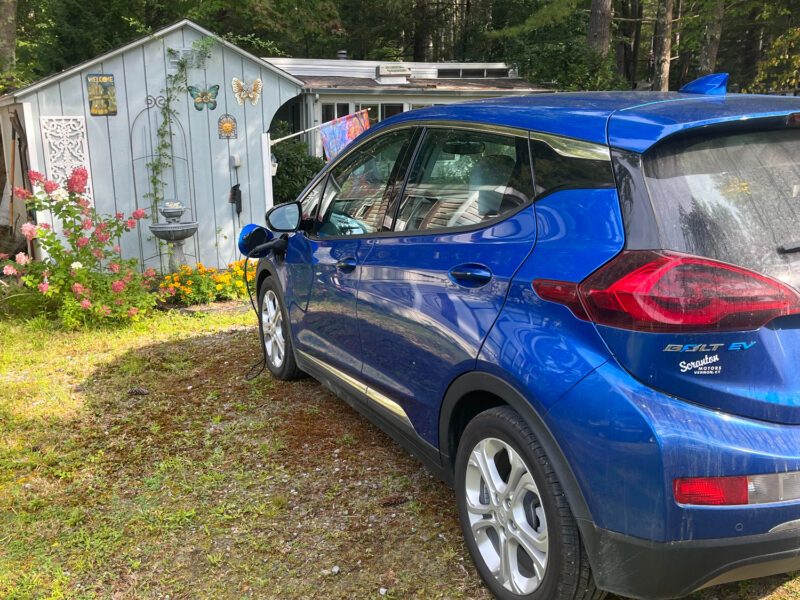
The irony of using a Bolt EV in the accompanying photograph. A car with some of the slowest DC fast charging, and a battery that’s been reduced to 80% capacity for three years by the company who makes it.
I’d say that just reinforces their point that even “bad” EVs don’t have significant issues with range. But yeah, a bit weird to emphasise it.
It’s actually a great example.
Bolt has about 250 mile range and it’s great for everything not too far, and even ok for infrequent road trips.
And your claim about 80% reduction is false and misleading.
Why do you hate EV’s?
I own a fucking Bolt. I don’t hate EVs. It’s difficult to get the advertised range when GM insists on binding it with a software update that prevents charging above 80% as a workaround while they are still sorting out their battery recall years later.
https://electrek.co/2023/06/14/bolt-battery-recall-diagnostics/
That’s a precationary limit because of a pending recall. The batteries aren’t degraded to 80%.
You can’t use it above 80%, the reason you can’t doesn’t make a difference for your ability to drive the car.
Right and for newer vehicles there is a couple of 2020 Bolts and a 2022 Bolt EUV for low $20k or under in my area. If I travel a little bit away from my area I have found 2017 Bolts for $15k.
As mentioned they’re not great for road tripping because of their slow L3 charge speeds, but perfect for me to use for my commute or local-ish running. It or a EUV will probably be my replacement for my ‘08 Rabbit whenever it goes, but I only put on about 3k miles a year on my car soooo it might be a while. I also need to see if i can put a family of 5 in one (reverse car seat, booster, and older kiddo in the back). I think they’ll do it.
Why aren’t plug in hybrids getting pushed harder?
You get the benefit of the vast gasoline network but you also get the maintenance of both ICE and electric systems.
Plus carrying around the weight of both the batteries and the ICE with its tank of fuel.
And yet they are still generally more efficient than ICE vehicles.
Of course! EVs are more efficient again, however, in part because they can replace the space and weight of the engine and fuel tank with batteries.
Because then car companies have to maintain two systems and the complexity increases. I’m very happy with my plug-in hybrid. I’m running 100% electric in my day-to-day driving and on longer trips the amount of gas used varies. If I’m careful then I can go a year without a trip to the gas station. I wish more companies went this route, but they want to keep their profit margins up. I’m just waiting for the flood of cheap EVs that will eventually come in when more and more companies enter the market. Chinese EV companies are looking to enter other markets and this should drive prices down, but legislators are proposing tariffs to keep prices up.
Does the unused gas not cause problems after that long, or is the moving vehicle enough to keep it happy?
I drive a chevy volt which includes measures that protect against that, including burning off gas if it’s been too long. In fact, I could’ve gone more than a year without a trip to the gas station, but the limit for gas to sit in the tank is about a year.
That’s cool, didn’t know they did that. Thanks!
On paper they are the best of both worlds. In practice it is the worst of both worlds. Yes range is no issue but you need to go to gasstations and still need to charge your car most places you go if you want to reap the benefits. I honestly prefer non plugin hybrids to plugin hybrids in this regard. But i much rather bite the bullet and drive electric, even if i have to stop and charge on roadtrips. The increase in comfort of electric driving is worth the downside of longer traveltime to me.
And that is from a drivers comfort point of view. Maintenance is the same story. Having all the downsides of a combustion engine in a car that could have been an electric car.
This article doesn’t really touch on the biggest issue of getting into an EV - the price tag. I mean, $26k to get into an entry-level model? I paid $11k for my SUV, and the only reason I could afford that was due to a pay-out from the company that totaled my previous vehicle. Show me a used EV with towing and storage capacity more in the range of $6k that I can expect to drive for twenty years with basic maintenance and you might get me interested.
Beyond that, they claim that an EV is cheaper to maintain over the years? OK I’ve been driving my used SUV for 15 years now and I’ve spent less than a grand on replacing parts (not including stuff like tires that are going to be replaced on any vehicle). My previous vehicle was driven for 24 years and cost even less to maintain because it didn’t have 4WD. It looks like within these time periods I would have expected to replace EV batteries several times (most estimates put battery lifetime between 8-15 years), and how much would that have cost? I understand that most people can’t be bothered to learn how to perform even the most basic maintenance tasks and believe that you need to buy a new car every 5 years, but I would like to see realistic maintenance estimates for those of us who don’t treat our vehicles like a piece of disposable tupperware.
A used market is mostly a matter of time. There just hasn’t been enough EVs available for long enough to have much of a used market
The older EV models currently in the used market should be avoided. They are mostly compliance cars like the original Fiat 500e and the VW eGolf — slow charging only, small worn out batteries, and little range. Or they are first generation Leaf EVs with failing batteries that are out of warranty or cannot be replaced due to eternal back order at Nissan.
The 2017-2019 Bolts can be a good buy if they’ve already had their batteries replaced under warranty/recall. Decent range and amenities, though some find the earlier model seats uncomfortable.
This next generation of used EVs (cars shipping as new right now) will be great — longer range and faster charging.
Agreed, and there’s a LOT of usage in my area so I would expect there to be a decent used market. Unfortunately it doesn’t seem to be there yet. I know in time EVs will be as cheap and common as ICE vehicles are today, but personally I feel like currently they are still only available to people with a LOT of disposable cash.
You got your current car for 11k but expext an EV to cost you 6k. Why is that? Shouldn’t you expect the EV to also cost in the same range as 11k to make it a fair comparison?
In terms of battery replacement, have you calculated after how many miles the battery replacement becomes “free” because of gas savings? This changes for everyone based on their electricity prices and whether they have solar.
Because I got the current SUV from a dealership with all the attached mark-ups and fees, at a time when similar models were selling used for about half that cost. However because I had the money available I was willing to splurge on getting exactly the one I was looking for. Also, an EV is not an SUV, and certainly not 4WD with the stronger frame to support off-road use, so it shouldn’t cost as much. I actually bought my wife’s car, a 2006 Murano with 4WD, for $6000 from a dealership, so even that has more capability and probably more cargo space that a typical EV. My baseline is how much vehicle I can get for that price range.
[Edit] Sorry… as far as “free” is concerned, well that never really happens, does it? Yes I could get solar installed on my house, but that costs as much as the car and wouldn’t likely get paid off before the car itself fell apart or was hopelessly obsolete. Since COVID I only have to drive in to the office two days a week now, so I’d be lucky if I even put 3500 miles a year on my SUV now, which is around $750/year in gas. A conservative estimate on solar installation is around $15,000 which means I would have to drive the EV and be completely powered by my own solar charger for 20 years to pay off the solar panels, and in that amount of time the solar panels themselves would likely fail from age or hail and need to be replaced (although hopefully the technology would have improved by then). Also note that because of the dense trees in my neighborhood, I’m not even confident I have enough of my roof in direct sunlight to power the house itself. Yeah it’s something I’ve looked in to, and while I could save a lot of money by building the solar installation myself, I’m still not sure I could get enough power even if I cover every inch of roof that sees Summer sunlight for more than a couple hours. Free ‘gas’ just isn’t going to happen unless I cut down my own trees, and convince several neighbors to also cut down theirs.
You have not considered some aspects. You have concluded that solar is only used for charging the EV and that it doesn’t power your house. Realistically nobody does that. Your solar beakeven should be converted to calculate how much time it takes to save 15k from both your electricity bill + gas savings. Then the whole equation becomes,
battery replacement cost + solar cost = (annual electricity bill + fuel cost) * x number of years
Only then can you know if the breakeven period is a save or a loss.
Ignoring solar, what’s the breakeven like when you charge the vehicle from grid? (With night time prices if you have such a tarrif/discount)
And to answer your last question… I can’t find any info on whether the city offers discount for at-home charging, but they do provide several level 2 chargers around the city at a rate of $1/hour, which seems fairly reasonable? Hard to say as I have no idea how long an EV take to recharge or how far you can drive on a 1-hour charge so I don’t have enough info to make a reasonable comparison there.
Actually solar powering my house was my first consideration. I’m already dealing with an electric company that didn’t think it was odd when they turned off the power to my house and the meter kept running (my typical monthly usage is around 4000kWh which breaks down to over 5000 watts of solar panels and roughly 300 square feet of roof space that isn’t blocked by trees) so I’m trying to find an electrician to replace the wires between the meter and the house. The assumption here is that the wiring has a ground leak – the more power I pull, the faster the leak, which ramps up my bill quickly. Meanwhile I’ve been considering installing solar panels on my house to offset some of that usage. Even if I’m really only using half that amount of power, that’s still a LOT of required solar panels and as I said there’s not a lot of exposed roof space available. My calculations weren’t including trying to recharge an EV because I don’t have any numbers on how much power that would pull.
Basically where I’m sitting, about 2/3 of my roof is blocked from sunlight by trees on the East and South which is great for keeping the house cool, but not so great for solar panels. If I was trying to supply half of my current electrical usage I would need roughly 12 square feet of good sun throughout the day, but my Southern roof only has that much exposed for 4-6 hours in the middle of Summer. In the Winter one of the trees to the South of me will lose its leaves, but the other tree to the South and all the trees on the East side are massive evergreens that block the sun all year. I’m having a hard time getting the numbers to add up just to supply my house with power, I just don’t see any way to also recharge a vehicle (let alone two). It’s still a project on my radar though and something I really want to get in place since I do use quite a bit of power here.
Oh, and that $15,000 installation price was for more typical homes that use less than 250kWh/month. Obviously I am nowhere near that.
Yes they aren’t cheap up front but the ROI is good.
The curse and trap of being poor - or Vimes law of boots. If you only have $5,000 to get a vehicle, doesn’t matter if your ROI is bad over time, your choice is bad ROI and a vehicle, or no vehicle. I really hope used EVs start to get parity with used ICEs, but I bet that’s at least a decade if not two away.
Are you comparing cost of used ICE Vs new EV?
I’d prefer to compare used to used, but looking around online at what’s available in my area, the cost of most used EVs appears to start around $15,000 for these tiny compact cars that would never be useful to me. The cheapest was a Nissan Leaf for $7500 with a listed range of 84 miles – hell we couldn’t even visit many of our friends in that distance! The more reasonable sized cars (at least judging by the pictures) like a Kia Niro or maybe a Nissan Ariya which have ranges over 200 miles start around $30,000 and go up very quickly from there. So yeah, even comparing used prices puts these vehicles way outside my price range.
Ehhh. For the range-anxious until charging infra catches up, there can be PHEVs.
I’ve been excited to have my next vehicle be a BEV for a while now, but having rented a Tesla while on vacation in Michigan (where the infra wasn’t exactly good for it) I understand why people might have reservations about jumping in with both feet. Also now that I’ve interacted with the vehicles and got a better idea of Tesla as a company, I won’t be buying one.
For the moment, given my use cases (I periodically have to drive between western WA and central UT) my next vehicle will likely be a PHEV unless there are real breakthroughs in EVs (fuel cells? swappable battery standards?) or charging infra where I need it.
Serious Question: Why can’t we just have towable generators so EVs can go from an electric car to a Plugin Hybrid for road trips?
Generators aren’t very expensive relatively speaking.
Yet I’ve never heard not seen this anywhere, and seems like a very easy solution to range anxiety.
What if the generator was inside the front of the car - and only turned on when the battery was low? Wait, I’ve just re-invented the hybrid.
Yeah okay but almost nobody is making Plug-in Hybrids and they cost an absolute fuck ton of money.
You also don’t need the generator for 99% of rides so you can remove it to reduce costs.
Look at the new “Ram Charger” that works like you describe. It’s 60k and for whatever reason needs a 600hp engine and a full electric engine.
almost nobody is making Plug-in Hybrids and they cost an absolute fuck ton of money.
The 2024 Prius prime starts at $33k, is a PHEV https://www.kbb.com/phev/best-phev-cars/2024/
BMW, Volvo, Mercedes are also making PHEVs for 2024 model year So are Chrysler, Mazda, Hyundai, Kia, Porsche, Land Rover https://www.autoweek.com/rankings/g45455983/best-plug-in-hybrids/
There are some really expensive ones on that list, but a half-dozen under $45k
Look at the new “Ram Charger” that works like you describe
Yeah a lot of the hybrid offerings in the truck market are really not targeting the budget market at all- some of them seem to reflect automaker bets that truck buyers want more power and don’t want to compromise on towing or range. Other hybrid trucks (looking at you, Toyota) aren’t using their hybrid systems to improve fuel economy, they’re using them to juice performance.
I didn’t know the Prius was a Plug-in now. Last time I looked at them. The Prius only ran the battery under 15 and only a very short distance. Didn’t think they changed that.
$45,000 is still a lot of money. That’s a $750 Monthly payment
An average EV consumes .32 kilowatt hours of electricity per mile. If you are driving 60 miles per hour, that means you are spending 19.2 kilowatt hours of electricity every hour. So you need a generator that’s at least 19.2 kilowatt. Tack on some more because you are now towing the extra weight of a generator and because you are probably wanting to go 70mph and let’s just say you need 25 kilowatts. This is what a towable 25kw generator looks like. It costs $22k. I’m sure cheaper ones could be made, but even at $10k, is it worth it? Just buy some plane tickets or rent a gas car for a week or take a train.
https://herogenerators.com/products/25-kw-caterpillar-towable-diesel-generator
Buy? No thanks I don’t even have a good place to store it, never mind maintenance.
But I’d rent it.
Only wrinkle: backing up. I’ve owned/used trailers many times so I have no problem with backing up, but many would. Can’t think of a way around this that would be even “almost” idiot proof.
Could use a trailer that stays directly behind the car. Like instead of just a ball hitch, have several mount points on the rear of the car, then it won’t swing freely. Maybe rig it to only use one wheel when the vehicle turns (otherwise I think it would cause a bit of understeer).
Though people do learn how to use trailers. Some truck drivers even know the black magic of backing up with multiple trailers.
deleted by creator
It’s a massive waste of energy. What does a good diesel generator have, like 20% energy efficiency? Not taking into account that you’re wasting a lot energy for towing it.
It would also have to be massive.
Why would It be diesel?
Besides what exactly is the alternative if there is no charging location on the way?
Just spend $150/day to rent a car in addition to all other travel expenses?
Serious Question: Why can’t we just have towable generators so EVs can go from an electric car to a Plugin Hybrid for road trips?
Lets work through some back-of-the-napkin math here.
Lets say the average speed you’re looking to take on your road trip is 50MPH. For that discharge rate you’d need to be able to charge at 50MPH to keep up. That would put you at a charging requirement of 50kw.
Here is a picture of a 50kw towable generator:

This isn’t even any of the additional gear needed for DC rectification and power management needed to interface with NACS or CCS.
and seems like a very easy solution to range anxiety.
You can see why this idea doesn’t really work then.
I’m going to need to see your work for the 50mph to 50kw conversion.
1 Kw per mph sounds pretty bad. I would’ve thought electric cars are more efficient than that.
Also one is a force while the other is a speed. You’d need a lot of assumptions to go from one number to another single number.
Googling a rough average returned 0.346 kwh/mile for electric cars between 2000 and 2022 (wide range, im aware). Traveling at 50MPH, you go 50 miles in 1 hour (assume you’re already going 50, and stay at that speed). So you’d use [0.346KWh/mile] *[50 miles/hour] = [17.3 KW] per hour @ 50 MPH
One of the problems is that air resistance increases at a squared rate vs velocity, so that average is only really accurate at one specific speed (which tbf might actually be 50mph). But this is a lot more accurate than just replacing “mph” with “kw” lol.
My biggest red flag was the picture of a commercial-grade-looking generator when plug in hybrids can fit the generator plus electric motor, battery, AC, and all the other stuff needed under the hood.
I have to commute one way 250 kms with one settlement on the way (75 km from one end) for work. There are not many EVs now that I would be comfy making that trip right now (more so after the battery ages a few years, in winter etc.) but their are some. In some countries the range is fine, in cities the range is fine but where I am the range is the major limiting factor. Please don’t call market demands “fear mongering” just give me more range.
I don’t need any super acceleration or a top speed 2x the speed limit, I want range.
I mean, worst case, just buy and bring a gas generator with you if you think you are going to be reaching those limits. With an EV, anyone can have a plug-in hybrid (albeit much less convenient).
how about evs arnt the fucking solution and build some fucking decent infrastructure
They absolutely are not The solution but even if a gargantuan government project to make America a public transport-first country started today (and god knows the political will is not there yet), people would need SOMETHING to use which isn’t as directly awful as traditional ICE vehicles during the many years it would take to switch us over. I want to live in a nearly 0 car world as much as you do and absolutely support political causes which bring us closer to that, but figuring out what to drive on these awful roads we have everywhere is a question that we can’t avoid answering.