
- cross-posted to:
- opensource@lemmy.ml
- cross-posted to:
- opensource@lemmy.ml
cross-posted from: https://lemmy.ml/post/54833264
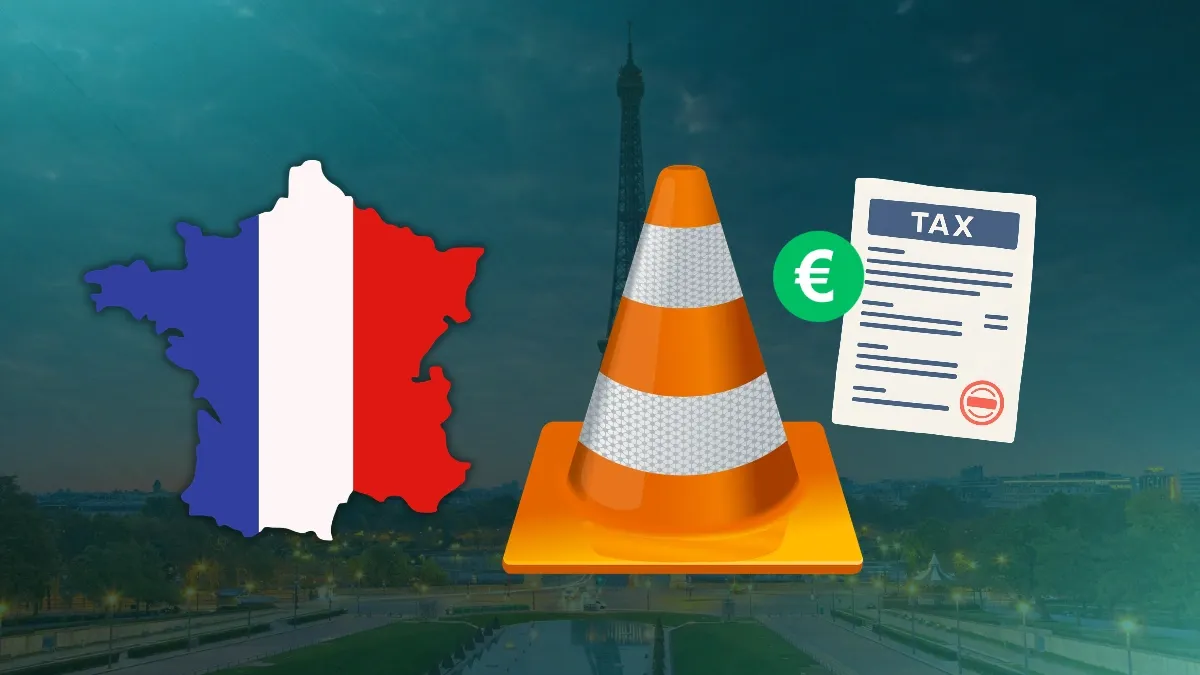
At least that’s what VLC thinks when protesting the new French law.
France’s National Assembly has voted in favour of a new “internet tax” that would charge companies for every gigabyte of data they send to users in France.
The idea is to make Netflix, Google, Meta and the rest of Big Tech pay more.
That sounds like a dream come true for many of us who prefer taking ownership of data in our own hands but unfortunately things are not that simple.
The way this law is written, it doesn’t stop at Big Tech. Even VLC, a free and open source media player maintained by a non-profit, could end up paying this new tax. What the new French internet tax says New French Internet Tax law
The measure is amendment I-1358 to France’s 2027 finance bill, tabled by Laurent Lhardit. It creates a tax on “producers of digital data” at €0.055 (5.5 euro cents) for every gigabyte delivered to subscribers of French internet providers.
Internet providers would measure how much data each sender pushes to their customers, with the collection supervised by telecom regulator Arcep and the tax administration DGFiP. Only the volume is counted, not the content or where it goes.
The amount is capped at 15% of the company’s revenue in France or 2% of its total revenue, as per the amendment. Note that it’s 15% of French revenue, not of total network traffic. And the text joins the two caps with an “or” without saying which one applies when they differ. How much money are we talking about?
The amendment cites an Arcep estimate of 200 billion GB a year flowing to French internet subscribers. It expects the tax to bring in €10 billion a year. It also names Google, Meta (Facebook, Instagram), Amazon, Netflix and Akamai (cloud server provider) as the senders of about half of that traffic.
You’d think the money goes to the telecom operators who build and maintain the networks. That’s the “fair share” argument European telcos have pushed for years.
But that’s not the case. The revenue goes straight into the state budget, and the amendment’s own justification talks about tax fairness between local businesses and digital multinationals, plus the ecological benefit of compressing data.
Why VLC is angry
A gigabyte of open source software counts the same as a gigabyte of Netflix. VideoLAN, the French non-profit behind VLC, posted on X that the tax would cost it over €1 million a year.
Lhardit replied that the cap would protect VideoLAN. He also said he didn’t see how the tax could be passed on to users of Facebook, Instagram or TikTok since those services are free.
VideoLAN didn’t take that well:
You have no idea what you are talking about. What you said about Facebook and Insta and other social networks are not targeted because they are free, means you don't understand the basics of economy. You don't understand the difference between Revenue and Profit.

VideoLAN (@videolan), October 30, 2026
The cap may limit what a low-revenue non-profit owes. But there is no explicit exemption for associations, free software or free content anywhere in the text. VideoLAN’s €1 million is the possible figure before the cap, and right now nobody can tell the exact figure for certain because of all the ambiguity.
VLC isn’t alone. OVHcloud founder Octave Klaba put his company’s gross exposure at around €70 million a year, and Free’s (Teleccom) Xavier Niel called the authors “ignares incompétents”, roughly “incompetent ignoramuses”. Those are French companies, by the way. Not exactly the US giants this internet tax bill was meant to tame. At the end, the consumer pays the bill
See, a “war on Big Tech” sounds great in a headline, and European governments are fond of laws that squeeze extra money out of American tech companies. But I don’t buy the idea that Netflix will pay them out of their pocket.
Netflix will do what it always does and raise subscription prices. And Facebook is “free” only because advertisers pay for it, which is exactly the revenue versus profit point VideoLAN was making.
So the government gets extra money, Big Tech protects its margins, and you end up paying. Meanwhile, non-profit projects like VLC, which never had a price to raise in the first place, are left wondering how big their bill will be.
Let’s just hope that this doesn’t take the form of law. Because this will set a precedence. I wouldn’t be surprised to see other European countries try their own version. No government will say no to extra tax revenue.
Like GDPR, this has all the ingredients of another mess. If a law is going to tax “internet companies”, it needs to say in black and white which ones. Right now, it doesn’t.
What do you think? A fair way to make Big Tech pay, or a blunt instrument that hits everyone else? Let me know in the comments.
You must log in or register to comment.
Watch it end up being cheaper to ship crates of poorly labeled CDRs.
We should burn Paris down to the ground.
GTA VI will cost €79.99 in France. After VAT, Valve gets €20. One download, at 210GB would cost Steam €11.55 in this tax. If you uninstall and reinstall once, Steam loses money on the sale.
Someone please correct me if I’m wrong, but I don’t see any way whatsoever that Steam won’t be passing this cost off directly onto users or just outright block French IPs. How incredibly stupid.
i want to pay taxes for every meter i walk… stupid shit law
Imagine all those open source projects or Linux systems, are they also going to pay this tax?
Eh merde! As if near-chaos across France wasn’t enough.

This dumb law might as well force people to go full sneakernet.
Isn’t this how you get every site on earth to just block French users? Something similar happened with the GDPR and American websites. The truly lazy ones just blocked everyone outside the US.
Let’s make all clients generate random files and send the checksums of those to the server. Only if a checksum matches the server will reply a single
1. This way we can keep the costs down, and it will only take 10^69 years to download the VLC installer.I’m not following the VLC example too well. Is France demanding the donations to VLC as revenue, thus hamstringing non-profit opensource software projects? That would seem like poor legislative design. I’d assume we’d want non-profit software development to continue as a practice, and that new tax as implied would potentially require a for-profit model for Opensource software’s survival on the web. Am I reading that wrong?
For those who are too lazy to dig into this: it’s effectively a political non-starter, and does not appear to have a remotely serious chance of becoming a French law.
We really are living in the post-truth world…
I’ve talked about this before, but the draft says that a “registered number with the IANA” would be recorded. So the ASN, likely to the hosting provider? Or the IP, with a birthday problem so it’s unlikely to be implemented de facto? Why the fuck does a video player need a registered organization and an ASN? It’s capped to income, there’s little to none.
Facebook and Insta and other social networks are not targeted because they are free
The video player is also free of charge? And Facebook also has income? Hello?
IDK, I use MPV so y’all will have to correct me if I’m wrong. I don’t think software should be wrapped around petite bourgies anyway.
Yeah this is never going to happen.
This been said so many times, and look where we are today.
Being arrogantly confident that a bad idea can’t become a reality, in 2026, at this point is just plain ignorance.
It’s against french law, it’s against eu law, the internet doesn’t work that way.
Do you need more reasons why this won’t fly?
I mean I do understand why you’re saying what you do, but IMO in this case it doesn’t apply in the same way as an arbitrary bad law.
Would the VLC fees be from people downloading the software? If so maybe they can host it and any large assets outside of France, perhaps at a university.
The tax is not depending on where the data comes from. If the data is delivered to France, it is taxed. Moving the place where it is hosted solves nothing.
Otherwise, this would not tax American companies.
first quad9, now this? wtf is the french government doing?
Discovering they don’t know anything beyond the 1980’s.
Internet providers would measure how much data each sender pushes to their customers
But what if my customers are pulling data rather than me sending data?
There is no difference.
It was a joke. Most people don’t know the difference between upload and download or push versus pull.
You know those washing machines, refrigerators and TVs that sent gigabytes of data without your knowledge? You’ll be getting a tax bill for that.
Based on a quick glance, the law isn’t a bad idea. FOSS is a boone to the economy, FOSS is the critical core that everything else is built on. The law just needs exemptions that state if the full product (including client, server, the full stack) is free to download, modify, compile, and run, then the project’s exempt.
Even though costs will be passed to the customer, this is still beneficial, as it creates pressure to move away from centralized tech.