With the ever-ongoing ‘progress’ of the proposed UK nuclear power plants, I wonder if this is the best course of action (not just in the UK, but across other nations also)?
Hey, I’m in the biz. “Either or” isn’t a thing. We need a completely diversified grid. Mostly nuclear would be ideal with a big chunk coming from solar/wind/hydro. Even fossil fuels have a place in certain applications.
May I ask what you do if you don’t mind me asking?
Mechanical engineer on the operations side of a large Co-Generation power plant. Partially qualified to operate in a nuke plant too, they just don’t exist in my area.
Interesting. What kind of energy sources does your co-generation use? Part renewables, part fossil fuels I presume?
No, all natural gas with number 2 oil (diesel) as a backup. The co part comes from the fact the Brayton and Rankine cycles are working together. The former being how a gas turbine works and the latter being how a steam system works. I can go into more depth but it’s boring. I like renewables, just not as a blanket one size fits all solution. People tend to form an oppinion about this kind of thing based on vibes not reality, experience or math. I’ve worked at hydro plants before and like I said am mostly qualified legally to work in nuclear.
Ah, fair enough.
Being legally qualified to operate a nuclear reactor is mind-boggling! Unfortunately it’s not as magnificent as being a certified forklift operator (not me).
Both are needed for a healthy power structure.
Wind, solar even with batteries have low innertia (actually no innertia at all by themselves). If you want to resist turbulences on the power network without free innertia resistance by turbines (nuclear, gas, hydro), you need expensive equipment to generate that innertia other ways, and it can get quite expensive.
Hydro would be great but it’s highly seasonal.
Hydro would be great but it’s highly seasonal.
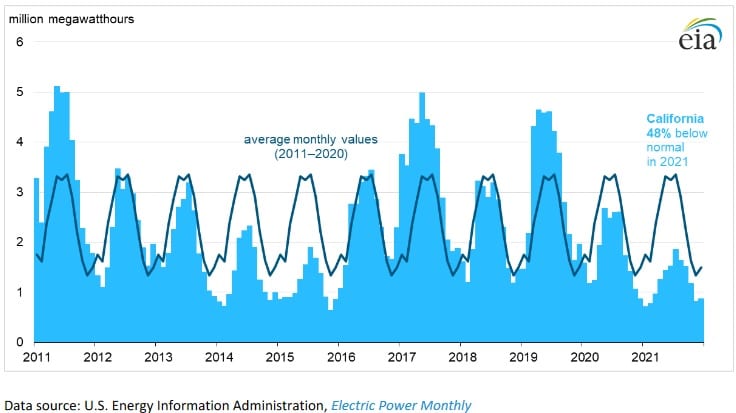
how is hydro seasonal? Even coldest Quebec uses hydro year around.
https://enerknol.com/wp-content/uploads/2022/05/EIA_pulse_1.jpg
Example of California hydro generation
So the planet’s been using solar and wind for millions of years and it seems to have worked okay.
Yeah, but demand has ramped up, and it seems that wind/solar is no longer able to keep up, unless I’m missing something
I barely see wind and solar adoption. Most roofs don’t have solar yet. Most fences aren’t solar. Terrestrial Wind has better adoption on some scales but still largely untaped as with coastale wind.
Nuclear was probably the best choice in the 1970’s; France made the best choice. But we’ve seen over and over again the problems are getting worse rather than better. Paperwork and process ever more unwieldy. Construction taking longer and longer. Radioactive waste building up with no permanent disposal. By far the highest cost power generation, and the difference is getting wider.
Much of the posts about how great it will be this time is just astroturfing by those trying to profit. No, “small modular reactors”, didn’t solve the cost, construction, or process issues, but only raised the cost of generation. No, thorium isn’t the silver bullet and really doesn’t exist yet.
Paperwork and process ever more unwieldy. Construction taking longer and longer.
Not with SMRs and portable reactors. Ontario will have 4 online with 6 years lead time. Fraction of the cost and time of a full CANDU build. Thorium is as real as the Stark arc reactor or fusion.
It seems like battery+solar is the cheapest worldwide as of recently.
I am not familiar with UK conditions. Scandinavian winters remain a problem for solar.
The UK has a great capacity for wind power, and the number of offshore wind farms is increasing
Radioactive nuclear waste
Wind & solar for sure. Nuclear fission is great right now, but fissile material is a finite resource. It will, like oil, eventually become too expensive to extract.
and watch what China will do, they will invest in uranium mining and monopolize it and idiot west will just watch them do this, again.
For fuck’s sake! It’s both, you can’t rely on a single one.
Guess which one it is being used and will be used for decades to come while everyone is distracted arguing which one is better?Where I live it’s solar, hydro and wind. No fossil or nuclear required. I don’t get why people like nuclear. It’s expensive, slow to build, produces waste and keeps countries hostage with its radium requirements.
Not every country can have hydro. In your case, hydro fills the role that nuclear would fill. When nuclear is not an option and hydro is not available that role is being filled by gas and coal.
I would say that the good answer is “mox” (not sure of its english name, but it is likely similar. Used uranium is extremly dangerous for a very long time (millions of years). Yet it could be recycled and used again, and the result would be extremly dangerous for about 500 years (which is still far too much, but less crazily impossible to manage).
We already have enough used uranium to cover the next 200 years of needs, at least… And so it would be a lesser harm for future generation if we use mox than new uranium…
(But the true answer is we need new bombs, so new uranium…)
IMO, GB needs to lean into its nuclear strategy. A decade out of Brexit, they have the speed of sovereignty but will come crawling back to the EU and get terrible terms for readmission if they don’t do something productive. The endless debate of “which is best” will ruin the country.
GB signed a contract will Rolls Royce to build SMRs, they need to deliver on time and on budget. Once those factories and workers are turning, GB would be in a great position to buy more SMRs and plug em into the grid and export power to the EU, export SMRs to the EU (esp France, they love nukes), and export energy intensive commodities to the EU (like steel or cement)
Wind and solar are great, no question there. However, the endless debate of this burns oil, gas, coal, and public sentiment.
when you say “long-run” is it human life expectancy long or heat-death of the universe long?
I mean long run as in however long we are going to need/have/use it, basically. So, until humanity ceases to exist, ig?
wind/solar then. nuclear power requires long-term storage up to 250 years for waste to be safely disposed of. during those 250 years leakage and accidents can lead to environmental impacts.
though wind and solar has industrial waste and environmental impacts through their manufacturing, the long-term effects are manageable when compared to the scale of a nuclear superfund site for the entire longevity of humanity.
this is all assuming there is no further technological developments that would change the nuclear waste to nuclear fuel, as I know there are currently some developing fusion technologies that are using nuclear waste as a fuel to run 100% clean. should those technologies develop further and paired with nuclear power the risks are mitigated and nuclear+fusion become a clean leader of power.
Nuclear is great for investors, data centers, and the military. The amount of energy it produces allows for more energy intensive operations and research, gives a lot more energy for everyone to play with, but they can also now import nuclear material for “energy” reasons.
Best course of action if you believe these things are good. Bad if you think people should be able to produce their own energy, and don’t need that much energy to prosper.
I have lots of love for CANDU reactors. Lived by a few of them just outside of Toronto for a bit.
They do have the big advantage of having all waste handled on site vs the hazardous disposal of solar panels and wind turbine fiberglass every couple decades plus the ability to start up a failed grid. Big downside is the slow build process and the long downtime during refurbishment if you only have one reactor on site.
Solar also isn’t great up here with the winters killing solar production half the year when we require more power for heating but it is fabulous for balcony and roof solar installations.
Wind is only viable at scale but otherwise a pretty great source of power in windy areas.
Solar and wind also aren’t able to start a grid that as failed although investing in battery storage (chemical or gravity based) could fix this.
Hydro power would be perfect if it didn’t require the flooding of a huge area but otherwise it is a great source of constant power that can often be used to kickstart a grid. It is also cheap power if you have the rivers for it.
If tidal power wasn’t so incredibly harsh on equipment it could have been a fantastic power source as well but if Nova Scotia/NB can’t make it work then it probably isn’t worth doing anywhere else.
I don’t know much about geothermal but I assume it is pretty great if you’re somewhere geologically active. It does seem awfully similar to fracking for natural gas when getting built so idk the environnement impacts of that.
Ideally you’d get the bulk of your power from solar, wind and small scale hydro alongside battery storage and then have nuclear plants available to pick up the slack when one of these isn’t running and during peak use times.
That gravity batteries are so simple it’s hilarious: pump water up hill into a tank and it generates electricity on its way back down.
Just in case anyone thinks this is hyperadvanced technology…
sure, it’s just that simple. It’s not efficient and pumps wear and need maintenance.
I think wikipedia gave water pump gravity battery a 60-80 percent efficiency rating, and also said that they can even lose energy. But so what, there’s always going to be peaks and troughs in renewable energy production, still a good idea to put the excess to use somewhere.
Solar also isn’t great up here with the winters killing solar production half the year
Toronto is on the same latitude as Rome.
Guess that’s a me problem for having horizontal solar panels. (No space for angled solar on a moving sailboat)
A combination of the two: Renewables and SMRs.
Nuclear is great but there’s a very small amount of uranium 235 (what is used to instantiate the chain). that’s the biggest issue, I think the relative abundance is 0.5 - 0.9% compared to uranium 238 98 or 99 percent.
Even the efficiency is like 33% where wind is 40 - 60% (depending on on shore or offshore) and solar is 20%. The main appeal here isn’t about optimization, even at the lower efficiency it produces a fuck ton of energy. 92 reactors produce the entire energy generation supply of 17%. There is approximately a thousand gas plants to produce the 40% of US energy generation, and we are talking about combined cycle level efficiencies (60%). If we doubled our nuclear power plant fleet to 200 nuclear reactors, we would generate more energy then the current leader in energy generation. Nuclear power plants produce a shit ton of energy.
The main reason to go with renewables, long term, is it doesnt use limited resources, and that there is still a lot of R&D that can’t be known theoretically, but through trial and error. With wind turbines, for example, there is so much mechanical failure as a result of the torque being generated by the wind, I wouldn’t be surprised if the turbine just breaks off from the base of the windmill.
PV cells also have a lot of R&D going for them, not mechanically, but electrically. The PV cells we commonly use they are generally inefficient because once light passes through the PV cell theres more energy that could be used. There are techniques to combat this issue by stacking multiple solar cells and running it through a wire, but that technique also costs more money.
SMRs I would consider are also the future due to lower upfront cost and maintenance costs, its easily commercializable compared to nuclear power plants (which are designed from scratch).
Nuclear has a problem. Right now, there is an estimated 90 years of potential uranium supply, which will be cut in half when Chinese reactors get on line. Uranium is not abundant.
And don’t flame me with thorium bullshit or uranium from seawater bullshit. Science fiction.