

Although the director of Immigration and Customs Enforcement (ICE), Todd Lyons, announced that he will leave the public sector on May 31 , he left in motion his “dream” for the agency, based on a famous delivery system : that groups of trucks stop migrants for deportation in a process as efficient “as (Amazon) Prime, but with human beings.”
Before expelling them, however , they must be detained somewhere. After the failure of the initial plan to build massive tent camps, Lyons launched the ICE Detention Reengineering Initiative , which is, according to a report by the American Immigration Council (AIC): “A much more drastic plan, which would radically transform the detention of immigrants like never before since the surge in detentions in the 1990s.”
It is based on the purchase of a network of commercial warehouses and the hiring of companies to handle their refurbishment. “Let the police and the guns handle their job; let’s outsource everything else,” Lyons proclaimed at the Border Security Expo in Phoenix. Along with locating and deporting people, detention is also a lucrative business for corporations.
An unpleasant “little surprise”
A Human Rights Watch (HRW) report from April 9 reveals that the Canadian agency GardaWorld Federal will deliver a “surprise” in September to 1,500 people who may be detained at some point in the industrial building being converted into a detention center, for $313 million. This will take place in Surprise, a town near Phoenix, Arizona.
This company is the same one that manages the controversial migrant detention center in Florida known as Alligator Alcatraz (Alcatraz of the alligators, because of the old prison island where mobster Al Capone was held and because of the alligators that inhabit that area).
That’s just part of the benefit for GardaWorld Federal, which could double its revenue from the center’s daily operations. For security, detainee processing, food, medical care, and facility management, it could receive up to $704 million by March 2027, at the end of the contract, which can also be extended for another two years. The daily operation has an average cost of $164 (2,851 pesos) per person/day.
This profit-making model creates incentives for contracting companies to overcrowd poorly adapted facilities for confinement , under systematic inhumane conditions and abuses that have increased the number of deaths, argues the report Profiting from Pain , from the Washington School of Law at American University, January 2026.
And also, incentives for contracting companies to lobby government officials to tighten anti-immigrant policies, which would allow them to hold more detainees for longer periods of time.
Budget boom for private prisons
The Trump administration’s emphasis on immigration enforcement was evident in the astronomical increase in ICE’s budget. $45 billion was allocated for the construction and operation of new immigration detention centers over four years—an average of $11.25 billion annually.
This figure dwarfs the $3.4 billion of the previous year, but it was a boon for companies that dedicated themselves to building huge expansions to the internment capacity, but not to improving conditions, despite the fact that previous administrations had denounced them as serious.
This is a consequence, HRW and AIC point out, of the prison privatization that began during Ronald Reagan’s administration in 1981, amid an explosive increase in inmates caused by the so-called “war on drugs” and “tough on crime” policies .
In 1983-1984, the two main contractors were created, which remain to this day:
- Corrections Corporation of America (CCA, renamed CoreCivic in 2016)
- Wackenhut Corrections (now GEO Group)
The first federal private prison was operated by CCA in Tennessee in 1984. The companies offered to build and operate prisons faster and supposedly cheaper than the State, receiving payments per “occupied bed” (bed rate).
Because most state and local prisons remain public at the federal level, private participation reached about eight to ten percent of the total prison population.
However, ICE gives the lion’s share to this sector, and currently between 70 and 90 percent of detained migrants are in facilities operated by private companies such as CoreCivic, GEO Group, and some subcontractors. It is undoubtedly the main driver of growth for these companies today.
Democrats and Republicans have been locked in a tug-of-war over this practice: in 2016 , Barack Obama ordered a reduction in federal use of private prisons; Trump reversed this in 2017; Joe Biden attempted to eliminate it in 2021, but the Republican’s second administration, which took power in January 2025, led to the most rapid expansion in history.
The prison population rose from around 40,000 to 70,000 in February 2026, and there are plans to reach 100,000 by November. After that, it could quickly reach 150,000 due to the expedited awarding of multi-million dollar contracts without competitive bidding.

Shares of CoreCivic and GEO Group soared after Donald Trump’s reelection in November 2024. And with good reason: both reported record revenues in 2025, exceeding $2 billion each . This was anticipated by investors.
Plus the extras, as the Migration Policy Institute points out:
“Companies can profit from the detainees themselves, who must pay to make phone calls or obtain basic necessities at company stores, usually owned by the company, which sell products at prices considerably higher than the market average.”
They profit from pain
Many organizations, including HRW, AIC, the American Civil Liberties Union, the Project On Government Oversight and the Brennan Center, denounced that the profit model generates perverse incentives: as companies charge per detainee/day, they strive to maximize occupancy and minimize costs in staff, food, hygiene and health.
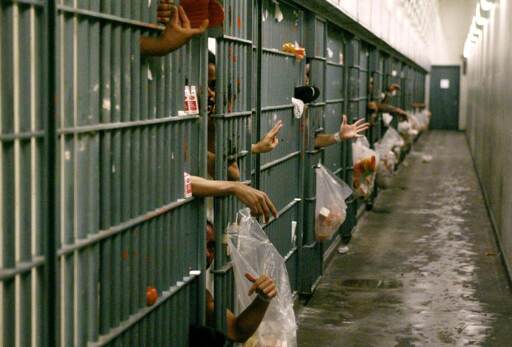
This inevitably produces systematically inhumane conditions such as extreme overcrowding, medical neglect and reduced supervision – there are fewer inspections of prison conditions – and different forms of violence such as physical and sexual abuse, punitive isolation and opacity.
“The privatization of the prison and immigration systems in the United States, and their inherent profit motive, exacerbates the harmful effects of trials” stemming from the criminalization of irregular entries, states the report ‘Profiting from Pain’, from the Washington School of Law at American University, published in January 2026.
“The inhumane conditions and detention are direct consequences of the privatization of immigrant detention centers and prisons,” he stated.

But also, just as President Eisenhower denounced in 1961 what he called the “military-industrial complex” as exerting undue influence over public power, affecting democratic institutions, the Brennan Center points to a “deportation-industrial complex” that lobbies to toughen anti-immigrant laws and policies.
In this way, those who imprison them ensure that they close off the paths to legality so that they can pursue and capture more people, thus keeping their beds full for longer.
Unfortunately for thousands, this is not a surprise.
Source -> https://archive.ph/G516o