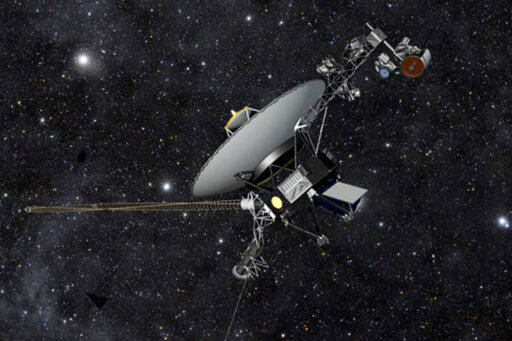
Does anyone know if the code that Voyager 1 (or similar era tech) is running is available anywhere for inspection? I would love to poke around in such a historical code base.
In 1977 69 KB was huge memory. First home PC’s from 1980 and 1981 like ZX81 they have 1 KB of memory. One.
Not really, mainframes could have 8 megs of core in the 1960s.
The Commodore 64 came out in 1982 and famously had 64KB of memory.
I could never get my Zx81 to save data tape.
Hopefully it doesn’t get blown up by some bored Klingon.
ah…back when Star Trek had some actual science fiction in plots.
Aliens find it and love our retro tech. “8 track!”
Funny observation on the side:
This content is geoblocked in Germany.
And, as far as I can tell, trying a few destinations with my VPN: only in Germany…So what the hell is in there, that we Germans must not see??? 😆
You already know too much, ja?
l would say there is more advanced information tech in 70s era Voyager than in a typical current German public administration office. ;-)
Maybe they really couldn’t be bothered with writing an Impressum!
Impressum would only be a necessity if they were targeting the German market, which they (as an English language only site) are clearly not.
I meant it as a joke but I could imagine them getting one email from Germany about GDPR and then deciding to geoblock the whole country instead of complying (and ignoring the fact it applies elsewhere in Europe too).
By now I am curious enough that I consider just writing them a mail and ask…
Edit:
Just did. Will post if they give me an answer…
Fear of change and modernization. :)
😆
It’s blocked on the server side, though… (nginx message).
Maybe some German “Neuland” shenanigans the page owner doesn’t want to be exposed to …
It’s a slippery slope. If you let the village know there’s a ship sailing the cosmos then next thing you know they’ll want the rathaus to use email instead of fax. Just best to follow the rules and keep things the way they are.
It and its sibling are probably the only working examples of flywire memory left in existence. That memory with little ferrite cores threaded with 3 wires was very labour intensive to make but was the backbone of the entire computing industry at the time. Very solid and reliable.
A kilobyte must have sounded like so much memory back then.
A byte is 8 bits. Even if we want to call bits quarters ($0.25) and bytes dollars, 69KB would be $69,000! That’s a lot of dollars.
(And it’s actually 1,024 or something instead of 1,000, which just increases it that much more).
It’s crazy how KBs used to be incredibly meaningful, and now we’re buying multi-TB drives like they’re nothing!
EDIT: Math fail. Let’s say TWO bits are a quarter…lmao
Wouldn’t a byte be $2 if a bit was a quarter, or do you mean 2 bits are a quarter? Also i think you were right to use powers of 10 in your estimate. Article says kilobyte, not kibibyte. I really like what your conversion illustrates, I’m just tripping up on the details. I could be wrong-- commenting so someone can correct me if i am-- if a bit is a quarter, 69 Kilobytes would be $138,000
LOL…yes. should’ve been an Eighth, but we don’t have a coin for that.
Your math is right. I was just thinking of a Byte as $1.00 and going from there. Then remembered that bits are smaller, but they shouldn’t be $1 because a single bit is not very powerful. But making it worth $1 or $0.01 would make the math messier.
But yes. Two bits are a quarter is probably the best compromise! Lol
If a bit is 3.5 grams, then a byte is an ounce…
That makes a kilobyte about 1000 ounces!
So then a TB must be about…a metric shitton?
It’s a trillion ounces, I don’t know how much that is in metric…
Nice
adj.
…
- Showing or requiring great precision or sensitive discernment; subtle.