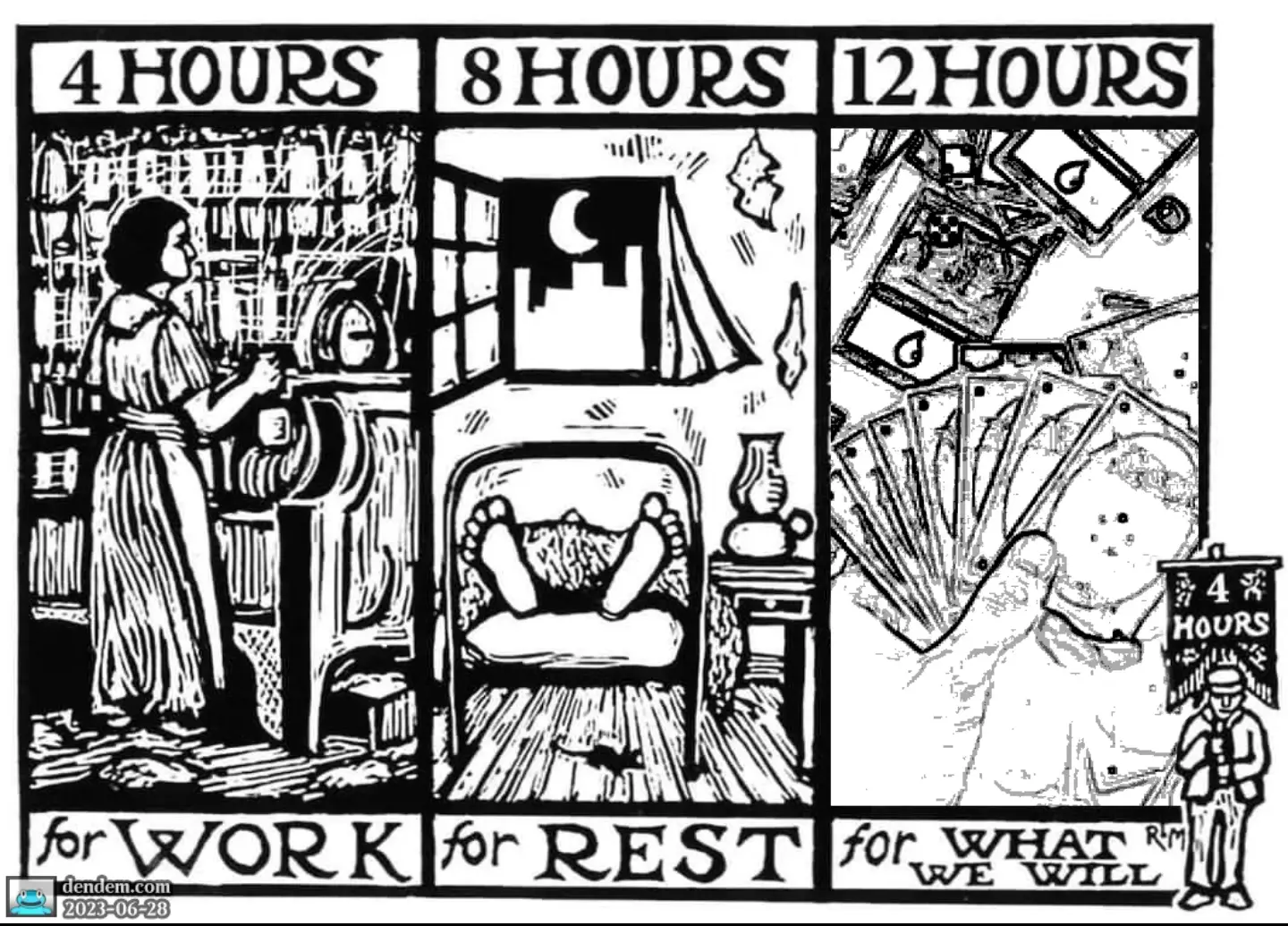
The benefits of productivity increases should not be consolidated at the top. We should take our time back.
i already do this. my boss just doesn’t know it.
Me too. My boss is cool with it.
12 hours? Must be playing Commander.
Just one quick game.
Without specialization we’re all farmers again.
If you understand the point that people shouldn’t be unitaskers, then yeah, more people would learn how to farm in this kind of world. More people would spend time doing waste management or construction or gardening or street-sweeping or meal delivery and on and on. Experts would have a chance to see the world from the perspective of the people who have to live with the decisions their expertise influences, and they would be able to make more grounded decisions.
This isn’t about getting rid of experts or specialised forms of production, it’s about freeing people to not commit to a single task their entire lives.
What if I’m a farmer specialist?
You’re no longer special.
Without specialization we’re all farmers again.
honestly that wouldn’t be bad, part time - returning portions of diets to home grown produce. I was really impressed with two 3x2’ raised beds could grow in our side yard (the part that gets the most light). I know it’s not practical for everyone, but pea-patches (communal gardens) are crazy popular here in Seattle, and i’m sure elsewhere.
A few hours a week devoted to helping the community garden or your own plots aren’t a full time vocation, but return massive dividends in whatever you can manage. We got great crops of cucumbers, tomatoes, peas, strawberries, fingerling potatoes and rosemary (front and back plantings producing way more than we can use ourselves).
Garden people, it’ll improve your lives.
No I think without specialization, we’d all be spending way more time surviving than we spend on work today.
And the only reason we have enough food to support the current population is massive farms with incredible yields made possible by enormous machines.
That whole pipeline of products and services is maintained by people who specialize in what they do.
In recent years I’ve run some experiments on what works for me and what doesn’t. ‘6h for work - 9h for rest - 9h for whatever’ division seems to work wonders for me, with one day off in a week.
Trying to sleep less than 9h just messes everything up, unless I divide the sleep into two sections. Funny how that works. Extra 1.5h of being awake, especially during the productive night hours, was quite nice. But I hate waking up, and doing that twice a day is just simply too much!
Every person will vary. I am more comfortable with 5-7 hours sleep.
How about 0 hours for work?
Contrary to what a lot of the rich want to push, humans are not lazy layabouts. It’s most obvious in the retired. It’s great for a while, but then many get bored (or just drop dead). They need something to do. I actually help out with a charity helping with that very issue.
The problem isn’t work. The problem is being locked into doing a job you hate, for not enough money, for a huge chunk of your time.
What we actually need to do is let people have more freedom to be productive, in a way that fits them. Though how to get from here to there is the big challenge.
I agree, but for me there is a difference between being productive and work. I want to feel productive, helpful, effective, feel the impact of my actions etc. but to me that is something different from work.
So i guess its mostly a semantic difference?
I’ve been doing that for years and honestly a little bit of work is better