

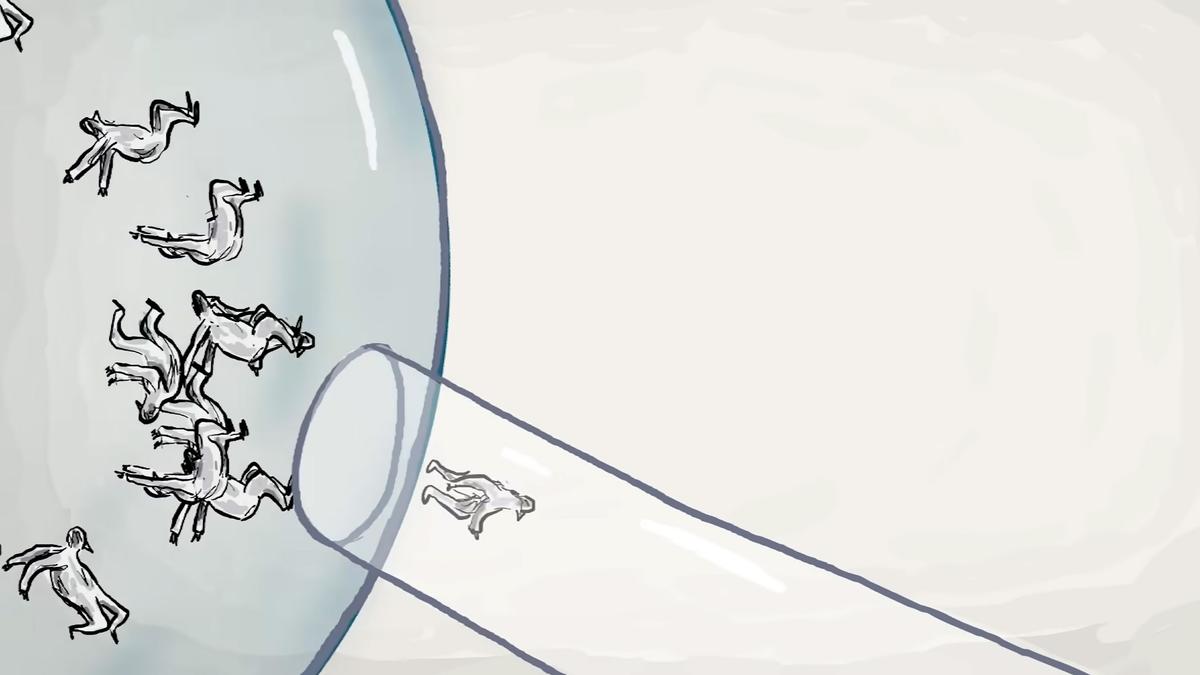
For most people today, public elections are synonymous with democracy. However, between 508 and 322 BCE, Athenians favoured a lottery system known as ‘sortition’. They largely believed it to be more fair, representative and responsive to the public interest than elections, which are often influenced by money and can foster destructive political polarisation. In this animation, Michael Vazquez, associate director of the Parr Center for Ethics at the University of North Carolina at Chapel Hill, breaks down both the potential of lottery-based systems and their limits. In particular, he highlights an updated lottery system conceived by the US philosopher Alex Guerrero, designed to address flaws in earlier models and some of the most pressing problems in contemporary electoral politics.
I was thinking about voter suppression and systems to avoid it the other day.
Imagine a system that runs as normally (either first past or a sensible voting system) unless >50% of eligible voters fail to vote or vote ‘none’ or something like that, and then a random citizen is put in power.
While it would probably help prevent active voter suppression, I have to imagine a combined system where some members are lifelong politicians and some are just thrown in the deep end would not work super well. Given that most elected officials need to spend most of their first term just learning how things work. Though that is also a problem that needs to be addressed regardless.
Imagine a system that runs as normally (either first past or a sensible voting system) unless >50% of eligible voters fail to vote or vote ‘none’ or something like that, and then a random citizen is put in power.
This is actually interesting, but I’d change it a bit. Every voter who doesn’t vote is treated as a vote towards “none”, and candidates must defeat the “none” category as well. If “none” wins, then that means none of the candidates won, and you resolve it through some other means (like lottery).
In theory, rule by lottery might sound good…but have you met the average person living next door to you? Just imagine what President Cletus of Buttfuck, Appalachia would do with a ten year term in office.
Appalachia has been politically stepped on by everyone for generations. That’s a big part of why they’re poor. Cletus may not be an expert on how to run a country but I bet he would help out some Appalachians. Your blatant classism is pretty gross.
as opposed to Trump?
I actually can imagine it. Its not that big a stretch.

