
Use commas in your passwords so they break the .csv file when they get breached.
inb4 it breaks the site you try to login to instead
or “not allowed”
huge red flag, that means they’re worried it’ll break when they try to store it or manipulate it as plain text.
You guys use passwords without a password manager in 2026?
It would marginally decrease the chance of your password being brute forced, which is likely the last way your password would ever get hacked, and most services have rate limiting to make this impossible or overwhelmingly unlikely anyway. So I’m gonna say no, not even slightly.
My tip: mix languages. Defeats dictionary attacks. Hello28Adios@ for example. English word. Number. Spanish word. Symbol.
Next level is to still use a capital letter but not the first letter. Or the last. So then you have heLlo23aDios@ — much much much more secure.
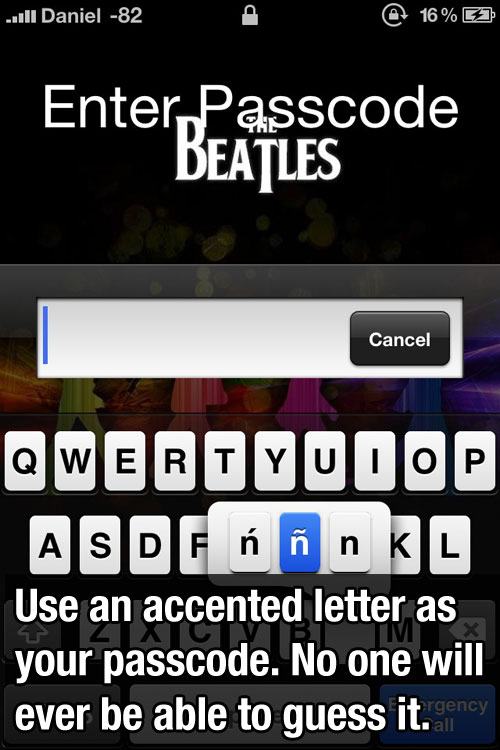
It’s been so long since I’ve seen the old iOS login screen that I thought you were registering for The Beatles dot com.
No. No human is trying trillions of combination to brute force an attack. A machine does it, the machine will try all symbols and lettera.
any brute force attack will use a dictonary based on know passwords and the usage frequency, if people are unlikely to use “accented letters” in their passwords it increase the time taken to bruteforce
Dunno why people are down voting you. Password lists have been around since forever, and anybody trying to brute force will start with one. Why cycle through “A”, “AA”, “AAA”, “AAAA”, etc first when you’re far more likely to score a hit faster with a list?
The correct spelling of my name has an accent letter., its been working pretty effectively for keeping people from finding me on social media.
My mom gave me this spelling cause it was “French” and fancy.
No I’m not French and have no evidence than anyone in my family has French ancestry.
Anywho. Yes. Accents are a great way to hide yourself on social media as well as add an extra layer to password security
I also have my social media location as another country.
Is your social media account’s location in France?
No but I should do that. I can’t believe I didn’t think of that.
Text: use an accented letter
Image: shows a different, unique letter.
As a Spaniard I feel this is rage bait. Like calling Q an accented O.
Ñ is not a letter, and even though at some point recently it was part of the alphabet its standing has always been flaky. It is technically just a spicy n with an accent.
De hecho la virgulilla (~) es un tipo de tilde. Aunque ahora que lo pienso, no sé sí la RAE tendrá un asiento para la Ñ… me decepcionaría si no fuera así.
RAE about ñ:
-
Decimoquinta letra del abecedario español. Su nombre es femenino: la eñe (pl. eñes). Representa el fonema consonántico nasal palatal /ñ/.
-
Esta letra nació de la necesidad de representar un nuevo fonema, inexistente en latín. En cada una de las lenguas romances se fue fijando una grafía distinta para representarlo, como gn en italiano y francés, ny en catalán o nh en portugués. El castellano medieval escogió el dígrafo nn, que se solía representar abreviadamente mediante una sola n con una rayita más o menos ondulada encima; así surgió la ñ, adoptada también por el gallego y el vasco. Esa rayita ondulada se llama tilde, nombre dado también al acento gráfico (→ tilde1)
EDIT: it is true that Spanish is not the only language so it shouldn’t be the one to decide if it is a letter or not. Since I only know 2 languages that used it, I checked the other one: basque.
According to euskaltzaindia:
ñ letra (eñe) ñ letra (eñe)
Zenbait jendek uste du [ñ] hots bustia <in> bikotearen ondorio dela beti, eta ñ letrarik ez dela euskaraz. Ez da hala. Erreparatu adibide hauei: ñabardura, ñaka, ñañan egin, ñaño, ñimiño… hitzei; -ño atzizkiaz eraturikoei: andereño, haurño, xoriño, gazteño, maiteño…; mailegatuei: piñoi, txanpiñoi, erresiñol, giñol…; zenbait herri-izeni: Abadiño (abadiñar), Oñati (oñatiar), Armiñon (armiñondar), Iruñea, Urdiñarbe (urdiñarbetar)…; zenbait ponte-izeni: Eñaut, Beñat, Iñaki, Garbiñe, Eguzkiñe, Zuriñe… [EH; 17. araua] (→ letra; → kontsonante busti-palatalen grafia eta ahoskera)
Definitivamente no era mi día…
Gracias por la corrección, se me fue.
And yeah, the RAE is not the ultimate authority on… really anything.
Appreciated the info on basque too!
RAE is by definition the ultimate authority on the Spanish language in Spain though.
-
Fyi. I keep all my user names and passwords in an address book. A physical one.
In my house. That is locked. In a drawer. Not sitting on the computer or near it.
Someone would literally have to break in physically, find the address book, and then flip through it to even realize what it was.
I also have codes for some user accounts. So instead of writing them out I give myself a hint as to which one I used. I generally use a variation of 3 ones. With different slight changes.
For my bank account access and the email account associated with it I only have hints. Not an actual user or email. So it can’t be bypassed with a password reset.
These are both unique though and neither are the same as each other nor anything similar to all the other user name variants I use for other accounts.
Well, you also won’t be able to log in from any computer with a US keyboard layout, so…
you could easily use ASCII code or copy the letter from Wikipedia/online