My interests: Journalism, Politics, International Relations, Urbanism
1 - The New Yorker is the best magazine in the English-speaking world. They employ incredibly good writers.
2 - Without The Guardian, British democracy is utterly fucked. The Brits just don’t know it. Most UK papers are owned by shady characters such as Jonathan Harmsworth. The Brits even have a paper (The Independent) owned by a politically-connected Russian mobster (Evgueni Lebedev).
The Guardian’s non-profit structure gives it more freedom that most UK papers. They often investigate stories the rest of the UK press just won’t touch: Paradise Papers, Panama Papers, Cameron’s tax evasion, etc…
3 - The two best newspapers in France are Le Monde and Mediapart, hands down. Mediapart is a non-profit. Le Monde journalists have special rights and can’t be removed by shareholders. These 2 newspapers are more independent than the rest of the french press.
4 - The Financial Times is the favorite newspaper of elites worldwide. CEOs. Billionaires. Millionaires. Presidents. Prime Ministers. Everyone reads it. And honestly, it’s very solid. The information is always extremely reliable. The FT is also the most expensive newspaper on the planet. But they sometimes publish free stories.
5 - The editorial section of the Wall Street Journal is directly controlled by Billionaire Rupert Murdoch. The WSJ is the jewel of his global media empire. Fox News and the New York Post are for influencing the masses. WSJ editorials actually allow him to have influence over US high income readers.
6 - If you read WSJ editorials, Rupert Murdoch’s ideas are very simple. Labor unions must be crushed. Corporate concentration is good. Netanyahu is a brave man. US military spending is good. Unions should be restricted by tough laws. Environmental rules are bad. Slash taxes on large corporations. Of course, he doesn’t write it openly. But this what virtually most of the WSJ editorial content boils down to.
7 - Many talented reporters work for the Wall Street Journal and end up deeply ashamed of it. It feels like prostitution. Many would much rather work for The Financial Times, New York Times or ProPublica.
Rupert Murdoch employs great reporters at the Wall Street Journal simply because he needs them to acquire credibility in order to influence readers through his WSJ editorials. If the WSJ was 100% full of trash, american high income readers wouldn’t purchase it.
8 - The best coverage of Silicon Valley is an online newspaper called The Information. If you truly want to know what Meta/Adobe/Microsoft executives are up to, read The Information. Most of their readers are very wealthy investors and rival tech executives.
9 - 90% of leftists who attack the New York Times are wrong.
"The New York Times doesn’t go after powerful people"
They literally took down Harvey Weinstein.
They literally went after Rupert Murdoch
“The New York Times is very pro-israel”
They exposed Israeli war crimes.
The Israeli Prime Minister says he hates them.
“The New York Times didn’t warn americans against Trump”
They did. They really did.
“The New York Times doesn’t cover labor rights”
They exposed how the biggest US Corporations illegally use child labor
They exposed Starbucks vicious war against unions
I’m not saying it’s a perfect news organization. A perfect news organization does not exist. But it’s a very solid one. 90% of leftists who attack it are using bad faith arguments.
10 - When it comes to television and radio, public media (PBS, BBC, NPR, CBC) is often more professional, more serious, than corporate media. PBS or CBC make outstanding documentaries. Stuff US/Canadian private networks just wouldn’t make.
11 - Generally speaking, journalism that you pay for is far better than journalism you don’t pay for. This is a general rule, not a law of physics. There are exceptions. The Daily Mail has subscribers. It’s largely non-sense. ProPublica is free. They do stunning investigations.
12 - AIPAC is a powerful lobbying organization. But there is limit to their power. There was an intense AIPAC campaign to stop the President Obama from signing a nuclear agreement with Iran. And he defeated them .
13 - Most Trump tweets aren’t written by Donald Trump. They are written by a dude named Dan Scavino. Most americans have no clue who Dan Scavino is. They wouldn’t know him if they met him in the supermarket.
14 - Having a lot of resources is a curse. Countries that have natural ressources (Iran, Algeria, Nigeria, Russia) tend to be highly corrupt and exploited by a small elite. It’s simple. The elite can take control of the oil fields, the gas fields, the mines. Just sell ressources. Shoot protesters. No need to invest in anything else. It’s much better to live a country with limited resources (Taiwan, Japan, Switzerland). Lack of resources force the elites to invest in science and education. The most unlucky country in Africa is Congo. It’s full of diamonds, forests, oil, gas, lithium, cobalt, rare earth. So Congo has suffered horribly because of that. In fact, it’s still being looted.
15 - If you want to transform an authoritarian regime into a democracy from within, the number 1 tool you need are powerful labor unions. Powerful unions can basically go on a general solidarity strike and shut down an entire economy.
16 - Everything Barack Obama predicted would happen if the US didn’t sign the nuclear agreement with Iran actually happened. Trump left the agreement. Iran started enriching nuclear fuel. Then a major war happened.
17 - Many Middle Easterners are very tribal. Most Israelis see themselves as Jewish first, Israeli second. Syrian druzes think of themselves as Druze first, Syrian second. Many lebanese Shias see themselves as Shia first, Lebanese a distant second. And so on. Their loyalty often lies more to their tribe than to the State they actually live in.
18 - Imperialism was bad. But imperialism didn’t actually cause instability in the Middle East. The most stable period was actually Ottoman Imperialism. For 5 centuries there was commerce and peace. Then, there was the British/French empire. Apart from some episodes of violence, it was stable. But when imperialism ended, it was basically a mess. Jews vs Arabs. Christians vs Sunnis. Arabs vs Persians. Jews vs Shias. Arabs vs Kurds. Alawis vs Sunnis. To this day, many of them have this tribal mindset.
19 - Saying “we don’t speak with terrorists” is completely dumb. Many terrorist organizations later became peaceful. Many terrorist leaders later became statesmen. It’s wrong to say “We can’t make any peace with those who hands are stained with blood”. Get out of here with that non-sense. If you truly want peace, seeking only decent leaders means you aren’t going to find anyone at all. Criminals make peace. This isn’t Scandinavia.
20 - The most ugly, polluted and noisy cities in the world have one thing in common. They have cars everywhere. The best cities in the world (Singapore, Geneva, Copenhaguen) all have one thing in common. They try to aggressively reduce car ownership. If you want to improve the cities, you need to increase parking costs. Pedestrianize streets. Build bike lanes. The hard part is the politics. Car owners see the short term pain. They never see the long term gains.
What are things you know because of your personal interests that most people have no idea about ?
You can clean dirty/corroded electronic edge contacts with a pencil eraser. Also helps equally as cleaning preparation before soldering.
Go ahead and try it yourself on an old penny, it’ll clean up and look shiny as new. Same principle for electronics.
A good rubber eraser also takes sticker adhesive right off of most surfaces, safely.
Wait wait wait, for real? I’m 42, how did I not know this?
The real LPT is always in the comments.
Ha, yeah. Snap-On sells a 400$ tool that takes 30$ consumable rubber wheels. Or you could use a 99 cent pink pencil eraser.
Snap-On’s Snap-On: they are a BRAND-Identity, not an engineering-actual-solutions-to-acutal-problems company.
There’s a Project Farm, or something, yt-channel, where they guy just does comparative-tests of different products, to see what the truth is, & … it’s a resource all ought be knowing-about.
Ha I DID remember its name right! https://www.youtube.com/@ProjectFarm/videos
_ /\ _
So does fresh duct tape.
When I detailed cars at a used car dealership for a living, I had a wheel made of the same rubber you find in erasers on the end of an air powered die grinder. It was soft enough to not affect the clear coat, but it was fantastic at removing commercial vehicle decals / stickers / numbers along with the adhesive!
I learned this when I was a kid, and the only problem is that nowadays, I haven’t seen a pencil nor its eraser and probably 15 years.
Still, a pretty great tip!
Normal people use alcohol or flux
I do a ton of electronics repair, would never in a million years think that an eraser is going to do anything but make my life harder
OK… But have you tried it?
Why would I do that? So I can fuck up my precision solders on expensive boards??? I need my electrical connections to be free of dirt and debris, and the way to accomplish that is by cleaning it with a solvent or flux. Using an eraser is the equivalent of rubbing it with your fingers… you’re not going to remove the small particulate or oils. Haven’t tried it; won’t. Its piss-poor advice.
Edit downvoters don’t seem to be aware that the last thing you need on a solder site is eraser particulate. Do yourself a favor, go rub a pencil eraser on two things and then try to solder them together without cleaning with flux or alcohol. Send pics lol
We who’ve done it blow the particles away to get them out of the area.
It’s a practice used when cleaning ( by sanding, grinding, etc ) throughout industry.
The removing-film & surface-dirt with an eraser is valid, but not cleanroom, obviously.
_ /\ _
Removed by mod
There’s a documentary about the British and American involvement in the Iranian coup called ‘Coup 53’
There’s a really good book called “All the Shahs men” too which I really enjoyed
Thanks, I didn’t know about it and I’ll definitely check it out.
I didn’t source very well but a lot of my info comes from “All the Shah’s Men” by Stephen Kinzer, which I highly recommend.
Well said. I stopped reading after point 13 for this very reason!
Ah yes oil rich Finland
No, oil rich Norway.
Well yeah that’s why talking about “oil rich Nordic countries” is stupid, only one of them is oil rich. That was the point
This isn’t actually true. You can look at the Nordic countries which are very oil rich and owe a lot of their prosperity to that.
I wasn’t actually aware it was just Norway, so I appreciate the correction.
I know more than I ever planned on knowing about audio equipment.
The first thing you need to know is that you cannot defeat physics with marketing hype. I don’t give a flying fuck how many wave guides Bose talks about or all the technology under the sun, you need a big speaker to make deep bass. There is nothing anyone can say or do to change this.
And when you look up audio equipment, ignore the “music power” because they will state what is the momentary maximum power the speaker can handle… but we don’t play micro seconds of MAX power music, we play steady audio… what you need to know is the RMS power the device can handle or output.
Furthermore, audio cables are a complete sham. You can take any power cable from a discarded vacuum, boom, you’ve got speaker cable. But but gold connectors… Yeah no.
Yeah, there’s a lot of snake oil in the audio world.
You’re spending five thousand dollars on solid gold cables that were soldered by blind monks then braided by trained gerbils, in an attempt to get the highest fidelity possible. Meanwhile, the album was recorded using the cheapest 10¢ per ft star-quad cable the studio could find, and $4.50 Neutrik connectors that were soldered by the studio’s unpaid intern.
There have been multiple instances where I have seen someone asking for advice on trying to track down an intermittent buzz in their system. They had people saying they needed to totally rethink their entire system, they had to buy thousands of dollars of new gear, completely change how they had everything routed… When all they needed was a 5¢ ferrite bead.
Chef’s kiss on this comment. I have been selling high-end audio gear for 2 years since I accidentally got good at it
I have never met a single person through this entire adventure who even knows what these are, and I’m continually laughed at and questioned why I would save them lol

They are inductors.
IF you put enough inductor 'round a cable, you can choke the change-in-current-flow in the cable, thereby removing frequencies from its transmission.
You will notice that inductors are used in power-supply-filtering circuits, along with capacitors, to reduce the changes in the supplied power…
Putting them on signal cables, means they have to be calibrated to what frequency they are trying to oppose, around that conductor…
People who just add them, for “magic” reasons, may have the right underlying idea, of trying to filter-out noise, but … you have to understand how noise is interacting with a specific signal, among specific conductors, to know how to stop it, right?
Same as when I was a boy & offered a tiny 9V battery to help start a car: I didn’t understand that the current required was thousands of times greater than what I was offering.
( this is for anyone who wants to know what those things are: they’re ferrites: iron-oxide inductors, that people put around cables, to choke harsh noise from them, for specific frequencies, for specific material-variations ( there are several kinds of ferrites ), for specific cables )
_ /\ _
Oh, for the people who say that waveguide-boxes for speakers are identical to closed-boxes for speakers, … the textbooks I’d read, years ago, had different equations for solving those 2 categories of speaker-box, so, no, I don’t buy that they are identical.
It’s entirely-possible that I’m wrong, but that is what the evidence I encountered in the domain gave me.
_ /\ _
Well, add one to the tally, what are those?
Ferrite beads for filtering out high frequency noise, particularly when cabling acts as a radio receiver.
When I was a cable guy a customer’s Monster Cable RG-6 fell off in my hand.
“Ah! My Monster Cable!”
“I’ll make you a better one.”
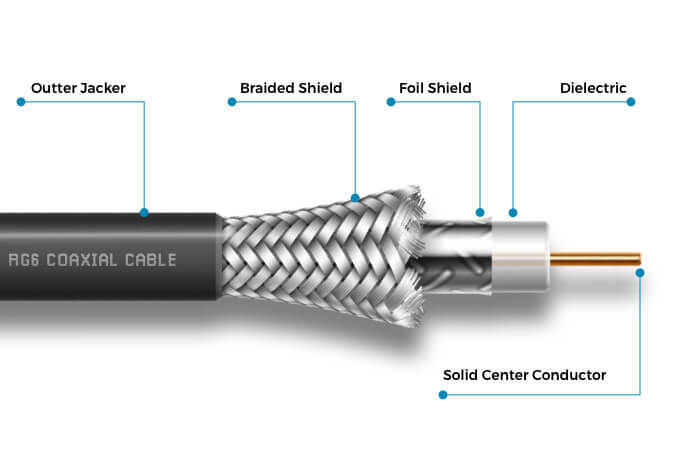
I knew they weren’t up to the hype, but fuck me, the shielding was single-wrap, made of Chinese whispers and toilet paper. The copper core could be bent with harsh words. The dialectric (white part) was some form of marshmallow. In my 3 years in the industry, Monster was the shittiest cable I ever encountered, a cut below the cheapest Walmart cable.
Made him a new one, cut to size, out of our standard quad-shielded, real coax. Quite a lesson for both of us.
Nice one! I’ll have to borrow that idea, and next time I scrap some coax I’ll coil up some for later. Good tip.
Yeah Monster is so bad they’re a dollar store item where I live. Not even kidding!
Cable hype is in every industry. You can buy hundred-dollar gold plated “Gaming” HDMI cables that are no better than any other HDMI cord
the one that kills me is some genius is selling TOSLINK cables with gold plated connectors.
TOSLINK is a fiber optic standard. The whole point of it is that the cable is non-conductive.
The gold is for good luck dummie /s
John Carver torpedoed the “golden ear” self-deluded class, one time, purrfectly…
He had them appear to review/compare a pair of prototype amplifiers…
They did, eventually coming to the consensus that 1 was categorically better than the other.
Then John Carver removed the covers, & the ONLY difference between the amps, was the packaging they were in: the circuit-boards were identical.
He had ZERO respect for all the snake-oil bullshit stuff going on.
I’ve dug-into speaker-builder books enough to know that yes, waveguides do make difference in acoustics, & yes, you can hear that difference ( compared with plain-box speakers that are closed, all 'round ).
I have not paid-for any of the speaker-builder software ( & Linux has some FLOSS stuff, in that domain, anyways, now ),
but yes, it is actual-fact, that to make lower-frequencies of sound, you need bigger speaker-drivers.
For high-fidelity concert, I’d want 15" drivers, or pairs-of-12"-ones, on the sound-reinforcement speakers, if it were needing good quality bass. ( for a Liquid-Jungle genre concert, or something )
( I can’t hear low-enough to hear the lowest human-hearable frequencies, but others can: it’d matter for them, right? )
_ /\ _
Nobody said wave guides don’t help, but they don’t produce bass the way the marketing hype lies. They just don’t.
Be careful with that makeshift speaker cabling though. If you’re using small gauge power cables, you could easily melt those cables with a powerful enough audio signal.
You’d be hard-pressed to find an amplifier that could output so much power it would melt a vacuum power cable or lamp cord lol
Light-duty power cables can handle like 1,400-1,800W you’re never going to find anything that can output even close to that… unless you are the audio/hardware guy for outdoor concerts.
Of course, don’t use angel-hair wires
Would you use this as speaker wire?
https://www.amazon.com/Conductor-Electrical-Oxygen-free-Automotive-2AWG-32-8FT/dp/B093LCQQFY/
I wouldn’t.
I’m just saying be careful. Power cables aren’t all equal. Anyone doing this should understand what kind of wire they need, and make sure they’re not using one that’s too thin.
Stuff like this:
https://www.amazon.com/Cordless-Charger-XBCHGX140-Replacement-Charging/dp/B0BFDFXYR4/
Is unsafe, even though it’s for a (rechargeable) vacuum.
deleted by creator
Use ANY shielded-cable which can handle the current, & has the right kind of connectors on the ends.
Period.
That’s the ONLY 3 criteria I care about, now.
That’s why I recommend Cat6A cable for the foil-shielding in it, to block alien-crosstalk, in ethernet setups: you don’t get speed-degradation-due-to-alien-crosstalk.
All the screaming that computer-speakers did, when a GSM phone was near them, that was due to lack-of-shielding.
Find any trustworthy site which lists AWG vs Amperage, & you’ll see what current you can put on that gauge of wire.
Match your current-carrying-capability, & don’t go overboard ( 2AWG for speakers for anything less than a DisasterArea concert, is stupid ).
Signal travels through copper at around 0.7 * speed-of-light ( impedance monkeys it, at higher-frequencies, audio’s functionally DC, for cables )
& the OP wasn’t talking about cordless-rechargeable vacuum-cleaners, but for normal vacuuming-the-whole-floor vacuum-cleaners, which have … 14AWG wire, roughly, in 'em.
_ /\ _
Yes, so, basically what I said. Be careful and understand what you need.
If you’re thinking from the mind of someone who understands current, of course you wouldn’t use 26 awg wire for speakers. When you’re giving advice online though, you have to think from the mind of someone who doesn’t have your same knowledge. OP telling someone “just use a vacuum cleaner power cable” isn’t specific enough, because they don’t have the knowledge OP has to understand what that means.
I completely agree with OP that speaker wire is generally a rip off, and using any suitable wire is fine. I just want OP to also say that you need to know what you’re doing, or you could start a fire.
I’ll give you an anecdote to hopefully illustrate my point. A while ago I was hanging out in a friend’s backyard on a chilly night. She wanted to provide some warmth for the guests, so she brought out two space heaters and a power strip. She plugged them in and turned them on and they ran for about 30 seconds, and the circuit breaker tripped. She went over to it and flipped it back on, and then about 30 seconds later it tripped again.
I’m not saying this to disparage her, but to illustrate that many people don’t understand current, and don’t realize what is and isn’t dangerous when it comes to electricity. It wasn’t unreasonable for her to assume that would work, and it wasn’t unreasonable for her not to understand why it wasn’t. The breaker is there for exactly that reason. When you’re talking about making your own wire, it’s too easy to get it wrong if you don’t know what you’re doing, and that could cause a fire.
Understanding that you need more conductor-cross-section to carry more current’s sooo fundamental to me, that that itself is a problem, obviously…
I’d presumed that telling people to go search for AWG that can carry whatever-current, would be enough…
The 14AWG point, though, should do for apartment-dwellers & normal home-owners.
( seriously, if you’re doing some kind of mega-installation, & you’re putting 20A circuits in, specifically for your amps, then you’d better be able to calculate Ohm’s law, for your speakers, & work-out what currents are required for them )
_ /\ _
If you want to design and build large-scale industrial plant infrastructure like pressure vessels, piping, pumps, turbines, etc., most of the codes and standards you have to meet cost money to even see -and they are NOT cheap (in the tens of thousands of dollars for a full set).
In several jurisdictions, the standards are incorporated into law by reference. Most people think that you should have free access to read the text of the law that you’re beholden to, but what happens when a copyrighted work is incorporated into the law?
archive.org asserted the law should be free to access. However, they lost a copyright lawsuit brought by the American society of mechanical engineers because they were hosting copies of these standards.
So, to read the law you are beholden to in this sector of manufacturing, you must either pay a private organization ($$$) or memorize it (impossible); you cannot make copies for yourself to reference at your leisure
Ahahah totally man. I dealt with a lot of this compliance, regulatory, quasi legal, bullshit too.
At one point to become an inspector of those huge oil storage tanks I had to basically study the specific building codes for those tanks back to front and upside down.
Cost hundreds to get the standards legally, thousands to take the tests, become registered, work with a qualified inspector etc.
That was 1 single standard, there are thousands. Tens of thousands when we’re talking industry generally, probably hundreds.
Then when you add international standards, everything is duplicated now per country. We make trade agreements and such to somewhat ease the shock of moving products and services across that Gulf of understanding.
Standards are trending in a good direction, we’re slowly moving towards more and more harmonized and universal standards but, we will never reach it, because we’re human, well always just be adapting to what comes next
Holy crap. Everyday I’m surprised at what is legal.
The standards for Normal, Utility, Aerobatic and Commuter category aircraft are codified in federal law, FAR part 23.
The standards for Special Light Sport Aircraft are ASTM standards referred to by law.
Same is true for ISO standards, in EU: I think it’d cost about 10 to 30 k-euros to get the standards required to sell a sailboat in the EU.
_ /\ _
People really misunderstand a lot about diving.
1
- SCUBA is an acronym that stands for Self Contained Underwater Breathing Aparatus
- SCUBA specifically refers to the gear with a tank, and not gear that uses an air hose connected to a boat
- Tanks are usually filled with just regular air, nothing special about it
- Oxygen becomes toxic at depth, so if you were to dive with 100% oxygen, you’d die at a fairly shallow depth
2
- Your flesh and blood absorb nitrogen from the air
- The amount it absorbs is based on the pressure of your environment/the air you’re breathing
- When you come back up to one atmosphere (1 bar) of pressure, your body slowly releases the nitrogen it has absorbed at depth
- This is a physical process, not one your body has any control over
- If you stay down for too long or come up too quickly, the nitrogen will become bubbles in your flesh and blood (the bends)
- That’s painful and can kill you
- A hyperbaric chamber (hyper-more than normal, baric-atmospheric pressure) can help by forcing the nitrogen bubbles to dissolve back into your flesh and release slowly
- You can use a special mix of air with more oxygen and less nitrogen than normal to increase safe dive times, but this also decreases maximum depth, because of oxygen toxicity
3
- Another danger is if you ascend without breathing out, your lungs can pop
- Humans don’t have any sense to tell us our lungs are too full
- This is called lung over-expansion and can also kill you
- It is also treated with a stay in a hyperbaric chamber
4
- Another danger is nitrogen at depth can induce an intoxicating effect like alcohol
- This is called nitrogen narcosis and can cause you to act carelessly and get yourself killed
- If you experience this, the correct course of action is to ascend a bit (like 15 feet) and wait until it subsides before you attempt to descend again
- You can use a special mix of air with helium or a special mix of just helium and oxygen to reduce the risk of narcosis on deep dives
5
- Regular diving gear has two second stage regulators, your main and your octo
- The name octo comes from how it makes your gear look like an octopus
- It’s a backup for you and for anyone who might need it
- The hose is yellow to make it easy to see
6
- The vest you wear (not everyone uses one, but most divers do) is called a Buoyancy Control Device, or BCD, or just BC
- It fills with air from your tank when you want to ascend to increase your buoyancy
- In an emergency, you can drop your weights, which should make you positively buoyant and cause you to ascend
And last, but not least:
- Diving is incredibly fun and an experience I’d recommend to everyone who is even remotely interested
You missed a bit. Overcoming your reflexes to “breath” underwater is HELL.
Dated a beautiful diver girl. She lived in the water. Got me in a class with one other person, young guy, to get our first cert.
Don’t know how to put this. Let’s say I’ve been in scarier situations than the vast majority of people reading this comment.
Truck full of skinheads armed with AR-15s rolls up to the punker hangout? Meh. Saving my own life in the face of certain death, twice? I could do it again, I hope.
I’ve been brave. I’ve been a coward. I have never in life been so fucking scared as taking that first breath underwater, took every ounce of courage I had. Only reason I didn’t bail? Didn’t want the young guy to fail. Because he was shitting bricks, couldn’t let him down. We made it!
This definitely varies by person. I never found it bad at all to take that first breath, and even found myself with the opposite problem. Once I was used to SCUBA I had to remind myself not to breathe while swimming without gear.
Also, underwater currents are a lot stronger and faster than you think.
I’m grateful my dumb ass never went to a dive spot that I read about where the currents between 15-60ft deep were intense and there was a chain to follow to guide you down or to hold on to.
No thank you. So scary.
There are dangerous spots to dive, and there are safe spots to dive. Diving can be incredibly safe as long as you know what you’re doing. And it’s incredibly fun. :)
Additional “fun” fact about lung over-expansion. The pressure difference necessary for it to happen is startlingly small if you, for some insane reason, completely fill your lungs. You can do damage rising single digit numbers of feet.
We did a family introduction in a local aquarium and it was amazing. I had a something strange happen to me afterwards. I stopped breathing from time to time. Weird, because rule number one is “keep breathing”.
It started at work where I got the feeling I was suffocating only to realise I was holding my breath unconsciously. I had a constant feeling of being out of breath and only felt good I if I was conscious about breathing. Took me a bit of therapy to get it sorted out. Therapist figured that the dive triggered something in me.
This might not be uncommon around here, but…
Between D&D and video games, I can identify most medieval weapons and armor.
Mythological beasts as well.
Why tf is a Bastard Sword called a Bastard Sword?
Because it’s not strictly one handed or two handed.
Its a combination of two separate families, like an illegitimate child. (Their logic and definitions, not mine)
deleted by creator
Thanks. You made everyone whonread this clech their buttcheecks.
The chemical used to stiffen cloth for archival book covers is also used to help snack bars retain their shape.
You mean, like, water?
Methyl cellulose. Also prescribed to relieve constipation!
I’m guessing starch.
I sat here for a couple of minutes, trying to think of something I was willing to reveal.
Alright then, keep your secrets!
Username checks out.
Almost every song you’ve heard has included at least one sample from the Roland TR808 drum machine.
You really do just need to turn it off and back on again 99% of the time.
Almost all of the internet utilizes akamai, Amazon, or cloudflare for some piece of vital infrastructure.
If properly made, furniture made of solid hardwoods will last multiple lifetimes.
Depending on the era and genre, the most ubiquitous drum machine would be a Linn Drum (late 70s & early 80s pop, e.g. ABBA), Roland TR-808 (80s soft pop, e.g. Phil Collins), or Roland TR-909 (90s House/Dance/Trance, e.g. Scooter).
There are many others, of course, and even if the actual machine wasn’t used, these sounds have been sampled and reused countless times, e.g. using a Fairlight CMI.
Interestingly, the 808 is the only one of the three that does NOT use samples itself but synthesizes all of its percussion sounds, which gives it a rather distinct character. Perhaps that is what led you to believe that it is the most ubiquitous drum machine - it’s easier to recognize than the others, even in a crowded mix.
Totally fair point, I suppose I just listen to more genres that incorporate 808s than the others. I’ve always loved the simplicity of the sine based synthesis of the 808, so much can be done with it.
I look up everything interesting that occurs to me on Wikipedia so I know a lot of shit about random topics.
Not sure the Guardian has enough readers to be so influential in British politics tbh, though it does try
I look up everything interesting that occurs to me on Wikipedia so I know a lot of shit about random topics.
This is a very valuable habit.
It’s amazing how much metalurgy you learn from Dwarf Fortress
Here’s another: the hot-rod/car-racing field is CRAMMED with snake-oil, & the best information is sooo shoddily converted into book-form, that is nearly useless.
David Vizard’s books, & the related books on the domain, are important-to-study, but DEAR G-D is there a RIPE market for anybody who wants to convert all that shit-publishing into quality publishing…
That’s a contributing-factor to why the entire internal-combustion-engine aftermarket is mostly snake-oil bullshit, unfortunately.
I bet the entire internal-combustion-engine industry could have made their engines 10% more efficient, average, had they studied what the inventors/racers had published, & used that information competently…
sigh
the same is true for the general-aviation industry, as a whole.
Notice that the 2 absolute innovators in these 2 domains, were Smokey Yunick & Burt Rutan: anarchists who did more research-engineering than … pretty-much the entire rest of the industry.
IF you want to become competent in sailboat-design, THEN you NEED:
- “The Principles of Yacht Design”, get the most-recent edition of it.
- ALL of Dave Gerr’s books.
- Fossatti’s Aero-Hydrodynamics of Sailing, or whatever that book is called
- probably Nigel Calder’s books, to understand what makes a lifelong sailor value a design-decision
- Tom Cunliffe’s books, to understand the difference between excellent captaining vs “good enough”, & the implications of that, on the design
- a book on windvanes, if you intend to impliment one, on your design ( for cruisers )
- “The Rigger’s Apprentice”, by Brion Toss
- “The Sailmaker’s Apprentice” or something like that, can’t remember, right now…
- the North Sails book on sails/sail-design/sailmaking
- look up the Sharrow propeller, on yt, for power-boats ( annular-box-wing prop, for outboards: no cavitation! )
- Harry Riblett’s book on General Aviation airfoils, available at the Experimental Aviation Association, if you are going to do ANYthing interesting with hydrofoiling ( he nailed the ATR-72 icing problem last-century, & that airfoil’s problem killed an airliner in 2024, with NASA still not admitting the truth about that foil )
- Julia, the programming-language, for doing your math: better than spreadsheets, can use real math symbols, & you aren’t touching any part of the code that you aren’t working-on ( in a spreadsheet, a stray typo can distort the entire sheet, & you can’t find what it is that is skewing everything unless you’re seeing the whole sheet’s equations: it’s the wrong paradigm: error-accumulation, instead of error-eradication. Julia has a learning-track on Exercism, & has a few good books. )
Getting that set of knowledge into one, will save you thousands of wasted dollars, chasing “wild geese”.
For aircraft-design, I’d say begin with Snorri Gudmundsson’s book, NOT Raymer’s.
( Raymer is careless, & you will save yourself much frustration if you avoid his books. Snorri’s is on its 2nd edition, so I’m presuming it to be the go-to book for the industry, nowadays: I can’t afford it, & may not ever, but I wish I’d got Gudmundsson’s book, instead of Raymers, now )
You’ll need Harry Riblett’s book on airfoils, as mentioned above. https://www.kitplanes.com/the-airfoil-adventures-of-harry-riblett/ Notice that the Bearhawk has his foil on it, and its reputation is awesome.
You’ll need this video-playlist, in order to understand just how AWEFUL the interference-drag is, on normal designs https://www.youtube.com/watch?v=MZhyjYE4Le0&list=PLO-XZZWFTH5ELMG3CECqMPZoEFREgwkPn
( I think it was 67HP & 250mph, in level flight, for one of Mike Arnold’s birds. )
Once these things by Mike Arnold & Harry Riblett sink-in, then the normal designs you see in general-aviation … become unconscionable: all that wasted-opportunity, all the needless drag-inefficiency.
Harry Riblett was using Eppler’s simple software, simple simulations, & nowadays you’d HAVE TO use OpenFOAM to do your simulations, XFoil mis-represents stall-onset, apparently, & XFoil is vastly better than what Riblett was using, years ago.
You NEED to understand both Bernoulli’s principle & the Reynolds number, in aircraft-design.
There are sites with video-training for OpenFOAM: CFD/Computational-Fluid-Dynamics’s complicated, & I’d recommend that.
It is entirely possible to design an aircraft, nowadays, on your own, using X-Plane, OpenFOAM, & the choicest study-materials, & YEARS of thinking on it, until your own unconscious-mind groks that-specific-component in the problem, then get digging on the next one…
Further, IF you take into consideration what Riblett & Arnold gave us, THEN you can do better than what most of the new designs in general-aviation are doing.
There is a video, which I now can’t find, on changing Burt Rutan’s Vari-EZ or Long-EZ aircraft to have blended canards, & it noticeably reduced the drag.
That is exactly the sort of thing that Mike Arnold instinctively understood, & if you begin with that kind of instinct, then you … don’t waste the opportunity that the normal aircraft-designers are enforcing.
You need to consider Prandtl wings, too, as that’s beginning to become significant in modern designs.
All the stuff I’ve realized in both these domains is affects patentability, & therefore I’ll not give you that: I want to be able to create a not-for-profit keiretsu which makes both sailboats & aircraft ( a keiretsu is like Panasonic: an organism made of companies, not a single-company ), someday, & patent-protection’s required to break the for-profit monopoly in both industries.
Sorry I’m not just giving you a bunch of answers, instead pointing you at competent-learning-means…
but the world really is better when you learn your-own way, & others learn their-own way, & the results are more … exploring-evolution’s-potential.
Both of these domains will take you under a decade to get from beginning-learning to where you’re really knowing-what-you’re-doing enough to become able to begin competently inventing.
Don’t expect to get to that stage in less than 7y, though.
It took me 8, before everything suddenly fell-into-place, & the different fluid-dynamics-interactions fit together, for different kinds of design, etc…
But I’d rather the world have other-people doing it, … than me knowing, but not doing it, & others thinking that university-courses is the only valid way.
LibreTexts.org iirc is also a place with some good information on it, in the aircraft-design space…
Whatever: IF anybody cares to earn competence in either domain, THEN I hope this boosts you into it, more efficiently.
If not, then just ignore this.
_ /\ _
I feel like there’s some amount of this in every hobby, which sounds like I’m downplaying this take and racing but that’s not that case I promise you.
I can imagine how this would be amplified big time in a pretty expensive hobby/semi-pro/pro? I assume there must exist some amount of pros
But yeah as a collector of a couple to many more likely expensive hobbies, it’s crazy how much shit you see designed to just separate people from their money efficiently
Forgot this stuff, sorry:
Aviation:
- you need ALL of Mike Busch’s books!
- Barnaby Wainfan, at Kitplanes: read ALL of his stuff. I disagree with some points of his ( & consider his faceted lifting-body aircraft to have been needlessly unsmooth: I like Mike Arnold’s ultra-low-drag paradigm! ), but he gives you sooo much understanding, that you simply aren’t competent in this domain if you aren’t understanding the stuff he’s giving.
- S-Glass is nearly as stiff as carbon, but MUCH tougher: consider it for your wings.
- E-Glass is radar-transparent, the other composites generally aren’t: make any radome of it.
- Turbine-engines cost about 10x as much as piston-engines, to buy, but maintenance-intervals can be MUCH greater, which is why commercial operations like them.
- All aircraft NEED redundant angle-of-attack indicators: fly that indicator, & you’re safe: nearly-all the final-approach-crashes due to stall would have been prevented with AoA-indicators on the flightdeck. ( the McDonnell Douglas 737Max fiasco is because McDonnell Douglas, now falsely-labeled as “Boeing”, they did a reverse-takeover from the inside, after the merger, allowed only 1 AoA-sensor on the airframe, & if that reading went wrong, the avionics highjack the aircraft from the pilots. People died. IN AVIATION, REDUNDANCY SAVES LIVES, for critical-avionics! )
Boats:
- there is the Kelvin Wake Angle that you need to understand: it is the angle from the longitudinal-centerline of your boat, out at an angle, along-which your wake’s peak lies. It is 19.5-ish degrees ( 19.47, iirc ). For multihulls, you NEED to make-certain that that angle doesn’t go from the bow of 1 hull to touch or get too-close to any other hull: it NEEDS to have space, xor you’re creating needless drag. Also, for slenderness, you need to be able to create that angle from your bow, & NOT have your bow’s bluntness violate that angle.
- the LWL:BWL ratios ( Length or Beam, WL means WaterLine ) of interest for multihulls are between 8:1 & 12:1. Going longer than that, as Gerr pointed-out, gives you too-much skin-drag. People who’ve studied aircraft-design know that you want the skin-drag to equal the other kinds of drag, because that’s your minimum-drag. Making a hull 18:1 means you’ve got less bluff-drag, but you’ve got waaay-more skin-drag, so you’re losing, in the displacement regime. Hydroplaning boats are different. Wave-piercing speedboats are different. The multihull designers generally target 9:1 because it really is an optimum LWL:BWL.
- Silicone-Silane is the ONLY anti-fouling that people ought be considering, nowadays ( “Silic One” is 1 brand of that kind of stuff ). NOTHING else works as well, or is as slippery for reducing drag.
- After you’ve earned you real-competence, & now you want to instantiate a business, you’re going to need ABYC membership, & if you’re wanting to sell into the EU, you’re going to need the ISO/DIN standards, which will cost you … about $30k, so you can make your designs compliant with their regulations. They intentionally constructed their standards to enforce as much buying-of-other-components-of-their-standards as possible. To me that is anti-economic-flourishing: putting needless barrier-to-entry, but they’re the ruling institution, so they get to make their economy obey their authority.
- The 1st implimentation of a boat, that vessel’s name, becomes the model’s name, so if you want to control your boat-names, then you can’t have your customers deciding on the name of the 1st implimentation of a design, can you?
- NOLO press makes books on intellectual-property, including Patent It Yourself, which includes a section on getting EU patent protection. Give yourself perhaps a year to get through that book: it’s technical stuff, and there is one hell of alot of stuff to know, in patent-applications, in order to not need to hire ( for $10k+ ) a patent-lawyer for your single application. EU patents are covered in a section of that book, but EU patents cost WAAAY more than North American patents, per point-of-application, or search, etc.
- look at the designs of Cape Falcon Kayaks: they’re elegant in ways that nearly-no boat-designers would do.
- look at the designs of Dave Gerr, if his site is still up, & see how solidly good his work is, compared with normal
- BoatDesign.net is the primary place for boat-design discussion, though … I think it was called “sailing anarchy” was a competitor to it, don’t know if they still exist ( don’t know if either still exists, actually )
- you need to study & understand composites, if you’re doing that, & I’d recommend studying some of the stuff from the aircraft-domain, too ( I got Niu’s composite-airframes textbook ), so you get much-better-than-DIY-“information” about what’s proper. 2" radius minimum for composite-carbon, & that may be pushing it, & you CAN’T mix reinforcement-fibers & get the benefits-of-both: you get the disadvantages of both, not the benefits… this one’s important & non-obvious, so I’m breaking it out into a discussion, not just this little list-point…
Say one has reinforcement-fabric with graphite fiber going east-west & kevlar going north-south.
Then the next layer is with the graphite going north-south & the kevlar going east-west.
Now vacuum-infuse it, so resin spreads forces between all the fibers…
What happens when the temperature rises, in hot sun?
The kevlar SHRINKS. Kevlar has a NEGATIVE Coefficient-of-Thermal-Expansion ( CTE ), but graphite’s is close to zero, & epoxy’s is positive…
So, now your layup is stressing, because some fibers are shrinking, & others are not, & the matrix is expanding.
Worse, when you try flexing it, kevlar isn’t stiff, so NO flexing-force is going onto those fibers, ALL of the flexing-force is going onto the graphite.
But did you calculate your layup so the graphite fibers would be able to take all the flexing that your piece needs to bear?
If not, now it’ll break.
In composites, the stiffest fibers resisting flexing, are taking ALL of the stress of that flexing, until they break, then the next-stiffest are taking all the load.
Mixed reinforcement-fibers is IDIOCY, but you can buy many brands of differently colored aramid+carbon reinforcement-fabric, from many vendors.
It is Niu’s composite-airframes textbook that caused me to know that, & the industry is pushing snake-oil bling, instead.
The only 2 cases where mixed-reinforcement-fibers makes sense, are
- entirely-cosmetic pieces, which bear no structural load, &
- pieces where you’re orienting all the stiffest fibers in 1 particular direction for stiffness in that direction, & you want flex in the other direction, so you use e-glass or something in the bendy-required direction.
Oh, & graphite-fiber’s just thinner, stiffer carbon, generally. Processed at a higher temperature.
There: hopefully I’ve given you enough so that you can compete against me better, in the future.
Salut, Namaste, & Kaizen, eh?
_ /\ _
Anyone remotely interested in Japanese music, J-pop, or rhythm games might have seen some music being labelled with something like “BOFU2017” or “BOF:NT” in song names, and a lot of these music have surprisingly high production value. This actually has some rather interesting history
So Beatmania was a DJ simulator rhythm game released by Konami in 1998 that was an inspiration for a lot of music games in the future. The Be-Music Source file format was developed for a community simulator of Beatmania. Later, BMS evolved into essentially its own rhythm game (which anyone can play btw, beatoraja is even available on AUR), and the community forbade players from playing official Konami charts (referred to as “illegal charts”)
In order to increase the amounts of content available for BMS, the community decided to host BMS creation competitions to encourage players to make more BMS… the flagship event is called “BMS of Fighters” (BOF), hosted annually starting from 2004. All music from the events are completely free and libre: as in, free as in both freedom and free beer. And the competition is fierce; a quick search on YouTube will show some top-ranking songs and their production values tend to be very high (… and there are some shitposts too, we don’t talk about Mopemope or that stupid Kirby song)
Obviously because of the libre nature of these competitions, a lot of these songs end up getting picked up by various rhythm games that are not BMS at all. The most popular rhythm games (like DDR, maimai) tend to have a generous collection of the top ranking BOF charts. The low-budget games even more so: when I was in China for two months and saw a lot of local arcade games (basically Chinese clones of maimai, DDR/PIU and Dancerush), guess what songs they have the most! Muse Dash which also started as a Chinese indie game also has a ton of BOF songs; in fact, Blackest Luxury Car, a song which I strongly associate with Muse Dash’s entire identity (they even have a stage modeled after the song), was in fact… a song from BOFU2017
It’s hard to tell but I wouldn’t be surprised if BMS have a wider societal impact on rhythm game music and even the entire Japanese music genre as a whole. A lot of the artists behind top-ranking charts probably got contracts with various rhythm games… or maybe even beyond those. One funny example I know is that one artist became the lead composer of a gacha game that grossed $18M last month; the game in question is almost universally praised for their good soundtracks
As for the BMS themselves… distribution is not centralized whatsoever, especially for less popular songs. Some are on Google Drive, some on OneDrive, some on certain hosting websites, some only in packaged archives that some people are thanklessly maintaining… but anyways it is rather fascinating
Also the 2025 BOF started on October 3rd and is ongoing now. The portal for all BOF events are here: https://bmsoffighters.net/
I was going through my saved comments again, and I want you to know that I very much appreciate you for writing this up. :)
There is a “Wilhelm Scream” for TV police radio chatter. It’s a sound effect that you’ve probably heard hundreds of times without realising it. I first encountered it while playing SimCity 3000 and it has bugged me for 20 years because I couldn’t work out what was said.
Here is the soundbite and an extensive list of TV show episodes and movies where it’s been spotted:
Now, I think I cracked it last year:
Please go listen to it for a few times and write down what is being said before you read my analysis
Spoiler
“Beta, scrub for one-forty-eight-nine St Andrews; prowler heard, not seen.”
She’s saying that the Beta (backup) unit(s) should scrub (cancel) their dispatch order to 1489 St Andrews because the alpha unit no longer needs backup. The complainant has said that a prowler (someone lurking outside) was heard, but not seen. Probably the alpha unit suspects it to be a false alarm on that basis.
This is only my guess, based on listening to it 1 billion times, but it seems to fit the context of the soundbite. Why she refers to backup as “Beta” instead of the NATO phonetic “Bravo” is a bit odd, but maybe that’s just her preference, or maybe current NATO phonetic wasn’t as common in policing in the 70s
For me it wasnt the police station but the traffic helicopter saying something half-unintelligible. My brother and I refer to it frequently as “yadda yadda reporting heavy traffic”
I remember this too. Isn’t it just saying “Helicopter one reporting heavy traffic.”?
There’s one for hospital scenes. Noticed it on the opening of Eyes of a Stranger from Operation Mind Crime.
You know you’ve heard this many times.
I first heard it in SC3K also! I just thought it was “Brandon Scott Michael whrregerrarrrfrrr”, as if the VA was just told to mumble a few filler words and then nonsense thereafter
Apparently it’s legit police radio chatter recorded in Los Angeles in the 1970s!