You must log in or register to comment.
it’s basic physics: animal products consume more energy (calories) than they produce in food because they exert energy on living - moving, eating, converting food to energy, etc.
Eating a plant directly (or with comparable processing to meat) means less wasted energy (as in calories burned compared to calories produced as food) simply because you’re going one step higher (lower?) in the food chain to obtain that energy.
brb, adapting my digestive system to directly extract energy from rocks.
Isn’t air travel and large ships far worse for the environment? I don’t mean to derail a conversation, but I suspect that air travel and ocean liners have a significantly bigger impact and I don’t see as much coverage on that issue.
Fortunately, we have a series of tubes connecting every computer on the planet that can help answer questions like this!
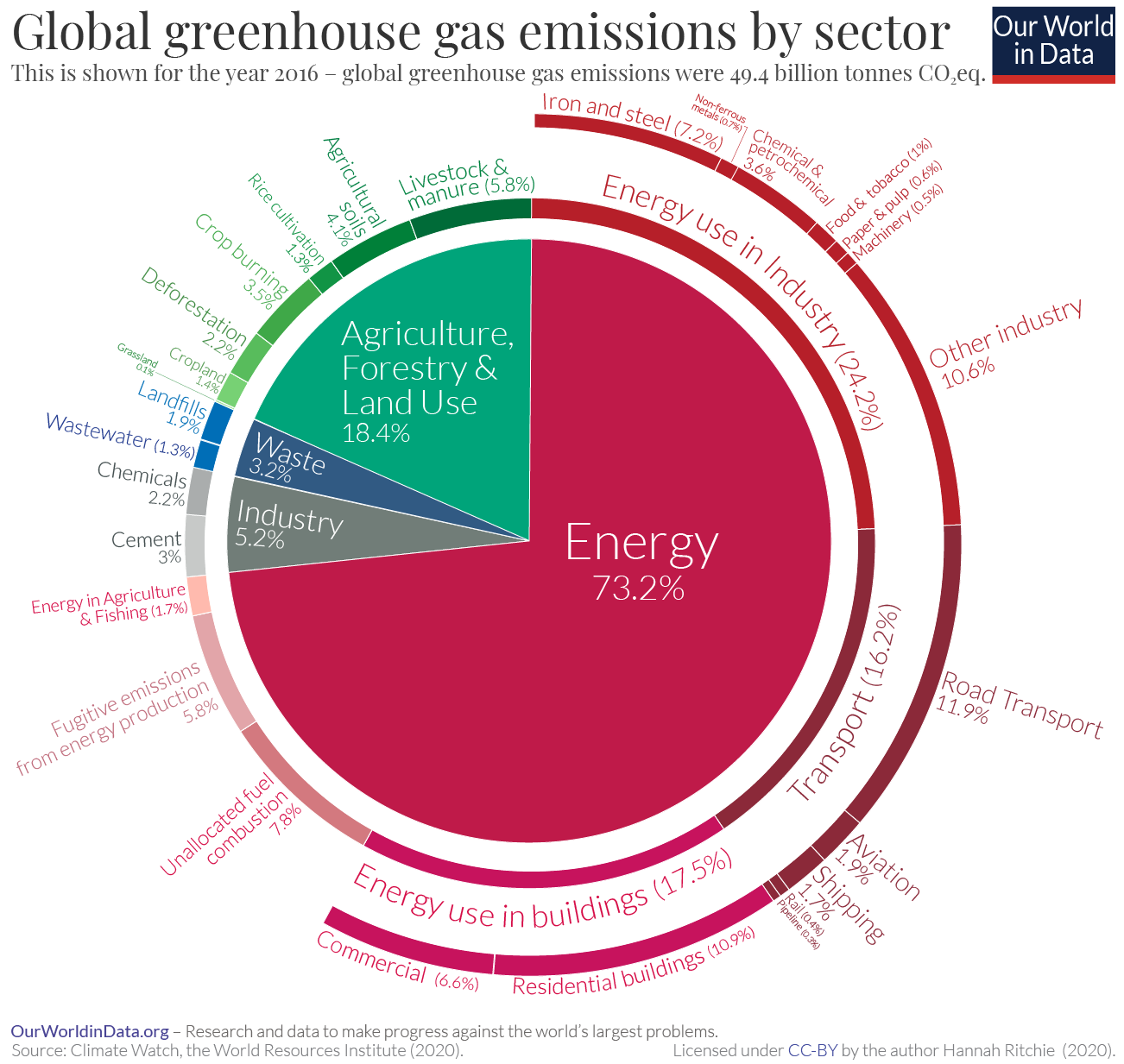
In short Aviation (1.9%) and Shipping (1.7%) are smaller than Livestock & Manure (5.8%) even before factoring in the secondary impacts that are largely driven by the livestock industry, like land use change, soil loss, and deforestation.
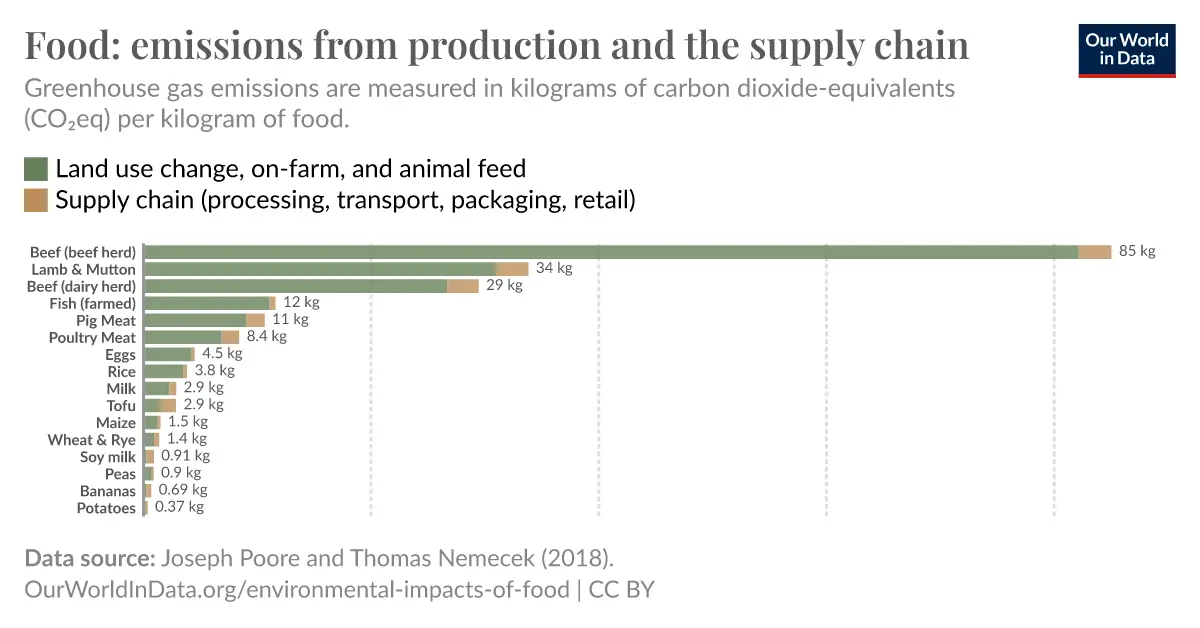
If you’re specifically talking about transportation emissions for food, there’s a graph for that as well!

Supply chain represents ~18% of the overall food footprint, smaller than livestock and land use changes.
Talking meat specifically, the transportation emissions are a tiny piece of their overall footprint, as is shown in the OP.
Damn these charts are nicely made.
Agriculture makes up a full quarter of our total emissions. Some of that is because of shipping it, of course, but there is absolutely no question whatsoever that agriculture is a huge contributing factor to climate change
Data about greenhouse emissions from transportation is talked about more frequently than any other source in my experience. I don’t see the relevance to this data as beef and tofu can be produced locally or shipped overseas, so the emissions to produce the product would be a separate discussion versus emissions in transit.
I don’t see as much coverage on that issue.
No, there’s plenty of coverage. If anything, there isn’t enough coverage on animal agriculture because people can’t fathom a world where they don’t eat meat (or even just significantly reduce their consumption).
I didn’t realize that there was a direct correlation between CO2 expenditure during food production and the final product’s flavour
I don’t like tofu. I like other meat substitutes but idk tofu is not the greatest comparison to meat in my opinion
I always find the comparison between tofu and meat a bit unfair, as it wasn’t invented for that purpose. In many asian cultures it is simply a thing in its own right, only we in the West have popularized it as a meat substitute and I don’t think that does tofu justice.
yea it is just another type of food,you like it or don’t
other meat substitutes
Tofu is not a meat substitute. Tofu is just tofu, unless someone specifically picks it as a substitute for meat and sticks to it, in which case I guess it’s their personal substitute for meat.
deleted by creator
The biggest difference here is not related to the animals themselves, but the scale.
Much of beef’s emissions has to do with land use changes and diet which are both a necessary (but unfortunate) part of managing 1.5 billion cows to serve as a primary protein source for billions of people. In comparison, there’s somewhere on the order of 30 million kangaroos on the planet (2% of the number of cows) and I’d wager the overwhelming majority of them are wild, not farmed for meat.
The difference in footprints here shows the differences in management practices and the downside of commercial ranching. If everyone on The planet switched their 0.5 servings of beef per day for 0.5 servings of kangaroos, nothing would be fundamentally different in the environmental outcomes. We’d still be clearing forests in the Amazon, just now it would be for kangaroos.
Sustainable meat consumption is only achieved through dramatic reductions in consumption. People don’t have to quit meat, but it does have to become a thing reserved only for special occasions. Like it or not, the only path to sustainable food consumption requires everyone eating veggies (including the dreaded tofu) most of the time. Getting beef fed things like seaweed increases the portion of yearly meals that can include red meat sustainably, but does not somehow eliminate the fact that there majority of people’s meals need to avoid red meat (sorry folks).
deleted by creator
You have evidence that farming 10 billion+ kangaroos (it would probably have to be closer to 15 billion, based on the weight differences, ~200 lb/roo vs ~2000 lb/cow) can be done without any compounding burdens, e.g., land use changes, increasing the CO2/kg?
Are there a lot of studies in industrial-scale kangaroo farming? I’m very much interested in evidence on how we could sustainably manage and farm tens of billions of animals to feed a global population at today’s levels of meat consumption.
If you’re comparing the footprint of wild caught kangaroos with industrially farmed beef you’re comparing apples to oranges. One cannot be a substitute for the other because they exist on tremendously different scales. Unless of course you have evidence on how we manage wild kangaroos to feed 7 billion people. If you do, please oh please share. I am definitely interested in the evidence!
In not disagreeing with what was presented, that wild caught kangaroo is lower carbon intensity than industrially farmed beef, I’m only disagreeing with the clear implication of that statement and its context; that we could somehow swap one for the other and not have to change our levels of consumption. So please, show me the data on global-population-feeding scale kangaroo farming, I’ll retract my previous statement and issue a formal apology in the Australian Times.
deleted by creator
You’ve got this all so backwards it’s mind numbing. Everything the other person says was correct.
deleted by creator
And it’s cheaper. I remember in 90s Australia helped Russia not to starve by exporting kangaroo meaty
deleted by creator
It used to be the cheapest legal meat you can get in Russia.
Edit: it was also added in soldiers rations during Afganistan campaign
The carbon that we dig out of the ground and put in the air, that is the ony one relevant to global warming. Everything else is just a change of phases in a cycle.
So avoid beef, lamb, and mutton, got it.
this is based on the poore-nemecek study and should not be regarded as “true”. it’s “true if they methodology reflects reality” but it does not.
Can you expand on that or at least link me to the people smarter than me?
I can just tell you: they did some looking at each production process and the inputs and outputs, then extrapolated it out to global scale.
The problem is that inputs and outputs vary wildly from place to place, that’s why some places are all corn and beans and others are cattle and yet others are something else. Given those differences are because of the economic inputs varying as opposed to the environmental inputs and outputs varying.
You can’t just go around to all the beef producers in the county and figure out how their operation works then multiply it by however much to fit the world scale because the rest of the world might be doing it wildly differently.
Although while I see the criticism of their methodology I think it means things are actually way worse, not better in terms of the environmental impact of beef.
The original paper says that they weighted each measure to the country’s national production and then weighted those by the country’s share of global production. They didn’t just average each result they got for beef with no regard for location.
I think their point is that scaling to the volume of beef production of other countries isn’t correct because the methods of production vary widely enough to produce much different results. As in, some countries likely produce more or less CO2/kg of beef so it makes no sense to simply scale the number they got from a single county to global scales.
Not the guy you’re replying too though, so I’m not certain.
Right, but they didn’t do that. It’s a meta-analysis, so they took the value that each study got for a given crop in a specific country and then weighted all of the values by the share of global production that that country is responsible for. So if we pretend that the only three countries are Estonia, Latvia, and Lithuania, they did the following:
- Found three studies from Estonia, two from Latvia, and two from Lithuania
- Averaged the values of the three Estonian studies
- Did the same for the two Latvian ones and the two Lithuanian ones
- Found that Estonia is responsible for 60% of the world’s beef, Latvia 25%, and Lithuania 15%
- Took their three national averages and weighted them 0.6 for Estonia, 0.25 for Latvia, and 0.15 for Lithuania to get the final value for beef
- Repeat for each other crop
The dataset was 1530 studies across 39,000 farms in 119 countries
Yes I was wildly oversimplifying the methodology using a hypothetical intended to help people who might not have a background in either research or beef production understand.
they take a myopic view of the inputs and outputs for food sources, not considering, for instance, that much of what is fed to animals would otherwise be wasted. the beef doesn’t produce all that CO2, poore & nemecek were calculating all the co2 that goes into the inputs. i mentioned elsewhere cottonseed, but frankly i know that only takes up a minute portion of what they’re calculating. instead, they are also counting soy, and that’s almost as dishonest as you can get. nearly all soy is pressed for oil, and after that, the waste product is what is fed to cattle and other livestock. technically, you could eat it, but most people don’t and don’t want to. feeding it to livestock actually reclaims waste products. and even the calculation for the soy itself is skewed since it often also counts the deforestation that has already taken place as an emission source, regardless of whether that particular plot of land has been deforested for decades.
Yeah that seems like it’s pretty flawed. Even just going down the soybean oil byproduct rabbit hole the Internet says most of it is “acidulated” to prepare it as an ingredient in lubricants and plastic. So beef production isn’t even the main use of the byproduct.
Do we have any better studies? Or is this like the infamous self defense with a handgun study, bad science and all we have at the same time?
Yeah but if you tell the factory farms to lower the beef number they’ll just cram the same number of cattle into a smaller area.
Beef and tofu and not nutritionally equivalent.
Did I have some sort of a stroke or something? Am I hallucinating graphs that don’t exist? Is OPs chart only showing tofu as an alternative and I just imagined the dozen or so other foods on the list that can be mixed and matched to build a nutritious meal with a significantly lower carbon footprint than beef?
Someone please send help, because all of these beef shills have me convinced that there are only two foods and we must all choose just one in the great food war
Way to be a dick about someone pointing out a bad comparison. I bet your mom is proud of you.
If you prepare a meal with tofu (or any combination of foods) instead of beef you need to substitute nutrients by adding a lot more weight, which add CO2e to the equation. Comparing by CO2/kcal would give a more appropriate comparison. Tofu is still far more CO2 efficient taking that into account, I know because I made that comparison myself after not finding any sources for it. But if Tofu was 20kg CO2/kg it would be worse than beef, even though posts like this would suggest it wasnt.
Everyone knows Tofu is more environmentally friendly than beef and we should start using the appropriate data to show it instead of exaggerating and giving deniers the chance to dismiss it.
In this paper, we show that plant-based replacements for each of the major animal categories in the United States (beef, pork, dairy, poultry, and eggs) can produce twofold to 20-fold more nutritionally similar food per unit cropland. Replacing all animal-based items with plant-based replacement diets can add enough food to feed 350 million additional people, more than the expected benefits of eliminating all supply chain food loss.
https://www.pnas.org/doi/10.1073/pnas.1713820115#ref-2
This one isn’t exactly about GHGs but I is crazy to think that we could feed a whole other US population by changing what we eat.
Good call, we should fortify tofu with fluoride to help out!
One’s a food. The other I think is plastic.
FYI: the packaging is not edible.
I am all for meat free (or lab grown) alternatives and they’re getting better but honestly in their current state if I had to eat tofu instead of beef I’d just eat neither. (Maybe I’ve just been unlucky and only tried really bad tofu?)
Tofu is really easy to prepare poorly, it’s important to season it heavily as bland tofu doesn’t really taste like anything. But this makes tofu extremely versatile, it can even be used in smoothies.
Exactly. There are so many who don’t like tofu. Like my mother in-law, who just took a bite of raw tofu and came to the conclusion it’s not for her. Yeah, no shit.
My wife and I then spent some time serving her various recipes, where tofu is one of the main ingredients. And now she likes it.I like, what my wife says about tofu: it’s like a blank canvas. You have to paint it with spices and various cooking methods to make it beautiful.
Another comparison are Mozzarella cheese or noodles. Bland and boring on their own, but great in combination with sauces and spices.
… Now I wan’t to eat the “scrambled tofu”, my wife sometimes cooks. It’s fucking delicious.
Adding here - have people ever had plain, microwaved chicken? If that sounds disgusting to you, but that’s how you expect veggies (/tofu) to be prepared, you may be failing to grasp the concept of cooking vegetables with the same care and attention that one would prepare a piece of meat.
Literally every time I cook for someone who says “I’ve always hated X veggie” they come out of it going “wow, I’ve never had it cooked like that, that was really good, nothing like how (parent) used to make it”.
99x out of 100, all I did was roast it with some seasoning (+salt), exactly like I would treat a piece of meat, and they act like their whole childhood was a lie.
The other comments are right, but if you don’t like tofu there are absolutely other options. Legumes in particular are really good for the same kind of role in many dishes, and in my opinion are generally far more enjoyable. Get some mushroom and/or seaweed flavours in there for the umami and butter beans for the texture and all the nutritional goodness and I’m a happy man
Like meat, tofu us an acquired taste and needs to be prepared properly. There’s no fat in tofu to make it taste like anything
Yeah i find that frying tofu in a fatty oil like olive oil helps a lot with making tofu taste better. Once you get a good “meaty” tofu its way easier to move to other styles of tofu, at least anecdotally speaking.
Sometimes I like to splurge and buy those pre-marinated tofus. I really like the texture of hard tofu. I don’t miss the texture of meat at all.
Less people, less problems. Walk around Bandung Indonesia and I’ll show you 10 people polluting to your 1 American. Good luck.
My beef also isn’t genetically modified to survive glyphosate, which gets absorbed by the soy that gets turned into your tofu.
If industrial farms would sell the manure and spread it on fields rather than blanket them with petrolchemicals (fertilizers) this entire argument would be completely moot.
We need to return to traditional farming where the cattle can graze and naturally fertilize the land instead of being confined and mainly fed corn (which exacerbates the spread of ecoli).
Traditional farming can also reverse desertification of land therefore can reduce the CO2 footprint of this industry.
I’m not saying don’t be vegan, just take a look beyond these studies that are cherry picked to cement your opinions on us monsters that are so apparently destroying this planet.
Also get mad at the military and they are the top contributors of CO2 emissions and they have 0 restrictions and are omitted from every study.
This is a lot to unpack, but I’ll do my best in case it helps someone understand theses issues better:
My beef also isn’t genetically modified to survive glyphosate, which gets absorbed by the soy that gets turned into your tofu
Glyphosate is bad, and should be banned. That said, beef is not somehow immune to glyphosate, as it is a contaminant in much of the food sources cattle eat, and the food for our food is not as strictly regulated as our food. Source Additionally:
-
Much of the glyphosate found in food is found in grains, which are often served as accompaniment to a primary protein (e.g., meat or plant proteins). Swapping a beef burger for a veggie burger (or, your tofu straw man), likely does little to reduce overall glyphosate exposure, which would be coming from the bun. Using plant glyphosate levels as a negative for going vegan is deceptive at best.
-
Glyphosate is not allowed in organic farming, so buying organic foods, including plant based protein alternatives, like organic tofu, dramatically reduces exposure to glyphosates. The system isn’t perfect but has been shown to quickly and effectively reduce glyphosate levels. Source
-
While “there is currently no consensus among the scientific community, and there is controversy over the safety of glyphosate and its health consequences” Source, there are studies showing correlation with negative health outcomes, so someone playing it safe may want to avoid these chemicals out of an abundance of caution. THAT SAID, there is a significant body of evidence that consuming red meat is linked to increase the risk of heart disease, cancer, diabetes, and premature death. Source. Another Source. If you’re avoiding “tofu” for your health, you’re not doing yourself any favors.
If industrial farms would sell the manure and spread it on fields rather than blanket them with petrolchemicals (fertilizers) this entire argument would be completely moot.
No. Manure is only a small part of the issue. Much of the methane produced by cattle comes from digestion, not excrement. Additionally, much of the carbon footprint of cattle is a result of land use change, specifically deforestation and other land use change. None of this is solved by spreading shit around. (And its unclear from your comment but just in case it needs to be said, fertilizers and glyphosate are unrelated, but I think you know that, it was just unclear)
We need to return to traditional farming where the cattle can graze and naturally fertilize the land instead of being confined and mainly fed corn (which exacerbates the spread of ecoli).
The concept of regenerative farming is thrown around a lot as a justification for eating beef. First of all, its not happening, so stop using a pretend what if to justify bad behavior.
Secondly, a cow can graze the food it needs off of ~2 acres of (highly productive) land per head. Source.
To meet today’s meat demand, there’s ~1.5 billion cows on the planet. If you were to give each cow 2 acres, that would take 3 billion acres of land, or 1.5x the land area of the continental US. This would be a logistical nightmare in addition to all of the other challenges that come with this land grab. There’s no scenario where we maintain current meat consumption levels sustainably.
At some point people are going to have to put down the steak and gasp eat some tofu.
Traditional farming can also reverse desertification of land therefore can reduce the CO2 footprint of this industry.
No beef required for this one. Though it is worth noting much of the desertification is directly a result of clearing land for cattle and their feed.
Also get mad at the military and they are the top contributors of CO2 emissions and they have 0 restrictions and are omitted from every study.
Agreed!
-