

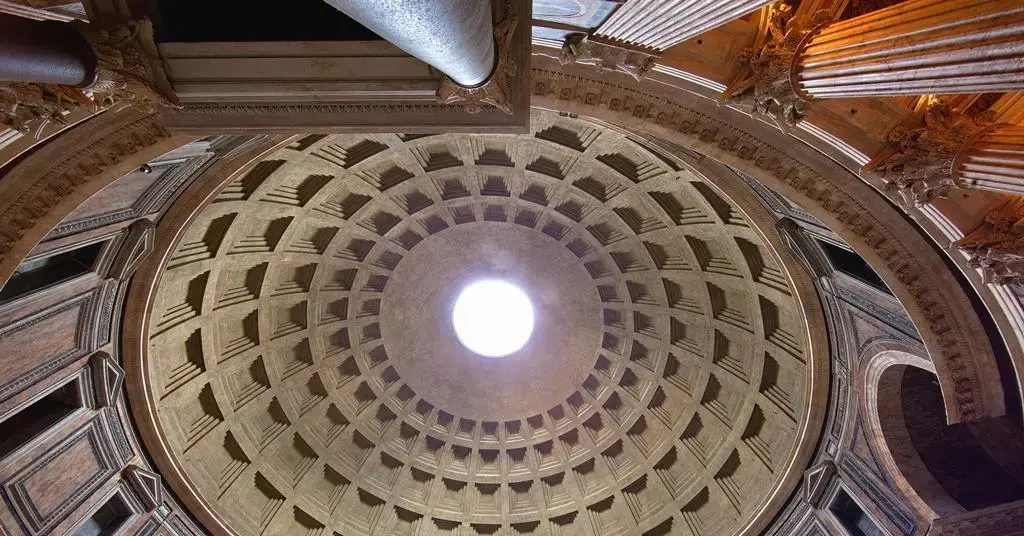
The concrete dome of the Pantheon in Rome remains stable enough for visitors to walk beneath, and some Roman harbours have underwater concrete elements that have not been repaired for two millennia – even though they are in regions often shaken by earthquakes.
Whence this remarkable resilience of Roman concrete architecture? It’s all down to the chemistry.
I think that plenty users here already highlighted the main points (survival bias, lack of reinforcement with steel, optimisation for other characteristics). I’ll focus on the chemistry instead.
Think on a tea strainer, a chicken wire, and some chain link fence. Sure, they might be made of the same steel, and they’re all meshes. But they’re all linked in different ways, with different properties, and they will serve different purposes. Aluminosilicates are also like this; even if you have the exact same composition, it’s perfectly possible that some are more resistant than others, based on their structure.
Studying Roman concrete might reveal something about the aluminosilicate of the surviving buildings that might become useful later on. With that knowledge, even if you believe (as I do) that modern concrete already surpassed Roman concrete in plenty attributes, we can make it even better.
This is one of the most commonly touted engineering myths that simply doesn’t hold up to even a brief analysis. The first glaring problem is the inherent survivorship bias behind claiming Roman concrete was objectively better than modern concrete. As other users have already mentioned, modern concrete is actually very strong and exceeds the strength of Roman concrete when such strength is required, but where it really has an advantage is in its consistency.
If every concrete structure built in Rome was still standing and in good shape to this day, engineers would be salivating over the special blend and would be doing whatever they could to get their hands on it or replicate it. But we don’t see that. We see the Roman concrete structures that have survived the test of time (so far), not the myriad structures that have not. Today’s concrete on the contrary is deliberately consistent in chemistry, meaning even if it typically isn’t designed to last hundreds of years, you can say with a great deal of confidence that it will last at least X years, and all of it will likely exhibit similar wear and strength degradation behaviors over that same duration.
There are other factors at play too:
- Romans didn’t use steel reinforcing re-bar, instead opting for massive lump sums of concrete to build structures. These massive piles are better against wear and porosity-related degradation, especially due to the self-healing properties of the Roman concrete blend due to volcanic ash helping to stop crack propagation.
- Our modern concrete structures are much, much larger in many cases and/or are under significantly higher loads. Take roads for example—no Roman road was ever under the continued duress of having hundreds of 18 wheelers a day rumble over them.
- Our modern concrete structures do things that would have been considered witchcraft to a Roman civil engineer. Consider the width of unsupported spans on modern concrete bridges compared to the tightly packed archways of Roman aqueducts.
None of this is to detract from Roman ingenuity, but to make the claim that Roman concrete was objectively better than what we have today is farcical.