

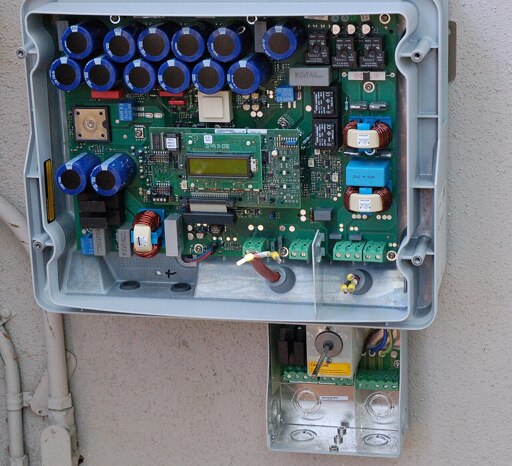
For those that don’t want to click the link herea the important part of what they are: The main advantage is that they electrically isolate the panels from one another, so small amounts of shading, debris or snow lines on any one solar module, or even a complete module failure, do not disproportionately reduce the output of the entire array. Each microinverter harvests optimum power by performing maximum power point tracking (MPPT) for its connected module.[14] Simplicity in system design, installation, lower wire amperage, simplified stock management, and added fire safety are other possible benefits.
The primary disadvantages of a microinverter include a higher initial equipment cost per peak watt than the equivalent power of a central inverter since each inverter needs to be installed adjacent to a panel (usually on a roof). This also makes them harder to maintain and more costly to remove and replace. Some manufacturers have addressed these issues with panels with built-in microinverters.[15] A microinverter often has a longer lifespan than a central inverter, which will need replacement during the lifespan of the solar panels. Therefore, the financial disadvantage at first may become an advantage in the long term.
There are also MOSFET based bypass panels that can achieve a similar effect at a far cheaper price point. Quite common here in Aus.
The high voltage DC strings are dangerous, but very price + power efficient and our install and wiring rules have made it quite safe.
They’re ridiculously expensive and not very efficient compared to DC systems.
There are also optimizers. They’re essentially a DC buck/boost that keeps output at desired voltage and pumps whatever amps it can into the circuit.
