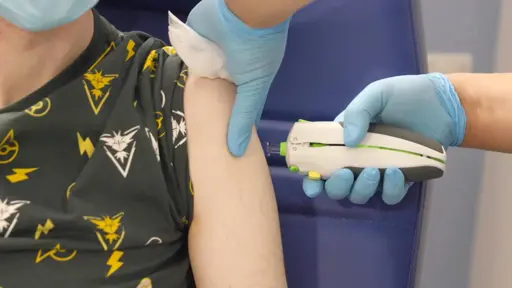
The whole idea of putting something in your body that AI came up with is unnerving, but this microfluid jet stream method of injection is kind of blowing my mind.
I assure you that they did not use LLM transformers to develop the vaccine. Pharmaceuticals have been using neural networks for years now to accelerate the process of drug discovery and it does amazing things, but it’s not because they’re taking text from medical journals and guessing what the most likely next token should be.
I’ve done a bit of work on this front a few years ago. We had a number of simulators that can tell you the likelihood that something binds to a specific protein, and you’re basically just searching through all possible compounds to find things that bind to a target while minimizing their interactions with other proteins that would be known to cause problems in the human body. When we find promising candidates, we send them off to a lab to synthesize and test in vitro.
This kind of search problem isn’t exactly easy to automate mainly because naive solutions are very expensive. It’s never been a problem of outputting nonsense. The automations use the same evaluation metrics as human researchers.
the low likelihood of LLM being involved in any active pharmaceutical R&D efforts is enough for me to wager
So we lump a lot of stuff under the term AI, but prior to ChatGPT, we would have been talking about “machine learning” coming up with this solution.
I really hate the way the AI companies have gone about their business, but machine learning certainly has its proven uses.
I think things like this - that humans probably could have invented on our own, just more slowly without the machine - are just about the perfect application of the technology. It’s being used as a tool that helps humans, not a machine that replaces us.
Typical Team Instinct behavior juicing up to try and stay competitive.
Hard pass for me.