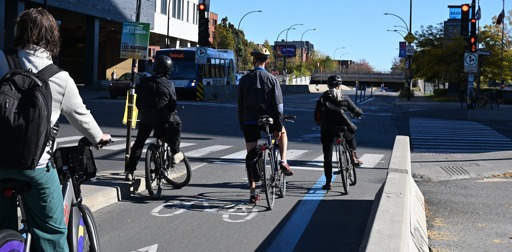
The title is a bit clickbait-y. I went into this one feeling strongly opposed it. Afterwards I’m still not sure, but I get that there’s some nuance to it.
Relevance:
In Québec and other parts of Canada, discussions are underway to adopt such regulations.
Author: Steve Lorteau | Long-Term Appointment Law Professor, L’Université d’Ottawa/University of Ottawa
Excerpts:
Interactions between different users on roads are often a source of frustration, the most prominent being those between motorists and cyclists.
For example, many motorists are frustrated when they see bicycles cross an intersection without coming to a complete stop, which drivers are required to do.
As a professor of law at the University of Ottawa who specializes in urban law issues, I have studied various regulatory approaches that have been adopted around the world, each with different advantages and disadvantages.
The uniform application of traffic rules may seem fair, but in reality, it can create a false sense of equality.
On the one hand, the risks associated with different modes of transport are incommensurate. A car that runs a red light can cause serious or even fatal injuries. A cyclist, on the other hand, is unlikely to cause the same degree of damage.
Furthermore, the efficiency of cycling depends on maintaining speed. Having to stop completely over and over discourages people from cycling, despite its many benefits for health, the environment and traffic flow.
Treating two such different modes of transport the same way, therefore, amounts to implicitly favouring cars, something akin to imposing the same speed limit on pedestrians and trucks.
Since 1982, cyclists in Idaho have been able to treat a stop sign as a yield sign and a red light as a stop sign. Several American states (such as Arkansas, Colorado, and Oregon) and countries, such as France and Belgium, have adopted similar regulations.
In Québec and other parts of Canada, discussions are underway to adopt such regulations.
It’s important to note that the goal of the Idaho stop rule is not to legalize chaos on the roads. Cyclists must still yield to cars ahead of them at stop signs, as well as to pedestrians at all times, and may only enter the intersection when it is clear.
Drivers will criticize cyclists while drivers themselves rarely stop for a right turn on red and rarely make a full stop at a stop sign
Permission to exercise discretion does not mean cyclists will blindly roll through danger. No one is more aware of the risk of cycling in traffic than cyclists. Riding defensively is a necessary state of mind. A rule change will have no effect on that.
The rule change has nothing to do with making cyclists safer. It makes the cyclists’ current behaviour legal and predictable to everyone.
This whole discussion is a distraction. The real solution is to have proper cycling infrastructure. You don’t need to reinterpret road signs if bikes have their own signs in their own protected lanes and protected crossings.
Bike infrastructure isn’t going to be possible everywhere. Idaho stop makes cycling better everywhere.
I don’t care about “everywhere”. I care about cities where most of the cycling happens.
As someone that has been living in Montreal for the past four years, which locale this article brings up numerous times, and biking about 350/365 days a year, I have to highlight a couple things to readers not from Montreal, or maybe even from the other side of the pond:
- Canada doesn’t know what yield signs are. Stop signs are on every corner, which are mostly handled as if they were yield signs, but maybe not even that. And this applies to all traffic, not just cyclists.
- Canada also doesn’t know what “right has the right of way” is. In some European countries if you come to an intersection without a light, a yield or stop sign, you simply give way to the vehicle approaching from the right.
- The individual boroughs have a lot of disconnect between each other on how traffic is handled. While they are trying to have a unified approach, there’s a lot of Balkanization.
- Much of the infra is dated. A remainder of design from the 60s and 70s that had patchwork applied to make it more livable. Things like green wave, automated traffic control or elevated pedestrian crossings and bicycle lanes at intersections are unheard of. Most lights are just set to a fixed cycle and have been operating like the same way for years.
- Intersections, especially with new developments, will have very sharp corners with narrow sidewalk, with greatly reduced visibility.
So that said, I rarely ever see the NYC courier style red-light skips between columns of cars by cyclists. Whenever I see that happen, it’s trashy people that seem to have little regard for anything, even their own lives.
I do see cyclists regularly doing Idaho stops at full stop intersections, but it’s the same as cars. I think this is a traffic design issue and not an issue with driving culture or cyclists in general. Stop signs are simply a bad design, and this has been elaborated on many times.I also see a lot of people ride on the e-bike bixi fleet recklessly. They provide far too much speed assist with minimal effort. The same goes with the electric motor bikes with a throttle that somehow pass as e-bike just because they also have the option for pedal assist. However this is not a problem with the vehicles themselves, but rather the lack of education and handling. In most western European nations children are taught how to bike in traffic and adhere to traffic rules at an early age. I can attest to this as I have grown up in Germany, and in grade 4 elementary we had to get our Fahrrad Führerschein, which was basically an attestation of having a course completed, for children.
Canada also doesn’t know what “right has the right of way” is. In some European countries if you come to an intersection without a light, a yield or stop sign, you simply give way to the vehicle approaching from the right.
Coming to Canada from Europe some decades ago, this was a shock. The “whoever stops first has the right of way” is so much worse, it’s not even funny. It requires much more attention, visibiltiy, consensus, to negotiate a simple intersection… It’s crazy. In practice, half the time people end up sitting and waiting for the other to go. The othe half, the more impatient people just go first.
deleted by creator
Simply not true though. Someone who doesn’t want PTSD from turning a human being into a big red crayon is going to make panic maneuvers, which could very well cause a different fatal crash. There are lots of “good” arguments as to why we should be able to ignore traffic signs under certain circumstances, but they all require that humans consistently get it right. Take the extra seconds to stop and make the roads safer for everyone, or if that is so much of an imposition, please just take the bus.
deleted by creator
For the record, for many years I used to live a few kilometers from work and commuted by bike. I gave it up after passing the second fatal collision on my route. I still try to be objective about traffic law. Given that you attach some importance to specifially cycling experience when adjudicating the obvious for anyone with any road experience, I don’t think you are capable of having a reasoned discussion over traffic rules where bicycles are concerned, but I hope that I am wrong.
The author tries to defend this exception to the normal stop rules as being unique from all the other road rules that sacrifice expedience for safety by saying there are only consequences for the cyclist when they get things wrong. That assertion is objectively wrong. It doesn’t take much experience to know that vehicles making emergency maneuvers to avoid someone who screwed up can kill people, and that is true whether it is a car, bike, or person who thought it was safe to proceed but were wrong.
And you’ll notice that I have not made a value judgment regarding the change itself. That’s because it’s immaterial. I’m merely pointing out that there actually are consequences to consider that extend beyond the cyclist. The person cited in the article handwaves these consequences, saying it only impacts the cyclist who gets it wrong because a bicycle isn’t big enough to hurt people. Anyone who has seen a stroller roll out into traffic can attest to the chaos that will actually happen next. Sorry, but I just can’t stand to see an alleged expert missing something that big in his argument and everyone just nodding along. If you want such a change to happen, it needs to stem from an intellectually honest discussion.
Read the article.
Read the comment. Helps if you understand the rule itself isn’t relevant to the consequences for getting it wrong.
So you’re just posting an irrelevant tangent on car accidents?
No, if you read the article you would know that the person making the case for the rule change thinks it would be justified because there are only consequences for the person on the bike. But he is demonstrably wrong, which is my point. That is what was being discussed in the original post I replied to. Not how the rule works. Just that there are indeed consequences to getting it wrong. If you don’t understand it, try reading the article and the comments again.
Furthermore, the efficiency of cycling depends on maintaining speed.
That’s some pretty specious logic. I would use less fuel if I didn’t foolishly waste it stopping at red lights too.
It terms of the energy that the human puts in, which is a pretty big factor in how people choose their modes of transportation
I think it is a little different given the physical demand of starting and stopping is on the person rather than on machinery. Adding say a dozen stops to what would have otherwise been relatively smooth speed on a bicycle will significantly increase the energy expended by the person cycling.
This right here. I stress fractured my ankle making hard stops over and over and over.
The point is that it’s the same for literally every mode of transportation. Including walking. In fact it is more energy expensive for cars, since the accelerate faster, accelerate to a faster speed, and weigh a lot more.
Saying that the energy is spent by the person instead of the machine might not be the best argument, since on rich countries people actually want to spend more energy from themselves, and less energy from their car.
There are many other reason why bikes should be treated differently. But energy efficiency is BS.
For example another commenter said how it physically hurts stopping so much on a bike. Which is actually a good argument. I don’t mind wearing out my car as I do wearing out my joints.
Yes it physically hurts them because it is them expending the energy and stressing their biological joints. Not a machine expending the energy and wearing out mechanical joints.
If someone wants to spend more energy on themselves instead of their car they can go for a joyride or something. I would bet that most people don’t want to spend extra energy on their commute just because.
It absolutely is not BS. All you’ve done is highlighted the fact that you evidently don’t cycle anywhere. If you did, you would immediately understand what they meant about coming to a full stop, vs a slow crawl.
Because heres the thing that’s different about a bicycle vs walk ing vs a car: bicycles stop balancing and tip over when they stop moving. There’s also an enormous amount of starting torque required for any wheeled vehicle starting from a full stop compared to a slow crawl, which is not the case for walking, and obviously cars (and ebikes) have a motor to get them through that torque so it is literally nothing to the driver.
You’re gonna get a bike-splanation on that.
Nah, I didn’t get to be a 67 year old cyclist by doing dumb things in downtown rush hour traffic. In any case, starting from all those intersections when the light turned green was great training for the velodrome. I was a mediocre track cyclist, but my standing start was pretty good, due to getting out of the saddle and getting up to speed as fast as possible every single commute.
Congrats, your personal preferences for fitness are not valid arguments for policy changes.
As a Vancouverite, this is the state of things anyway. All stop signs are yield signs. All yield signs- actually there are no yield signs.
This was a dumb title OP.
Literally everyone in this thread didn’t read the article, didn’t comprehend what the Idaho stop rules are, and is just in here nonsensically bitching about cyclists getting run over thinking this rule will allow them to blow through all intersections willy nilly.
I think the lawmakers here are maybe not considering all of the consequences.
Yes a bike won’t be able to cause as much damage to another biker or a vehicle if they don’t stop at a stop sign and then hit one.
Especially when compared to a vehicle hitting another vehicle.
But those aren’t the only two things at a stop sign or intersection. There are also pedestrians crossing the street, often with aight telling them that it is safe to do so. People with disabilities like blindness, people with children, etc.
What happens if there is a line of vehicles to the left of the bike lane blocking the view of the cyclist and they keep going straight since it’s a three way intersection, no road on the right so no vehicles to even worry about, and then a mother with a baby in a carriage steps out from in front of the vehicle at the front?
Sure a bike won’t do as much damage as a vehicle, but it can still certainly do a lot of damage in the right circumstances.
deleted by creator
Did you read the article?
It does not allow cyclists to blow through stop signs. It requires them to treat them as yield signs, which means slowing down and yielding the right of way is someone else is going the other way.
Well… if you don’t want the bicycles to slow or stop on traffic lights, another ridiculous idea is to time the traffic light changes to the average speed of cyclists instead of cars.
If the old days they time the traffic light to cars so cars doesn’t have to stop at every traffic lights. Maybe now its the cyclists’ turn.
This way, you can keep the traffic rules equal and drivers who do not want to stop at intersection can drive as fast as the cyclist.
If you think cyclists will be too slow to reach the next traffic light, you can arrange the interval to use double the speed of cyclists, so the lights turn right in the middle between the two lights.
Then the Question will be, what is the average speed of cyclists on the streets?In Québec, cyclists always say that driving laws do not apply to them, they never stop at STOP sign or a red lights, are on the road or the sidewalk instead of the cycle lanes, etc.
They are very dangerous as they respect nothing especially in suburbia. In Montreal sometimes they stop!!! because it’s stop or die, mainly.
As a cyclist, I agree. Not all cyclists are like this, but a great majority are. These cyclists are a threat to everyone. Pedestrians, other cyclists, and themselves.
As a pedestrian, I’ve been hit several times on De Maisonneuve Ouest’s bike path while crossing at an intersection because a cyclist ran a red light into crossing pedesrians. As a cyclist, I’ve also had near miss collisions and have been pushed aside by assholes in leotards that want to go fast during rush hour when the path is full on Rachel. Absolute lack of consideration for others. The mentality needs to change.
Bike how you want, but if you fail to follow the established rules for vehicles on the road and get injured, it’s totally on you.
Who is it on if you completely follow the established rules of the road and get injured?
Give me cycling infrastructure of comparable quality to car infrastructure and we got a deal.
Read the article before posting.
Replace most of these:

With those:

That is literally what the Idaho stop rule change is.
I know but I think this should happen for all vehicles. If we want lower speeds on back roads, we should speed limit or even better, narrow them instead of sprinkling stop signs that some people treat as yields.
So here’s another angle. I’ll run reds on my bike when traffic is light, but I do it for the sake of the drivers. Surprisingly in Kelowna we have decent bike infrastructure, so in a lot of places I could just hit the button to change the lights immediately and give myself the right of way. Then I feel like an ass when three cars queue up at the red when I’m long gone. I’d rather just treat the red as a stop sign If it’s safe to do so.
I think it’s the nuanced case by case decision making that lower speeds and overall defensive nature of cycling offer isn’t understood by people who don’t bike regularly. Not sure what the solution is there.
The solution is what’s in the article, the Idaho stop rules.