
Today, from Amtrak’s website:
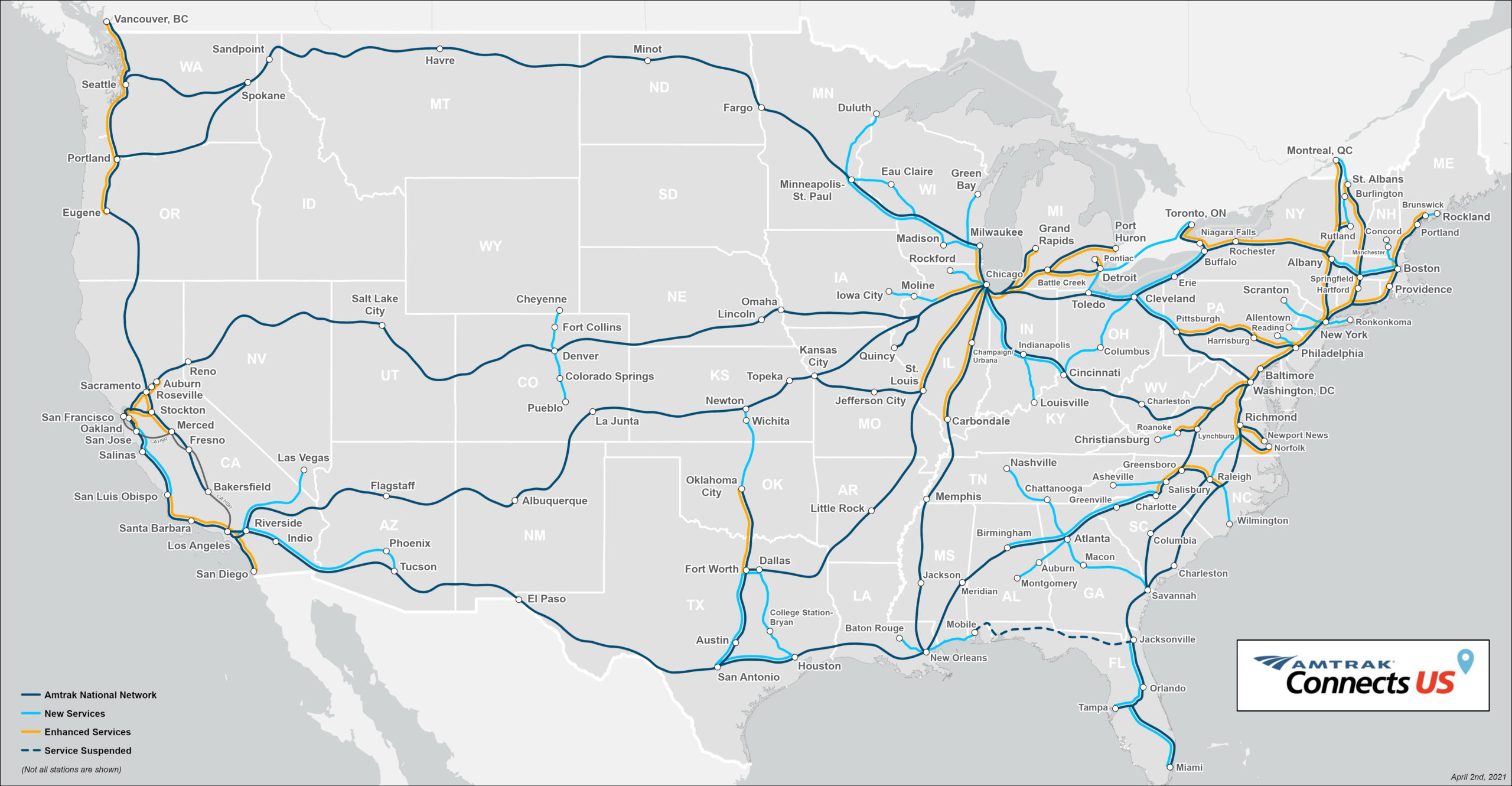
The blue diagonal names makes this really hard to compare.
And it doesn’t really show how fast/reliable service is. With freight having priority on all the rails, passenger gets fucked over, becoming slow, unpredictable, and spotty.
This is disingenuous, rail is slower and less accessible than it used to be but ridership is actually higher than ever. That map is from a future plans report highlighting certain routes that are being expanded and added. https://media.amtrak.com/2024/12/amtrak-sets-all-time-ridership-record-in-fiscal-year-2024/ https://media.amtrak.com/amtrak-connects-us/
but ridership is actually higher than ever.
If you mean by hard numbers, that would also be disingenuous because the population is far higher now than it was in 1979- 225.1 million vs. 345.4 million.
But if you mean as a percentage of population, that’s different.
Of course population is far higher, but population density and rail infrastructure efficiency are inextricably linked. I’m not saying Amtrak is anywhere close to as good as it should be, passenger rail, especially commuter rail and high speed rail is a national embarrassment in this country.
All the proof you need that north america is not “too big” to build a railway. There are already several railways from coast to coast.
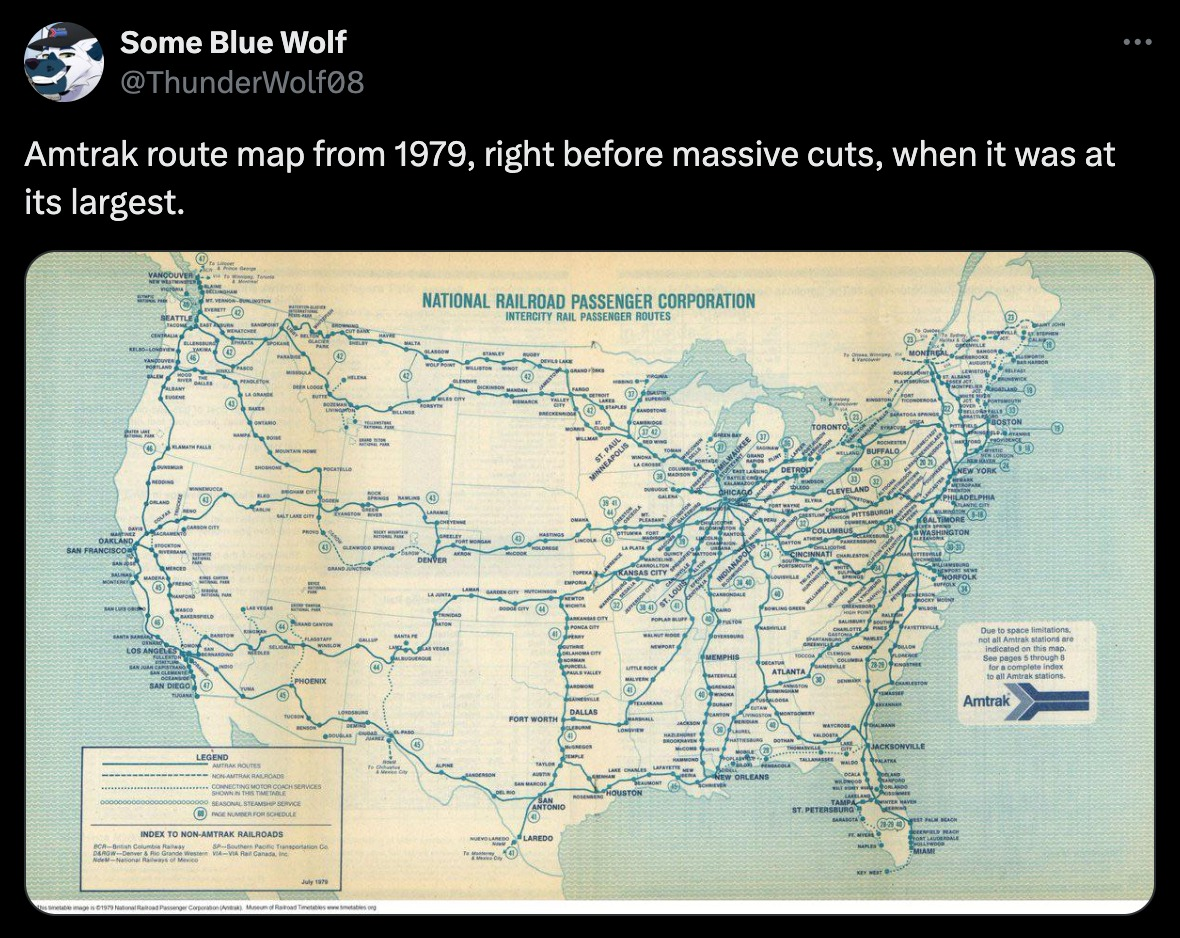
I spent a few minutes playing ‘spot the difference’ here’s what I’ve got:
- Line from Portland to Salt Lake City is gone.
- Line that goes through Southern Montana and Southern North Dakota is gone.
- Line connected Nashville to Louisville is gone.
That’s about it? That doesn’t seem like that much. First picture is full of place names and has dotted lines for “connected motorcoach services” that make it seem a lot fuller.
The light blue lines are Biden and the IRA. They’re not built/running yet.
what… I know that you don’t have much in the way of public transit but… you remove what little you have now?
Oh this is nothing. Read up on the streetcars. The country basically removed most of its mass transit light rail because the car companies weren’t selling enough cars.
They didn’t even do it in smart ways. This town just paved over the tracks. Now, 80 years later or whatever it is, the streets are caving in and they have to do all these expensive repairs.
Not only that, but most cities will claim they aren’t big enough to support a tram, despite nearly every city having trams 100 years ago
Did they purposely avoid South Dakota?
Is there anything to not avoid in South Dakota? I’m sure there’s still a conestoga wagon or stage coach or something to Sioux Falls if you must go there.
Reasonable, sustainable infrastructure stands no chance against the petrol-dollar.
You make a good point, but I wouldn’t use The Atlantic Council as a source considering who their chairman is: https://en.wikipedia.org/wiki/John_F._W._Rogers
If they would just reconnect Louisville-Nashville it would be so much more convenient. If you want to travel between Chicago and almost anywhere in the Southeast, you have to go by way of either DC or New Orleans, which can make the trip like 20+ hours. I challenge anyone to find an area that could better increase connectivity with an equivalent length of track. Hopefully the fact that they’re adding the cities to the network at all suggests that they have plans to connect them to each other in the future, because like, it ought to nearly double the passengers in both cities if you can go north or south, on top of the through traffic.
Still didn’t go anywhere near me.
Reag- Oh wait that was Carter.
Carter liked the trains. Reagan was the one behind the defunding. That’s why 1979 was the peak and not 1980.
I’m sure Carter liked trains, but he was still a neoliberal who staffed his admin with people who believed Amtrak should be profitable and cut 10,000 miles from Amtrak’s network.