In a parallel universe, someone is memeing about how teachers waste our time on useless stuff and never taught us to convert between units.
This is actually pretty important to being able to solve engineering problems in the real world. Invariably, every little sub industry has its own cursed unit system. And dimensional analysis is great for solving real problems on its own.
And if you get to a high enough physics level, they start setting hbar = c = 1 or G = c = 1, and you never have to worry about it again.
I’m the mean time, it’s worthwhile to learn the trick to do this stuff fast-ish.
I dislike that my highschool never once gave me the concept that units can simply be treated like constants to be cancelled out.
I used to do the conversions for each variable before putting them in the equation like a fool.
Now I’m slapping all of the conversions alongside the original values/units in a single expression like god intended.
deleted by creator
I’ll be pissed if the comments are about metric units
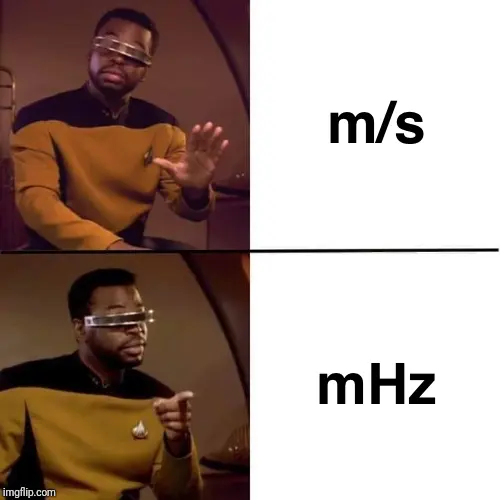
That’s interesting. Obviously, you’d put a center dot to disambiguate millihertz from meter-hertz, but I can’t recall ever having learned a rule about that. So some combinations of units are inherently ambiguous?
Also: Hz/dpt.
I can’t tell which unit is more cursed: millihertz or meter hertz. Surely, anything that could be measured in millihertz is more natural to measure as a period, or as revolutions per minute or something, right?
EDIT: Also, TIL about dpt. Thanks!
A dioptre (British spelling) or diopter (American spelling), symbol dpt, is a unit of measurement with dimension of reciprocal length, equivalent to one reciprocal metre, 1 dpt = 1 m^−1.
TIL about dpt
Tell me you don’t [Edit: need] glasses without telling me you don’t need glasses :D
I actually do have glasses, I just never bothered learning about any of the technical details behind my lenses. Optometrist measured my eyes, I chose the cheapest frame the store offered, came back a week later to pick up the glasses and that’s about it.
Speed as meter per hertz is a rather odd case, like with a machine that goes in discrete steps.
In any case, I never use implied multiplication (and others) and always simply put everything where it should be.
Thanks, I hate it
✋ 1 bit
🖖 125 millibytes
Saw a video using mHz recently and it took way too long to realise the readout was correct and not a typo of MHz …
Metre hertz? Lol
Wait what, jow many kilominutes per hour is one mile per stone?
African or European swallow?
deleted by creator
Just multiply by (1000m/1km)(1h/3600s) and cancel out the units, kids
Don’t ky/s over unit conversions OP. It’s not that hard.
It isn’t even that much of a time waste you just multiply 1000/3600
But it would take me a couple of hours to figure that out.
Have you tried converting those hours to seconds?
deleted by creator
I hate it when they do it !
The true evil are the fuckers who post recipes in grams instead of cups and ml.
I don’t have time to get out a million little differently sized utensils because I need 2 cups of this, ¼ cup of that, ½ a teaspoon of the third thing etc. when I can put the bowl on a kitchen scale and use the tare function.
But I love that 😫