
You must log in or register to comment.
I have no way to know the lived experience of women, but I have observed since about 4 years of age that the buck stops with me. I, and I suspect the vast majority of men, have no backstop - If I have any problem that I can’t fix myself, or can’t pay money to get assistance with, I am fucked.
I hear anecdotally that women are more likely to tell people about suicidal ideation… Does this imply that women have better results using social networks to move past the stressors or illness behind that ideation?
Best case if I was feeling like I couldn’t bear to keep living and told someone, maybe a family member would have me committed for my own good. Then after the imprisonment, I am also unemployed and still have no one with the bandwidth to help me deal with whatever issues I was having.
I have observed since about 4 years of age that the buck stops with me. I, and I suspect the vast majority of men, have no backstop - If I have any problem that I can’t fix myself, or can’t pay money to get assistance with, I am fucked.
I think this is an important observation. Women, almost always, have some avenue of potential support, even if it’s unsavory. Men very often have nothing.
Afaik suicide attempt rates are 2-3x more common in women than men. Men are just more likely to choose methods that are more deadly.
Not to belittle it on either side but I do wonder what causes that disparity. Is it that men plan it more thoroughly or have access to more dangerous methods? Do women choose methods that, unintentional or not, can be backed out of more easily? Are women more likely to report a failed attempt than men? If that 2-3x factor is true, then why don’t we see similar numbers of idk completion? I hesitate to say success because it is very much not a success to commit suicide, there are always other options, even if they’re not perfect.
I’ve heard the claims that women generally opt for less effective methods because they’re more likely to want to leave an opportunity to back out, or try to avoid leaving a messy corpse. I have not data here, these are simply claims I’ve heard.
I’ve heard the latter, as in even in death women are thinking about others.
Anecdotally, I’ve heard that almost universally. Every woman or girl I know who has chosen not to commit suicide, someone having to find their corpse factored highly in their reasons.
Someone being there to find them in the first place might be a factor in all this.
When you commit suicide your corpse doesn’t just disappear after a few days. Somebody has to find it sooner or later, whether that’s the paramedics/police or someone else. And yes, seeing someone’s corpse after they committed suicide is very traumatic, even to emergency responders
In part the reasons are perpetrated by media and culture. If you go back to the medieval period records men and women died at about the same rate and they both used predominantly drowning and hanging as method.
Think about the dramatization of suicide for a hot minute and poison shows up as having this stigma of being a woman’s weapon or the “easy way out” more often than not the dramatic gut punch for men has been stuff like a gun to the head, hanging, jumping off a tall something… Something violent and effective and “brave” for lack of a better term. Certain types of death are coded as “emasculating” and those types of death are generally easier to rescue someone from because of the length of time between making the decision and actual death.
The deaths of women (at least provided they are not villians) in media are more often played up for gore and empathy when they are violently murdered but played down when it comes to suicide. Either the type used is quiet and gives the illusion of the peaceful end of quiet despair, it happens off screen or the camera angle changes to soften the impact. There is no comparative “unwomanly” way to die. This is in part because at some level it hits different. Executioners in women’s prisons have reported that it effected them way more and caused mental traumas. People who make fiction use this to manipulate the way you’re supposed to feel.
At some level with enough iteration you create expectations of what suicides are supposed to look like based on their individual thematic meanings… Which are coded by gender.
have access to more dangerous methods?
Are there any methods that are available to men that aren’t available to women?
Women are more likely to opt for “clean” methods to avoid leaving a mess for grieving family. Paracetamol overdose, poisons, natural gas. For whatever reason (and anecdotally I can blame the way women are socialised to put others first by valuing “feminine” traits of caring and nurturing) women will go for a slower, even more painful method if it means less trauma for those finding the body. Women often have an existing support network that “failed” them, and they don’t want that support network to feel guilty, so making their death seem “peaceful” plays into the suicide plan.
Men are more likely to go for methods that are quick and effective because the ultimate goal is to die. Men don’t have that same support network, there was nobody there to “fail” these men, they often had no one in the first place, so there’s not as much consideration for what the method of death may mean for those left behind. Men are more likely to jump in front of trains or shoot themselves.
The support network plays into this as well, because women often have other people, they may accidentally let on that something has changed in their lives suicide motivation. Even a simple “you’re a great friend, thank you for being there” text could send a red flag and women are more likely to have paramedics called by a suspicious friend or family member.
Because men often don’t have anyone, they don’t raise any red flags, so their attempts have no external intervention.
That’s a lot of good info, but it sounds like the short answer to my question is “no?”
Sorry, I replied to the wrong level in that comment thread and in doing so didn’t answer your question at all because I wasn’t thinking about your question specifically.
Women have all the same options as men, but because of the way women are socialised those options seem unfavourable.
because of the way women are socialised those options seem unfavourable.
Do you think the inverse is also true? That men are socialized in a way that makes certain options seem unfavorable? For example, men are far less likely to pick methods that give other people a chance to intervene.
Now I’ll be thinking about suicide by penis all night.
Personally, I think it comes down to two things. The first has to do with the root causes of the suicidality. If what you have is severe, can-barely-get-out-of-bed depression, you’re more likely to choose a more passive and less likely to succeed method like swallowing the pills you currently have in your medicine cabinet. If one of your root causes is anger, then you’re more likely to choose a more active method like leaving the house and finding a tall building.
And the second is that men are twice as likely to own a firearm.
Men prefer guns and women prefer pills. The study from back in the day . … https://pubmed.ncbi.nlm.nih.gov/11079640/
So the data suggests we should promote women’s suicides more /s
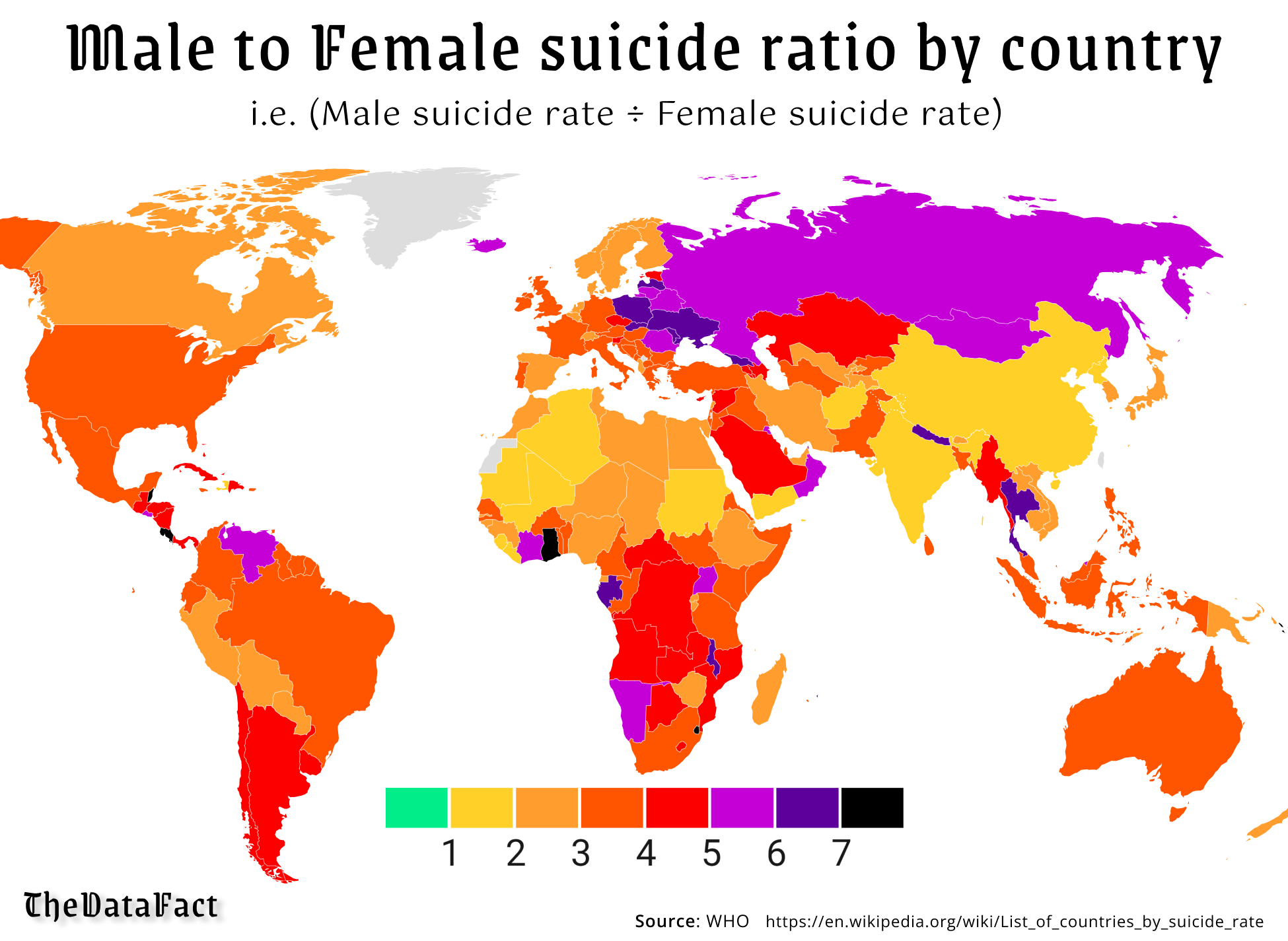
It would be interesting to find a way to also represent the overall rate. Some of these countries really stand out for their high male:female ratio even though their overall rates are not particularly high.
Total numbers aren’t relevant for ratios unless the numbers are low enough that the ratio swings wildly from year to year.
Yeah, data could be skewed for countries with very low populations. That could be why Greenland is left out, despite data being available from the wikipedia page that the data is taken from.
Wasn’t paying attention and misread the map at first. It’s showing male suicides / female suicides. So a green nation would be 1:1 equal suicide by gender. So every nation has a strong bias towards male suicide, some much more so than others.
Is it all attempted suicides or successful suicides only?
A suicide rate means successful, just like a murder rate is successful murders and not attempted murder.
Thank you for clarifying
Successful. Women actually attempt suicide more, but more often choose drug overdoses rather than immediately fatal means.
Women actually attempt suicide more
Is that on a unique persona basis or does a person with a failed attempt skew the numbers with a second?
Considering various social taboos around suicide, I’m not sure how reliable such data is.
Counting corpses is pretty reliable, objective data.
Provided the cause of death gets reported truthfully
This is true. And in communities around the world where suicide is stigmatized, there is heavy pressure on authorities to record deaths as “accidental” rather than suicide. In fact, this is borne out by statistics in which you see higher rates of death attributed to accident in such communities, once you control for other variables. This is especially the case in societies in which there is social shunning of entire families who have lost someone to suicide. The coroner in these communities may worry with good reason about serious mistreatment of families if there is a public record of suicide. It’s also not unreasonable to think that this misreporting may play into the gender divide in suicides. If different sexes tend to use different methods, some of these methods are much more ambiguous and easier to record as an accident than others.
Hello,
Didn’t we all move to !map_enthusiasts@sopuli.xyz ?
I didn’t know about that community, but I also don’t see why I shouldn’t post here? The beauty of the Fediverse is that there can be many places that serve the same purpose.
So why is higher make suicide green?
Pretty sure green would be male/female suicide parity (for every man to commit suicide, there would be a woman as well). I’m pretty sure the scale indicates more men than women commit suicide the further up you go. That being said, it is not a very good graph, and also doesn’t show total numbers, which would be interesting to see.
I’m pretty sure that green goes from 0 to 1, i.e. from 0 male suicides to suicide parity.
That would be correct. There are clearer ways that the data could have been displayed
Yeah the graph is pretty bad. I had to actually think about it and still got it wrong.
deleted by creator
For every female suicide, zero males commit suicide! Hooray! /s
In Greenland there was 1 polar bear attack per female suicide.
In Greenland there was 1 polar bear attack per female suicide.
I choose that this infers someone’s lover killed themselves after they died from a polar bear.
Look at all that “privilege”.
Two things can be true. Privilege does not guarantee happiness or satisfaction in life.
As a cis-het-white male I have basically every mainstream privilege, as a result I’ve lived most of my life completely unaware of the discrimination many others face on a daily basis. When “SJW” first became a term I considered myself anti-SJW. I was depressed and struggling in life and being told I had advantages over other people was not something I wanted to hear. Since then my understanding of what privilege is and means has changed a lot.
Having privilege does not have to be a scary thing and you are not a worse person because you have privilege. It’s simply a fact of life. We intrinsically understand that attractive and/or talented people have advantages in life and get treated better based on traits that are purely biological, those traits do not guarantee those people happy or even productive lives. Take that knowledge and apply it to race/gender/sexuality and you understand privilege.